Ukraine Says Drones Delivered Four Tonnes of Food Across 100 Oleshky Locations
Four tonnes of food sounds substantial until it is set against a community where roughly 6,000 people may remain and no stores are functioning. Ukrainian officials say drones distributed that cargo across 100 locations in Russian-occupied Oleshky, but they have confirmed receipt of only some packages and estimate the relief may last no longer than a month.
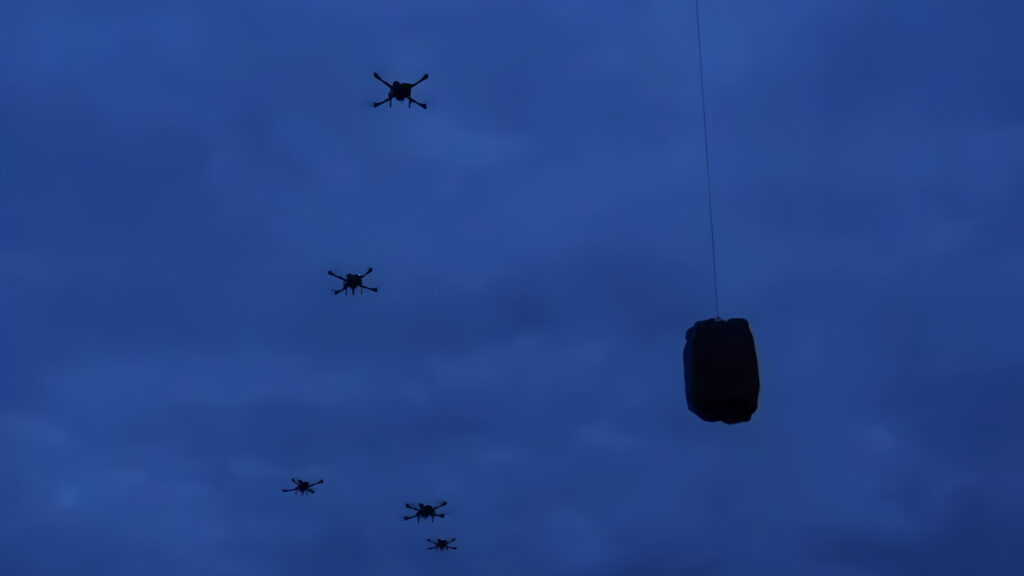
The boxes contained food and cooking oil and were delivered in multiple waves after several weeks of planning, according to regional officials. Oleksandr Tolokonnikov, deputy head of the Kherson Regional Military Administration, said some residents collected the supplies. He also alleged that Russian troops forcibly seized packages in some cases, a claim that has not been independently verified.
The operation demonstrates a useful but tightly bounded role for unmanned aircraft: moving relatively small loads when trucks, relief convoys and ordinary retail supply chains cannot reach a population. Ukrainian officials say conventional humanitarian access to Oleshky is blocked and travel is dangerous. Russia has acknowledged critical shortages of food and medicine in the community but says its forces are working to address them.
Distribution matters as much as total payload
Spreading the cargo among 100 drop points was important because a concentrated delivery would still require residents to travel and gather around one location. Distributed delivery can shorten the distance between a package and its intended recipient while reducing dependence on a single collection point. It also makes the mission more complicated from a logistics perspective: every additional destination divides the available payload and creates another handoff that cannot be guaranteed.
The arithmetic illustrates the limit. Four tonnes divided evenly among 6,000 people would amount to less than 0.7 kilograms per person. That is not a ration estimate the remaining-population figure covers Oleshky and its surrounding area, while the precise number of recipients is unknown but it shows why the delivery is temporary relief rather than a replacement food system.
Tolokonnikov said the supplies could give residents “the opportunity to live there for up to a month.” That estimate depends on how many people actually received packages, what food remained locally and whether households could share supplies. Unreliable mobile connections and residents’ reported fear of reprisals make those variables difficult to check independently.
A cargo drop does not complete the supply chain
In commercial logistics, delivery normally ends with a documented handoff. Here, reaching a designated location did not necessarily mean that a civilian recovered the package or retained it. The alleged seizures, if confirmed, would further separate the reported payload delivered from the amount ultimately consumed by residents.
Oleshky’s geography adds to the humanitarian constraint. The community lies about three kilometres south of the Dnipro River front line. Ukrainian officials say the nearest reported place where residents can obtain supplies is Radensk, roughly 20 kilometres away. About 6,000 people, including approximately 200 children, are estimated to remain in Oleshky and the surrounding area, compared with a pre-invasion city population of about 20,000.
The European Union has cited acute shortages of food and medical assistance in Oleshky and neighboring communities, along with obstacles to evacuation and access to basic necessities. Ukrainian Foreign Affairs Minister Andrii Sybiha has called for humanitarian access and an evacuation corridor.
Ukrainian officials describe the four-tonne operation as a larger follow-on to smaller drone deliveries conducted since April. Scaling from isolated packages to 100 locations shows that unmanned aircraft can form a temporary distribution layer when ground access disappears. It does not create a dependable route, replenish stores or allow civilians to evacuate. Until conventional humanitarian access is established, each drone delivery remains a finite intervention whose real impact depends on an uncertain final handoff.
| More aerospace and engineering stories, right in your MSN feed. Follow AMI on MSN |
By Stephen Wallace — Editor for AMI’s aerospace integration and unmanned mobility coverage, focused on drone manufacturing, VTOL systems, autonomous networks, and air-ground mobility links.