


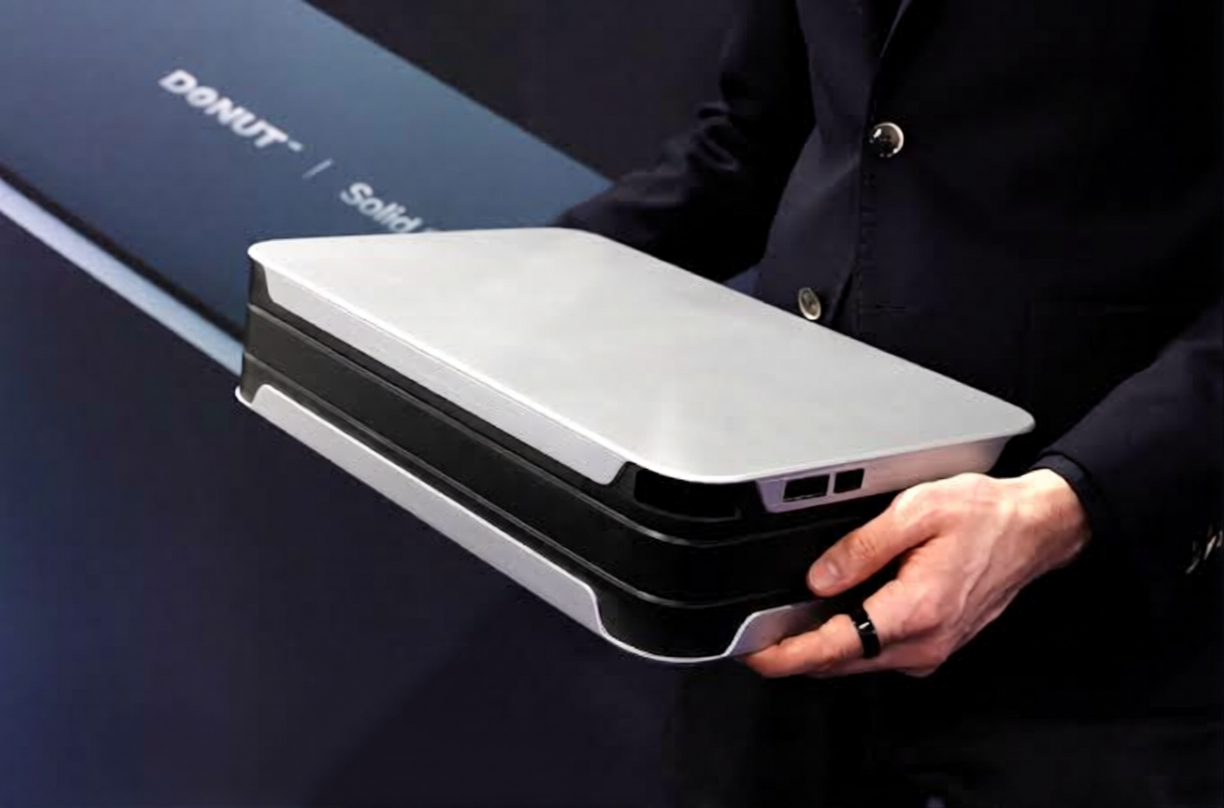
Donut Lab Pushes Solid-State Battery Delivery to Late 2026, Tests Leave Gaps
Donut Lab has not started production of the solid-state electric-vehicle battery it said would be ready for mass production within months. The company’s website now lists an estimated delivery schedule of the fourth quarter of 2026, while published prototype testing still does not establish that one production cell can deliver every advertised benefit.

That distinction matters because Donut’s promise was not merely a high-performing laboratory cell. At CES, the company presented a battery intended to charge fully in five minutes, reach an energy density of 400 watt-hours per kilogram, survive 100,000 charge cycles and operate from minus 30 to 100 degrees Celsius. It also claimed lower cost than conventional lithium-ion batteries and no thermal-runaway fire risk.
The Verge TS Pro electric motorcycle, starting at $29,900, was supposed to provide the first commercial demonstration. Donut said its battery packs were weeks from entering production for the motorcycle. Verge has since shipped some TS Pro models, but production of the Donut battery has not begun, and no outside researcher has published a teardown of a production unit.
What the laboratory results support
Donut has released reports covering prototype tests conducted by Finland’s VTT and Britain’s Intertek. Across separate evaluations, the prototypes produced favorable results involving charging, high-temperature operation, charge retention, fire resistance, swelling and energy density.
One VTT test measured 409 watt-hours per kilogram, slightly above Donut’s advertised 400-watt-hour figure. That is a significant prototype result, but the tested cell was identified as version 1.6. Earlier reports referred to versions 1 and 1.5.
The version differences create the central validation gap. A fast-charging cell, a high-energy cell and a durable cell can each perform well in separate tests without proving that one unchanged design combines those properties. Engineer Ryan Hughes summarized the issue: “You can achieve all the Donut Lab claims if you use different cells for each test; that was never in doubt.” The bit raising eyebrows was them claiming to do it all in one cell.
This does not invalidate the individual measurements. It limits what can be concluded from them. To support the complete commercial claim, Donut would need production-representative cells of a defined configuration tested across the combined operating requirements, followed by hardware that outside parties can inspect.
The chemistry test answers only a narrow question
An Intertek elemental analysis found only trace quantities of lithium and sodium in the submitted material. Donut has used that result to address speculation about whether its battery is lithium-ion or sodium-ion, but the analysis does not independently identify the chemistry or connect every previously tested performance result to the same cell design.
CEO Marko Lehtimäki has said the exact chemistry will not yet be disclosed. That leaves an understandable intellectual-property boundary, but it also prevents outside specialists from assessing how the claimed energy density, charging rate, cycle life, temperature range, safety and cost could coexist. Donut did not provide answers to technical press inquiries.
Production hardware is the decisive test
Moving from prototypes to vehicle batteries adds manufacturing questions that isolated laboratory measurements cannot settle. Commercial cells must be made repeatedly with controlled dimensions, interfaces and material quality. The process must also deliver acceptable yield, withstand vehicle use and support pack-level thermal and electrical management at the advertised cost.
That scale-up challenge is recognized across the industry. The U.S. Department of Energy’s solid-state battery manufacturing projects, for example, separately emphasize large-format cells, low failure rates, continuous processing and validation of scalability. Those are manufacturing disciplines, not properties established by a single record-setting prototype.
The delay carries a broader credibility cost because prospective Verge buyers and more than 1,300 reported individual Donut investors are waiting for inspectable hardware. Lehtimäki said in an interview posted April 1 that the battery would enter production vehicles in 2026. The current fourth-quarter estimate leaves time for that forecast, but it is materially later than the original suggestion that production was only weeks or months away.
A production-representative battery installed in a customer vehicle would change the discussion. Until then, Donut has several favorable prototype data points, but not the one result its original promise requires: a commercially manufactured cell demonstrating the full combination of charging speed, energy density, durability, temperature tolerance, safety and cost.
| More aerospace and engineering stories, right in your MSN feed. Follow AMI on MSN |
By Thomas Caldwell — AMI’s senior editor for mechanical and mobility engineering, covering vehicle electronics, systems integration, electrification, chassis systems, propulsion, and safety policy.



