Strategic Petroleum Reserve’s 40-Million-Barrel Offer Could Cut Inventory Near 244 Million
The Department of Energy has solicited an exchange of up to 40 million barrels of crude from the U.S. Strategic Petroleum Reserve. If companies take the full amount before replacement crude is returned, inventory could temporarily fall from 283.8 million barrels to about 244 million barrels, excluding other changes. The new solicitation continues a previously announced 172-million-barrel release as the Strait of Hormuz remains largely closed.

But stored inventory is not the same as oil that can be delivered at emergency speed. The Government Accountability Office found that the reserve could withdraw oil at only 61% of its design rate in December 2025, even though inventory then exceeded 410 million barrels. More than one-quarter of that oil was unavailable for drawdown because of construction and cavern outages. The latest offer also may not be fully taken: when DOE offered 40 million barrels in June, one company agreed to borrow only about 500,000 barrels.
A large reserve with constrained flow
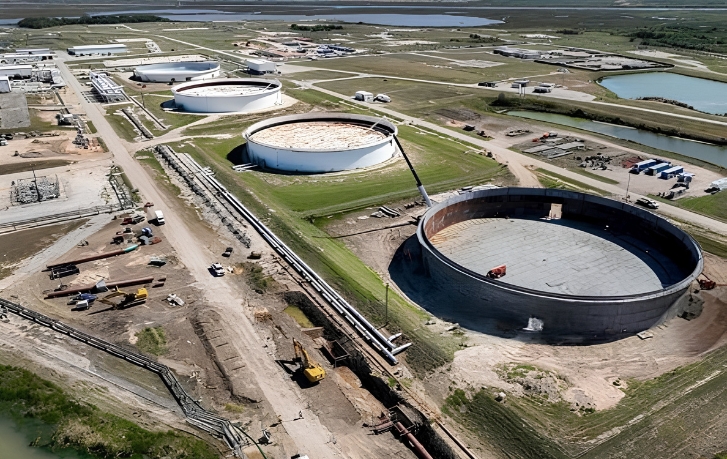
The reserve has an authorized storage capacity of 714 million barrels, while DOE lists a maximum nominal drawdown capability of 4.4 million barrels per day. It also says oil takes 13 days to enter the market after a presidential decision. Those headline figures describe the system’s intended scale, not necessarily its available performance during a particular release.
At 283.8 million barrels, the reserve holds about 40% of its authorized capacity. A temporary decline to 244 million barrels would reduce that proportion to roughly 34%. Neither percentage establishes how much crude could be delivered on a given day because maintenance, construction and cavern availability can constrain flow independently of the national inventory total.
That distinction is central to emergency planning. Inventory measures the quantity of crude underground; drawdown capability measures how quickly usable oil can move through wells, pumps, pipelines and terminals into the commercial system. A reserve can therefore contain hundreds of millions of barrels while delivering well below its nominal rate.
The GAO benchmark shows that this was not merely a low-inventory issue. Withdrawal capability was already limited to 61% of the design rate when holdings were above 410 million barrels, and refill capability stood at 56%. Further inventory reductions could add another constraint to a system already managing aging infrastructure, maintenance backlogs and unavailable storage capacity.
The barrels are borrowed, not permanently sold
The current transaction is structured as an exchange. Participating companies receive crude now and must return an equivalent amount later, plus additional premium barrels. DOE says its earlier exchanges achieved a 25% premium in returned oil, allowing immediate supply to reach the market while eventually increasing the quantity placed back into the reserve.
That structure trades near-term inventory for future replenishment. It can ultimately return more oil than was borrowed, but those replacement barrels are not available during the interval between delivery and repayment. Contracts awarded through the latest solicitation will determine the return schedule, while outgoing deliveries are planned for November and December 2026.
Demand for the offer remains an important uncertainty. Limited participation in June was attributed to concerns among traders about repayment premiums and crude-quality requirements. If similarly weak interest persists, the reserve may remain well above the projected 244-million-barrel level. If all 40 million barrels are accepted, the temporary reduction would be substantially larger.
Hormuz keeps the timing consequential
The reserve held about 415 million barrels before the conflict with Iran began in late February. DOE data subsequently placed it at its lowest level since January 1983. A department spokesperson has said 70 million barrels is the minimum amount needed to operate the reserve, although that equipment-related floor does not indicate how much inventory planners would want available for overlapping or prolonged supply emergencies.
The external disruption has not yet been resolved. Intelligence firm Kpler counted two vessel transits through the Strait of Hormuz on one recent Wednesday, compared with eight the previous day and 130 to 140 per day before the conflict. Iran has presented conditions for reopening the waterway, but those demands have not been reported as accepted terms.
The latest exchange therefore places two different clocks on the same system: crude can be released this year to address the current disruption, while replacement barrels arrive later. Whether inventory actually approaches 244 million barrels depends on commercial uptake, but the GAO findings establish the more durable constraint barrels in storage cannot be treated as fully available unless the reserve’s delivery infrastructure can move them when required.
| More aerospace and engineering stories, right in your MSN feed. Follow AMI on MSN |
By Thomas Caldwell — AMI’s senior editor for mechanical and mobility engineering, covering vehicle electronics, systems integration, electrification, chassis systems, propulsion, and safety policy.