Reported Drone Attack Ignites Novoshakhtinsk Terminal, Halts Rail Traffic Both Ways
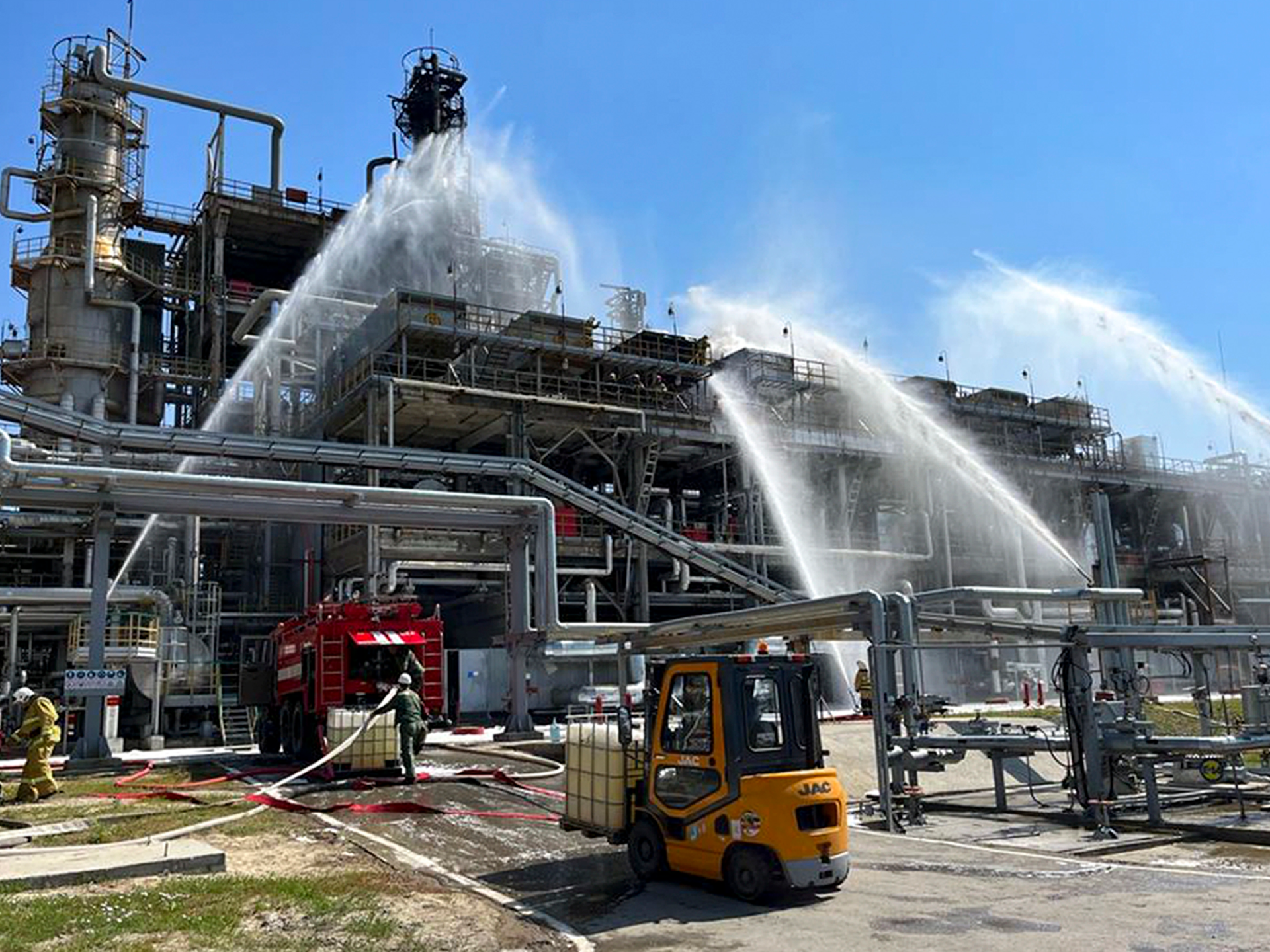
A reported drone attack ignited a major fire at the Novoshakhtinsk Oil Refinery’s oil-loading terminal in Russia’s Rostov region overnight on October 9-10. Damage to a railway bridge also forced authorities to suspend train traffic in both directions, extending the immediate disruption beyond petroleum handling to the surrounding rail network.
Rostov Governor Yuri Slyusar confirmed the fire, the bridge damage and the rail suspension. He also said regional air defenses had shot down more than 50 unmanned aircraft since the previous evening. That interception figure is an official Russian claim and has not been independently verified. Responsibility for the reported attack had not been conclusively established.
The combination of fire and railway damage matters more operationally than the reported explosions alone. The terminal is a transfer point rather than the refinery’s main production site, handling petroleum products from the Novoshakhtinsk facility and other suppliers for export. Its stated design capacity is approximately 2.5 million metric tonnes per year, and it has also been described as supporting Russian military fuel supply.
Annual capacity does not reveal the immediate loss
A design figure of 2.5 million tonnes establishes the terminal’s industrial scale, but it does not show how much throughput was actually interrupted. Annual capacity is a maximum or planned handling level, not proof that the site was operating at that rate when the fire started.
The information available as of October 10 did not quantify damage to loading equipment, storage infrastructure or transport connections inside the facility. It also did not say whether unaffected portions could continue operating, whether cargo could be rerouted or how long firefighting and inspections would take. Without those details, converting the fire into a daily or monthly supply-loss estimate would be speculative.
That distinction is central to assessing energy consequences. A visually substantial industrial fire can produce anything from a short operational pause to a longer bottleneck, depending on which functions were affected and how quickly safe access can be restored. Confirmation that petroleum shipments have stopped, reduced operating capacity or moved elsewhere would provide a stronger measure than the terminal’s nameplate capacity alone.
The railway interruption creates a separate logistics problem
The confirmed suspension of trains in both directions is the clearest immediate operating consequence. A two-way closure prevents normal traffic from simply continuing past the damaged bridge, affecting any passenger or freight services assigned to that section until railway authorities approve a reopening or establish an alternative arrangement.
No duration or repair estimate was given. Bridge damage can require structural inspection even when the visible damage appears limited, because rail infrastructure carries concentrated, repeated loads and depends on alignment within tight tolerances. That is general engineering context, not an assessment of this bridge’s condition. Authorities have not disclosed the extent of the damage or the work needed to restore service.
The terminal fire and rail closure should therefore be treated as linked disruptions in one industrial area, but not automatically as a single proven failure chain. The available account does not establish whether the damaged bridge directly serves terminal shipments, how much petroleum normally moves over it or whether the rail suspension will constrain terminal recovery. What is confirmed is that energy-handling operations faced a fire while nearby rail movement stopped in both directions.
Large drone numbers increase readiness pressure, not certainty
Slyusar’s claim that more than 50 drones were intercepted indicates the scale of the reported regional air-defense response. It does not establish how many aircraft were launched, how many reached intended destinations or what caused each instance of damage. Those questions cannot be resolved from the interception claim alone.
At a systems level, repeated large-scale alerts can place sustained demand on detection, identification, command and control and emergency-response organizations. Protecting a region containing industrial facilities, transportation links and populated areas is broader than defending one terminal. Even a high claimed interception count can coincide with fires or transportation shutdowns, but that outcome by itself does not reveal where a defensive system succeeded or failed.
The Novoshakhtinsk network has faced earlier reported strikes, including a July attack on an oil-loading terminal and a September incident that temporarily suspended refinery operations. Those episodes provide context for recurring pressure on the region’s energy logistics, but they do not determine the severity of the latest event.
The next meaningful facts will be operational rather than visual: when trains resume, what bridge repairs are required, whether the terminal remains active and how much of its approximately 2.5-million-tonne annual design capacity is actually unavailable. Until those figures emerge, the two-way rail suspension is the measurable disruption; the petroleum-capacity loss remains unknown.
| More aerospace and engineering stories, right in your MSN feed. Follow AMI on MSN |
By Stephen Wallace — Editor for AMI’s aerospace integration and unmanned mobility coverage, focused on drone manufacturing, VTOL systems, autonomous networks, and air-ground mobility links.