Ukrainian Drone Strikes Push Russian Diesel Exports to Decade Low as Crude Earnings Rise
Russia exported less diesel in September than in any other month across more than a decade of Vortexa records, yet its crude-export earnings remained near a post-invasion high. That split captures the uneven effect of Ukrainian drone strikes on Russia’s energy system: refinery disruption constrained transport-fuel production and forced costly domestic support measures without stopping the country from shipping substantial volumes of unprocessed oil.

Diesel and gasoil exports fell 28% to 144,000 barrels a day. Russia restricted exports to protect domestic availability, imported about 350,000 tonnes of motor fuel by sea and made its largest road-fuel subsidy payment in more than four years. Those measures indicate that maintaining supplies for motorists required intervention beyond ordinary refinery and distribution operations.
Higher product exports did not mean diesel recovered
The apparent contradiction begins with the product mix. Russia’s total seaborne refined-product exports rose to approximately 1.17 million barrels a day in September, a three-month high. But fuel-oil shipments increased 6% to about 613,000 barrels a day, while naphtha exports climbed 35% to roughly 363,000 barrels a day.
Those increases outweighed the fall in diesel, making the aggregate export figure look healthier than the transport-fuel balance underneath it. Fuel oil is a heavier product, while naphtha serves primarily as a petrochemical feedstock or blending component. Neither is a direct substitute for the diesel needed by road freight, agricultural machinery and other compression-ignition equipment.
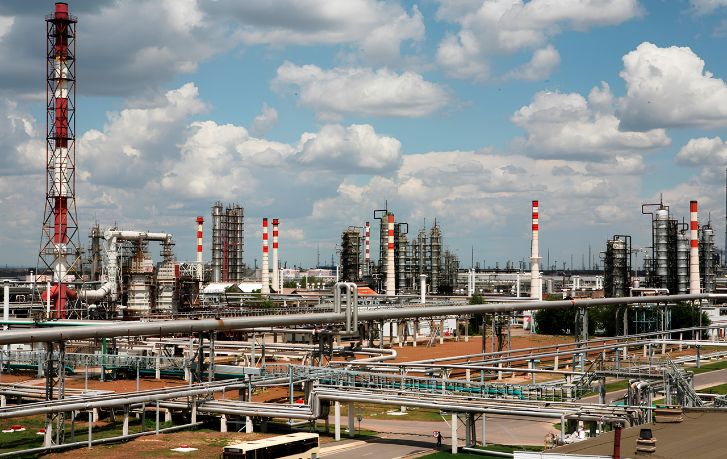
The divergence is consistent with a refinery network struggling to turn crude into the mix of higher-demand fuels normally expected from more complex processing. The International Energy Agency reported that Russian refinery throughput fell to 3.8 million barrels a day in June, its lowest level in more than 20 years and about 30% below the previous year. It estimated diesel production had fallen by nearly 30%.
That distinction matters because a refinery is not a single on-or-off machine. Initial processing separates crude into fractions, but additional units upgrade those streams into lighter, cleaner and more commercially valuable fuels. A network can therefore continue moving petroleum products while becoming less capable of supplying the specific grades its domestic market and export customers require.
Distribution shifted along with production
Russia also redirected its export logistics. Nearly 80% of its exported fuel oil left through Baltic ports, while Baltic naphtha loadings rose almost 50%. The concentration of these flows indicates that the response extended beyond refinery output to storage, port allocation and tanker scheduling as disruption affected Black Sea infrastructure.
Imports added another layer to that rebalancing. Reuters calculations put Russia’s seaborne motor-fuel imports at about 350,000 tonnes, mostly gasoline arriving from India, Morocco and Türkiye. For a major oil producer and refined-product exporter, buying finished motor fuel abroad is a notable systems response: crude availability alone does not guarantee that the domestic network can produce the required fuels in the required locations and quantities.
The subsidy payment served as a financial control mechanism within the same system. By compensating oil companies for supplying the domestic market when exports could be more attractive, the government supported pump availability but transferred part of the disruption’s cost to public finances. Export restrictions, imports and subsidies together show that domestic stability was being maintained through allocation and payment measures, not simply through restored refining capacity.
Crude remained the financial shock absorber
Russia’s crude exports reached about 3.99 million barrels a day in the week through September 27. Elevated global prices pushed the estimated value of seaborne crude shipments close to its highest level since the full-scale invasion began. Refinery outages can even leave more crude available for direct export when domestic plants cannot process it, although raw crude generally captures a different value than upgraded fuels.
This is why the drone campaign’s effect cannot be measured by total oil exports alone. The stronger indication is the forced change in what Russia shipped, what it retained, where cargoes departed and how much intervention was needed to supply motorists. Repeated strikes across a geographically dispersed refinery network also create an industrial readiness burden: protection, inspection and repair resources must cover many large fixed sites, while interruptions can propagate into pipelines, storage terminals, ports and subsidy requirements.
The exact amount of unavailable refining capacity remains uncertain. Kyiv’s assertion that long-range drones disabled more than half of Russia’s capacity has not been independently established, and outside estimates vary by date and methodology. Trade flows provide a firmer boundary for the analysis: diesel exports reached a documented decade low while lower-value product exports and crude shipments remained substantial.
Officials were considering allowing some producers to resume diesel exports in October to prevent excess inventories, but that remained a proposal rather than a confirmed policy change. Whether such exports actually restart and at what sustained volume will be a clearer test of refinery recovery than September’s rise in headline product shipments.
| More aerospace and engineering stories, right in your MSN feed. Follow AMI on MSN |
By Stephen Wallace — Editor for AMI’s aerospace integration and unmanned mobility coverage, focused on drone manufacturing, VTOL systems, autonomous networks, and air-ground mobility links.