China’s Car Exports Jump 73% as Domestic Passenger Sales Fall 28%
China’s car industry moved in two sharply different directions in September 2026: domestic passenger-car retail sales fell about 28% from a year earlier, while passenger-car exports rose approximately 73%. The divergence shows how weak demand at home and extensive manufacturing capacity are redirecting Chinese automakers toward customers and competitors overseas.

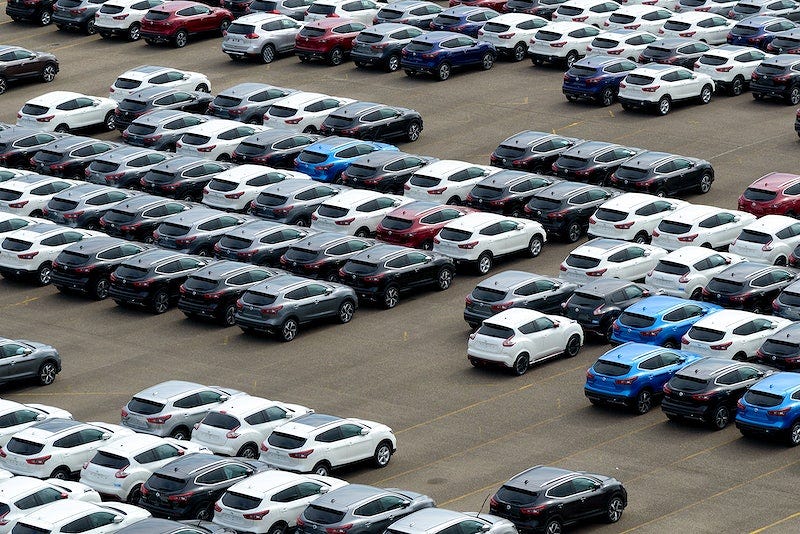
About 1.63 million passenger cars were sold to end customers in China during the month, marking the 12th consecutive year-over-year decline. At the same time, China exported roughly 917,000 to 923,000 passenger cars, depending on the statistical definition and recording method. The China Passenger Car Association figure cited by Reuters put exports at 923,000, up 73.2% from September 2025.
Exports offer an outlet for underused factories
The numbers reflect a capacity problem as much as a sales story. China’s theoretical annual vehicle-production capacity exceeds 55 million units, although some plants counted in that figure are outdated or not economically viable. When domestic sales weaken, exporting more vehicles can keep viable assembly plants and supplier operations busier, spread fixed costs over greater production volume and provide access to markets where price competition may be less severe.
China’s domestic market is experiencing intense discounting alongside weaker consumer sentiment, economic uncertainty and problems in the property sector. Changes to subsidies and purchases brought forward by temporary incentives have also affected demand. Even battery-electric vehicles and plug-in hybrids were not insulated: their combined domestic sales fell 16.7% year over year in September, although they still represented a large part of the Chinese market.
The export totals require careful interpretation. An exported vehicle is not necessarily a vehicle sold to an overseas end customer. Cars may still be aboard ships, sitting at logistics centers or held in dealer inventory. September’s passenger-car exports were equivalent to approximately 57 vehicles for every 100 passenger cars sold at retail inside China, but that ratio does not mean 57% of Chinese production was exported. Retail sales, wholesale manufacturer deliveries, production and customs-recorded exports measure different stages of the system.
The broader vehicle count also should not be mixed with the passenger-car figure. Including commercial vehicles, China exported 1.053 million vehicles in September. Under a broad definition, exports reached approximately 8.2 million vehicles in the first nine months of 2026, more than four million of them using newer powertrains, primarily battery-electric or plug in hybrid systems.
China’s advantage extends beyond assembly wages
The competitive pressure comes from an integrated manufacturing network spanning battery cells and materials, power electronics, software, automated production and final vehicle assembly. Scale and dense supplier networks can lower component costs and shorten the time needed to move a design into volume production. Vertically integrated manufacturers such as BYD can coordinate more of that chain internally, reducing some supplier interfaces and allowing faster changes to hardware and software.
That does not make rapid development an unqualified advantage. Shorter product cycles place greater demands on validation, software configuration control, supplier quality and post-launch support. Chinese regulators have proposed rules intended to discourage rushed launches without sufficient validation, illustrating the systems-engineering tension between development speed and confidence that a vehicle’s interacting mechanical, electrical and software functions have been adequately tested.
For Volkswagen, BMW, Mercedes-Benz and their suppliers, the pressure now operates in two directions. They are competing for a shrinking pool of buyers in China while facing more Chinese vehicles in Europe and emerging markets. Chinese brands accounted for 11.9% of registrations across the European Union, Britain and the European Free Trade Association during the first eight months of 2026, up from 6.7% a year earlier, according to European registration data reported by Reuters.
Europe’s established manufacturers retain important strengths in safety engineering, chassis development, manufacturing quality, dealer support and brand recognition. The harder systems challenge is preserving those attributes while reducing cost, shortening development schedules and building software-centered electrical architectures that can be updated without adding excessive complexity.
Trade restrictions may alter where Chinese vehicles are assembled, but they do not remove the underlying industrial capability. Several Chinese automakers are planning or pursuing European production, which can place manufacturing closer to customers and reduce exposure to import barriers. September’s 73% export increase therefore represents more than a one-month shipment spike: it is a visible outlet for capacity that China’s weakened domestic market can no longer absorb at its previous rate.
| More aerospace and engineering stories, right in your MSN feed. Follow AMI on MSN |
By Thomas Caldwell — AMI’s senior editor for mechanical and mobility engineering, covering vehicle electronics, systems integration, electrification, chassis systems, propulsion, and safety policy.