F-22 Pilot Commands Anduril Fury Drone in First Airborne Test
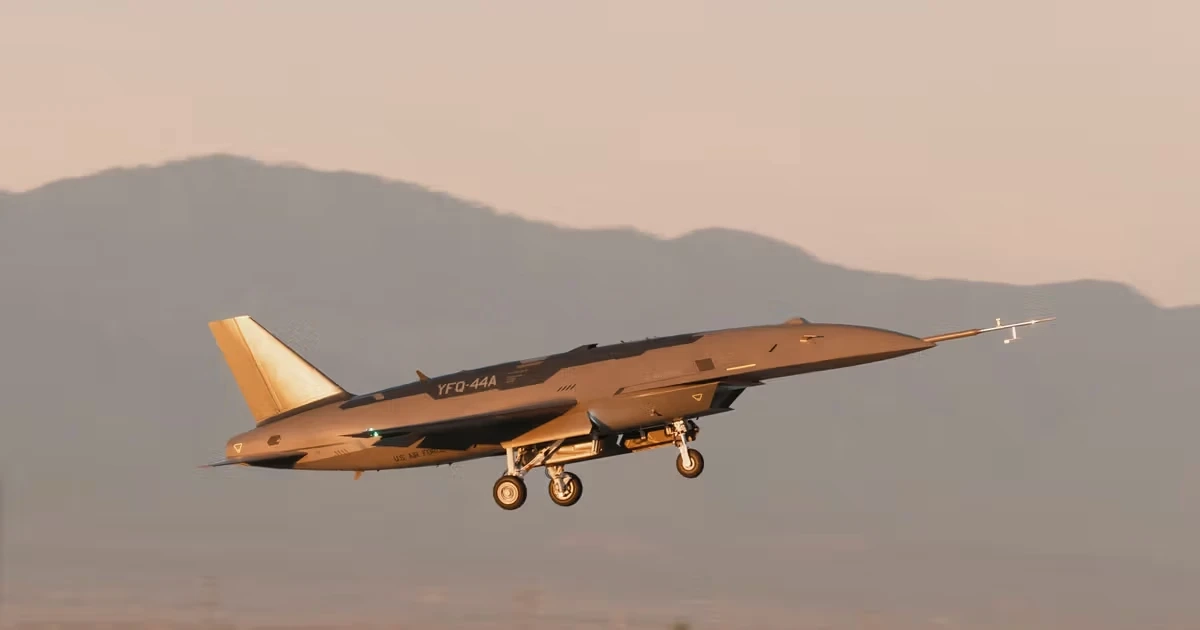
An F-22 Raptor pilot issued tactical commands to an unmanned Anduril YFQ-44A Fury in flight for the first time, demonstrating a central function behind the U.S. Air Force’s plan to field at least 500 semi-autonomous aircraft by 2032. The Air Force announced the demonstration on Oct. 16, describing the F-22 pilot as an airborne “quarterback” directing a single drone.
The two aircraft took off from Edwards Air Force Base and joined up in the air. From the F-22 cockpit, the pilot transmitted an updated mission plan through a tactical data link and issued high-level directives. Fury’s onboard autonomy software interpreted those instructions in real time, then conducted dynamic maneuvers and simulated combat tasks.
That division of labor is the essential engineering idea behind crewed-uncrewed teaming. The pilot communicates the desired mission or behavior without manually flying the drone through each movement. Autonomy aboard Fury handles the lower-level execution, allowing the pilot to remain a mission commander rather than becoming a remote-control operator.
Anduril, a newer entrant challenging the established defense primes, is Fury’s prime contractor. The Air Force has ordered production FQ-44A Fury aircraft as well as General Atomics FQ-42A Vengeance drones for the first increment of its Collaborative Combat Aircraft program. An initial tranche is expected to start entering operational service around the end of the decade.
A first for the F-22 and Fury, not the entire concept
The milestone has a precise boundary. Anduril described it as the first airborne command demonstration involving an F-22 and a pre-production YFQ-44A. The company had previously disclosed Fury formation flights with F-35 fighters, but those fighters did not command the drone in midair. General Atomics also announced an F-22 demonstration with its MQ-20 Avenger in November 2025.
This latest event is consequential because it used one of the production-selected aircraft types and exercised the command relationship planned for operational service. F-22s are expected to become the first airborne quarterbacks for the Air Force’s Collaborative Combat Aircraft fleet, making the interface between a single-seat fighter and autonomous aircraft a defining part of the program rather than an optional feature.
The test, however, involved one F-22 directing one Fury. The eventual requirement calls for one fighter pilot to manage multiple drones simultaneously. Scaling from a one-to-one demonstration to one pilot supervising several aircraft introduces a different human-factors problem: the interface must present enough information for informed decisions without competing excessively with the pilot’s responsibility to operate the F-22.
The cockpit remains undisclosed
Neither the Air Force nor Anduril disclosed how the F-22 cockpit was configured for the flight. Earlier Air Force budget documents referred to tablets, cables and associated integration equipment, while Lockheed Martin has been working with the service on control architectures and user interfaces for the F-22 and F-35.
The absence of interface details leaves cockpit workload, alert management and multi-aircraft supervision among the largest unanswered questions. A successful data link and correctly executed directive establish that the command chain can function. Operational use will demand repeatable performance while the pilot is also managing the crewed fighter, interpreting the wider mission and deciding when to intervene.
Trust will be built through that repeatability rather than through autonomy alone. The Air Force plans to use data from the demonstration for further software integration, developmental testing and future operating concepts. Anduril vice president of autonomous airpower Mark Shushnar said reaching operational service will require the company and Air Force to prove the capability, define procedures and build operator trust in semi-autonomous wingmen.
The work extends beyond the cockpit. The service must establish how units deploy, launch, recover and support these aircraft at scale. Manufacturing hundreds of drones by 2032 will have limited operational value unless maintenance, software, training and ground procedures can sustain them alongside crewed fighters.
Fury and Vengeance are scheduled to participate in Exercise Emerald Flag in December 2026. Lt. Col. Lyndon Bartlett of the Experimental Operations Unit described it as their first large-force integration exercise. That event is positioned to move the program beyond one fighter commanding one drone and into the more demanding environment that will determine whether the Air Force can turn an airborne demonstration into a supportable fleet of at least 500 aircraft.
| More aerospace and engineering stories, right in your MSN feed. Follow AMI on MSN |
By Stephen Wallace — Editor for AMI’s aerospace integration and unmanned mobility coverage, focused on drone manufacturing, VTOL systems, autonomous networks, and air-ground mobility links.