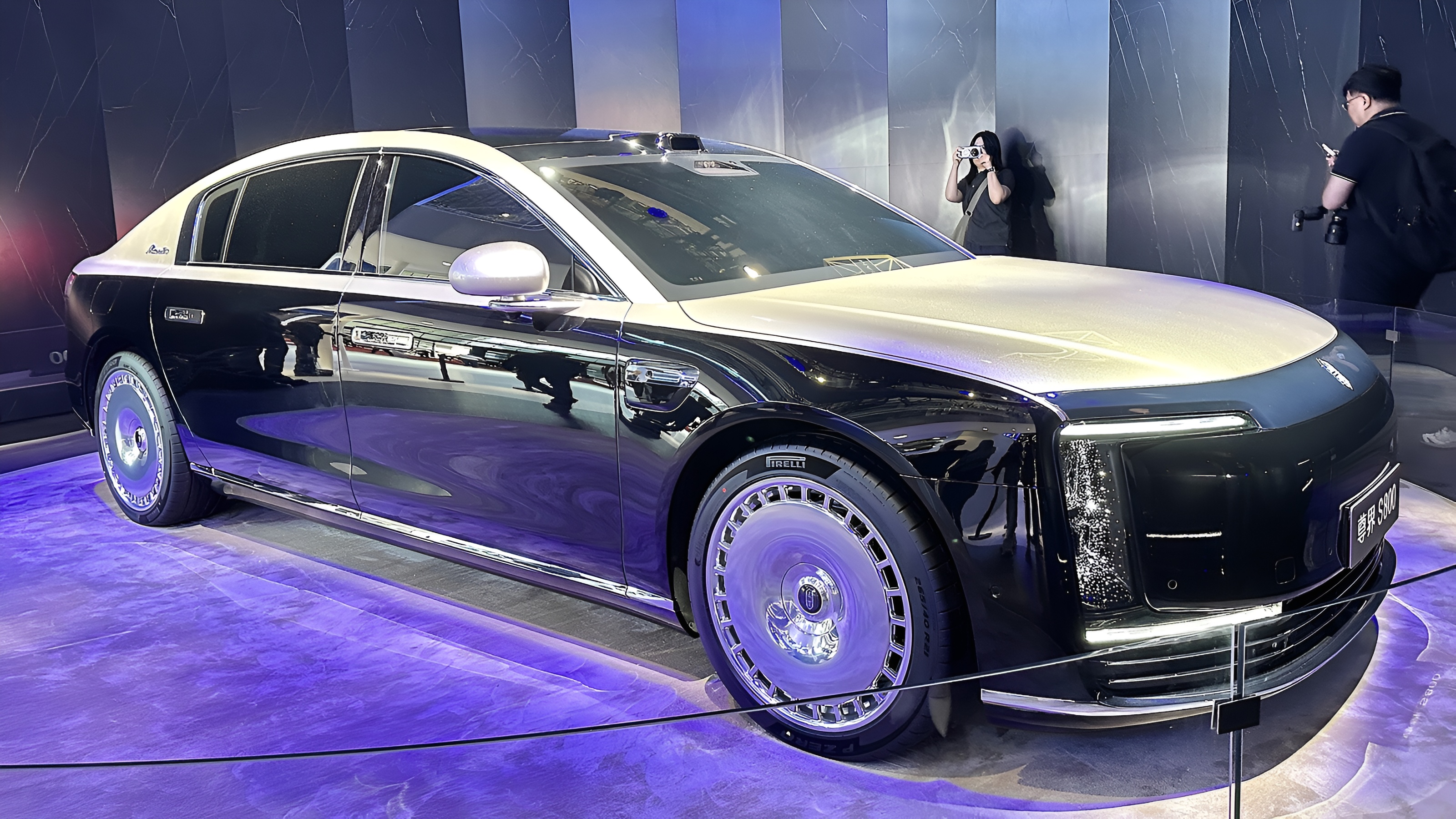
China Investigates Maextro V800 After Brake Brackets Fail in All Three Tests
China’s Ministry of Industry and Information Technology opened an investigation on October 15 after brake-pedal brackets reportedly fractured in all three Maextro V800 luxury electric minivans subjected to repeated emergency-stop tests. The failures prevented normal pedal operation, while the vehicles’ emergency-braking function continued to decelerate them but required substantially more road to stop.

Dongchedi tested the three V800s by repeatedly braking from 100 kilometers per hour, or 62 mph, to a standstill on a closed course. The first vehicle’s bracket reportedly failed during its third stop, the second during its fourth and a subsequently purchased V800 during its second. Average stopping distance was about 38 meters, or 125 feet, before a fracture and approximately 140 meters, or 459 feet, when emergency braking took over.
Those results describe a failure in the pedal’s supporting structure, not the loss of every part of the braking system. The distinction explains how the vehicles could still slow after drivers lost normal use of the pedal. It does not reduce the practical consequence: the reported stopping distance under fallback operation was more than three times the earlier average.
A structural link in the driver’s braking command
A brake-pedal bracket belongs to the mechanical path through which a driver applies force and commands normal braking. Its integrity therefore affects whether the pedal remains properly supported and usable. When that supporting part fractures, other braking capabilities may remain available, but the driver’s primary physical interface no longer operates as intended.
The V800 results place two separate engineering questions before investigators. The first is why the bracket fractured during repeated high-demand stops. The second is whether the fallback response provided an adequate safety margin once normal pedal operation became unavailable. The reported tests establish the recurring fractures and changed stopping performance, but their underlying cause has not received a final professional or regulatory determination.
The three-for-three result gives investigators a repeatable pattern within this small test group, although it does not establish how frequently the condition would occur across customer vehicles. Relevant areas for an official review include whether the test loads reasonably represent foreseeable operation, whether the bracket design and production process consistently meet their requirements, and whether validation sufficiently covered repeated emergency braking. The ministry has formed a joint investigation with China’s Cyberspace Administration and State Administration for Market Regulation and says findings will be released in due course.
Maextro disputes the conditions but promises a redesign
Maextro, developed by JAC Group and Huawei, said no customers had reported bracket fractures since V800 deliveries began. It described the test as involving “nonstandard extreme conditions” and maintained that its development and validation exceeded industry requirements. At the same time, the company promised to improve the bracket-base design, revise testing parameters, change production quality management and provide existing owners with a free upgrade.
That combination leaves a central policy tension unresolved. Maextro challenges whether the testing represents ordinary use, yet its proposed actions address design, validation and manufacturing controls the same system layers that determine whether a structural component has sufficient margin and is produced consistently. Regulators must now decide whether the observed failures indicate a defect requiring formal corrective action, a test-boundary issue, or another condition supported by their technical examination.
The promised free upgrade has not been announced as a recall, and Maextro had not filed a recall plan with the market regulator as of the investigation’s opening. That status affects owners because a formal recall normally establishes a defined affected population, remedy and regulatory process. A voluntary free upgrade may remove the direct repair cost, but regulators have yet to determine its scope, timing or adequacy.
The case also arrives during China’s year-long vehicle-quality campaign. Under measures announced in August, automakers are expected to inspect product quality, reliability, durability, testing and supplier operations, and to file recall plans promptly when defects are identified. That framework gives the V800 inquiry a consequence beyond three test vehicles: the official finding will determine whether Maextro’s proposed upgrade remains a company remedy or becomes part of a formal defect process.
For owners and other road users, the unresolved issue is not whether some deceleration remained available it reportedly did but whether the V800’s normal mechanical control path can withstand the loads regulators consider reasonably foreseeable. The ministry’s eventual finding must reconcile three repeated test failures, Maextro’s absence of customer reports and a fallback system that stopped the vehicles only after roughly 140 meters.
| More aerospace and engineering stories, right in your MSN feed. Follow AMI on MSN |
By Thomas Caldwell — AMI’s senior editor for mechanical and mobility engineering, covering vehicle electronics, systems integration, electrification, chassis systems, propulsion, and safety policy.