Ukrainian Troops Evacuate Wounded Soldier From Minefield With ‘Ayudag-6’ Drone
Across the heavily contested frontlines of eastern Ukraine, the constant proliferation of first-person-view attack drones, pervasive aerial reconnaissance, and dense minefields has turned conventional casualty evacuation into an almost impossible mission. Standard military medical evacuation doctrine relying on armored personnel carriers, tactical ambulances, or rotary-wing aircraft has largely collapsed within forward kill zones where any visible thermal signature or vehicular movement draws rapid artillery strikes. Under these unforgiving battlefield pressures, wounded infantrymen holding remote positions frequently face prolonged isolation when hostile sensor grids and persistent loitering munitions sever terrestrial access routes entirely.
To bypass these deadly perimeter barriers, frontline commanders have increasingly relied on unmanned ground systems to haul ammunition and drag wounded personnel back from the edge of contact. While tracked and wheeled robotic ground vehicles have spared combat medics from hazardous journeys, dense mine barriers, collapsed trenches, and shell-cratered terrain often halt terrestrial machines in their tracks. When frontline ground access becomes completely severed and rescue teams face lethal exposure, units are left with no choice but to formulate unconventional technical measures to preserve the lives of trapped troops.
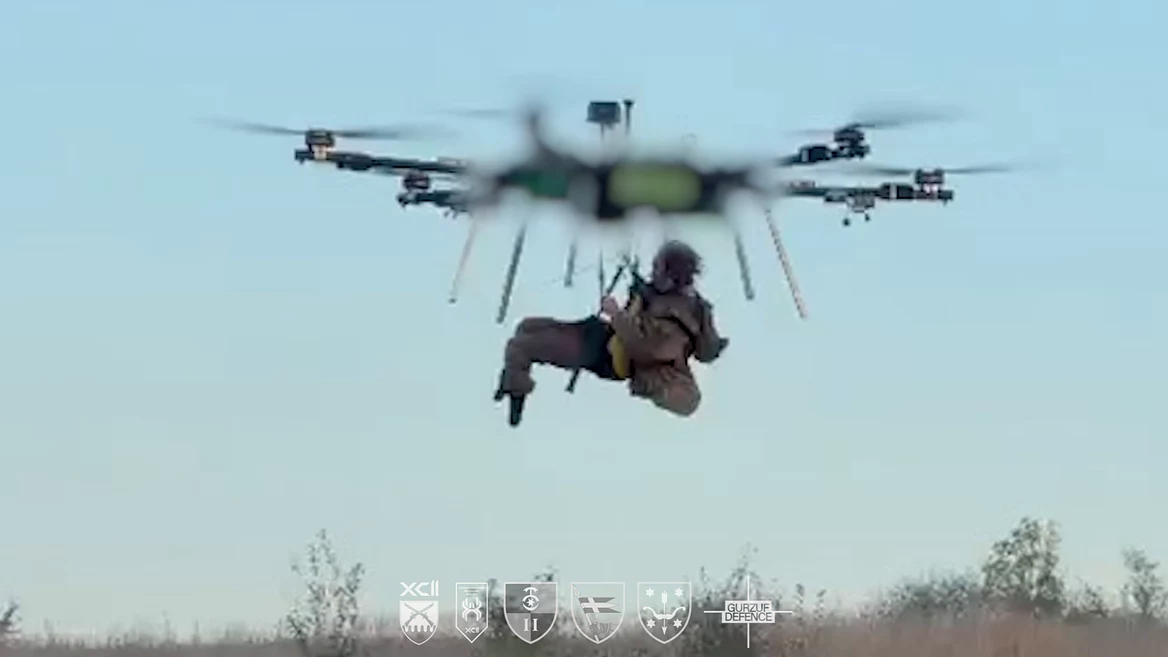
That tactical threshold was crossed when Ukrainian forces completed what defense officials describe as the world’s first combat medical evacuation of an injured human soldier using an aerial drone. Trapped in an isolated defensive position surrounded by active minefields and monitored by hostile surveillance aircraft, a wounded serviceman from the 30th Separate Mechanized Brigade was successfully lifted directly into the sky. The improvised aerial extraction allowed rescuers to bypass impassable ground barriers and recover the soldier after enemy fire and dense mine belts had exhausted standard evacuation options.
The daring recovery was executed using the ‘Heavy Shot’ ‘Ayudag-6’, a heavy-lift multi-rotor hexacopter developed by Ukrainian defense manufacturer Gurzuf Defense. Originally designed as a heavy bomber platform tasked with dropping explosive payloads onto armor and fortified bunkers, the hexacopter was rapidly reconfigured by front-line military technicians to transport human cargo. Working in close partnership with the manufacturer, drone engineers adjusted the aircraft’s flight control algorithms and fitted a specialized winch mechanism to maintain stability and prevent severe pendulum swaying during the lift.
BREAKING: Ukraine has carried out the world’s first medical evacuation of a human via a drone from the battlefield the 30th mechanised brigade of Ukraine managed to save their injured comrade from a minefield. Just absolutely insane. https://t.co/TxcR5Lz0MG
— WarMonitor🇺🇦🇬🇧 (@WarMonitor3) October 19, 2026
Before the extraction could occur, unmanned reconnaissance craft dropped climbing equipment, carabiners, and a smartphone containing step-by-step video instructions directly into the wounded soldier’s trench. Despite sustaining serious shrapnel injuries to his legs during previous enemy strikes, the infantryman managed to strap himself into the harness suspended beneath the drone’s frame. Once the pilot confirmed the lock, the hexacopter ascended, hauling the serviceman underneath its rigid landing gear for a flight spanning roughly 62 km across contested airspace.
Carrying out the long-distance aerial mission required synchronized coordination across multiple military formations, including the 92nd Separate Assault Brigade, the 14th Mechanized Brigade, and the 10th Army Corps. To prevent hostile air defense systems or interceptor drones from engaging the slow-moving hexacopter, adjacent units staged diversionary drone strikes while electronic warfare teams screened the flight path. An uncrewed aerial systems operator from the 30th Mechanized Brigade guided the aircraft throughout the 74-minute flight, staying in radio contact with the soldier until he touched down safely behind friendly lines.
Following the touchdown, frontline combat medics transferred the serviceman to a rear medical center where he is currently undergoing medical treatment and rehabilitation. As a squad leader and robotics programmer from the 92nd Brigade known by the call sign “Napalm” told The War Zone, “This is a historic event, at least for our unit for sure”. While military analysts caution that hoisting injured soldiers under multi-rotor bombers remains a high-risk measure of last resort, the mission demonstrates how uncrewed aerial systems are fundamentally rewriting casualty recovery in modern combat.