Truck Driver Kicks Out Windshield to Escape Dangling Cab on ‘Interstate 5’
Urban transit corridors across Southern California serve as vital logistical arteries, moving high volumes of commercial freight and commuter traffic adjacent to strategic transport nodes. Along elevated segments of ‘Interstate 5’ near San Diego International Airport, multi-lane expressways navigate tightly packed metropolitan topography where high-speed vehicle maneuvers demand precise roadway engineering. Even minor trajectory deviations along these elevated bypasses carry heightened consequences for commercial transport and urban safety.
Reinforced concrete barriers and median walls are deployed along high-density highways to absorb kinetic energy and redirect errant vehicles back into active lanes. When commercial haulers and medium-duty freight trucks collide at highway speeds, the substantial momentum can push physical safety barriers past their intended structural thresholds. Breaching these barriers on elevated road bridges introduces severe hazards, creating threats not only for the vehicle occupants but also for motorists on lower thoroughfares.
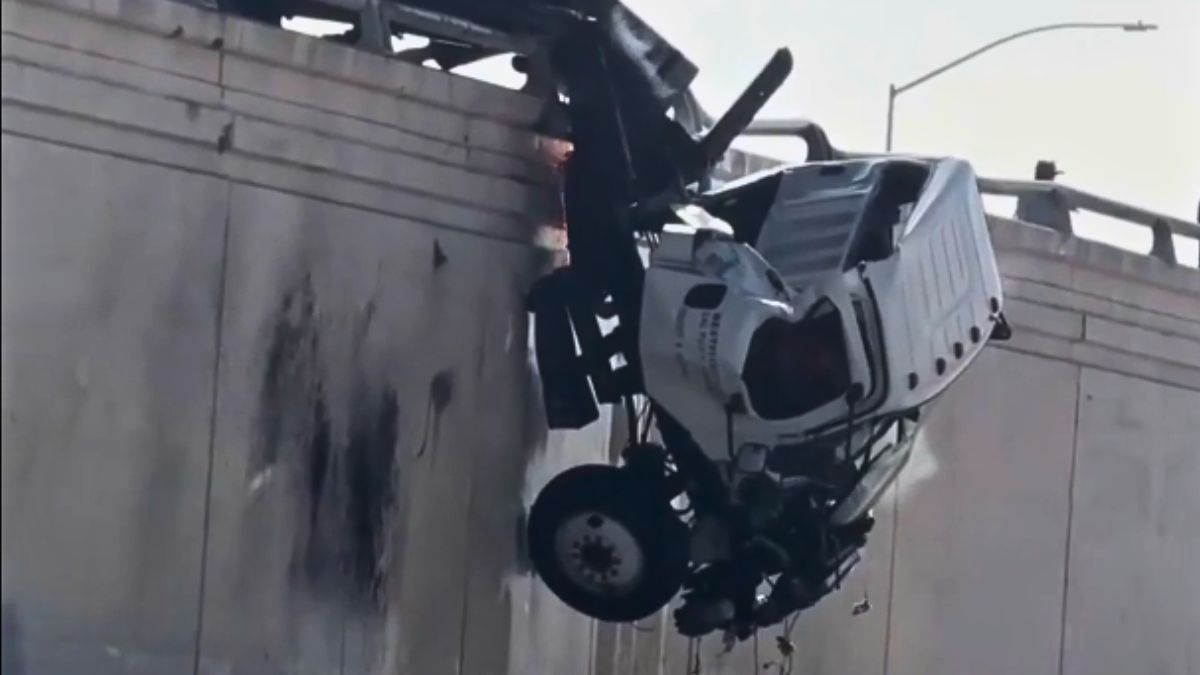
That infrastructure vulnerability materialized into an urgent emergency near the Washington Street interchange in the Mission Hills neighborhood of San Diego. A northbound commercial moving truck collided with a passenger sedan on ‘Interstate 5’, caroming violently into the elevated concrete divide. The collision forced the forward cabin of the truck through the barrier, leaving the front axle and operator compartment suspended out in open air over a steep drop toward the lower roadway.
Faced with a precarious drop of nearly 30 feet and an unstable cabin shifting against damaged concrete, the driver executed an immediate escape by kicking through the front windshield glass. California Highway Patrol officers and nearby civilian bystanders quickly gathered directly below the overhang, holding out an open blanket to serve as an improvised catch tarp. The driver jumped through the shattered windshield opening, landing safely into the blanket held by the ground rescue party.
ALERT: Semi-truck driver kicks out the windshield and jumps to safety after crashing off a freeway and dangling over the almost 30-foot edge. The moving truck was headed north on Interstate 5 in San Diego near the airport when it collided with a car and crashed through the freeway’s concrete barrier. The truck then became suspended over a steep drop-off to the road below. Police and bystanders held out a blanket, and the man in the truck kicked out the windshield and jumped to safety. The 2 men in the truck refused medical treatment, and the 4 people in the other car involved have been released from the hospital.
— E X X ➠A L E R T S (@ExxAlerts) October 21, 2026
Emergency units from the San Diego Fire-Rescue Department arrived on scene shortly after the initial collision report to discover diesel fuel pouring onto the pavement. As commercial transport outlet CDLLife reported, the dangling rig was left hanging by a thread while “spilling fuel and starting fires” along the divided corridor. Firefighters rapidly laid down containment measures to suppress the active engine flames before thermal stress could compromise the remaining chassis balance.
First responders concurrently extracted a second passenger trapped inside the vehicle, safely pulling him out through a side window before the cab could shift further. Despite the violent impact and the subsequent drop from the hanging wreckage, both occupants of the moving truck declined hospital transport, walking away from the perimeter without severe physical injuries. The rapid intervention by bystanders and field officers prevented an imminent fall that could have easily resulted in fatal trauma.
Emergency medical personnel evaluated four passengers travelling inside the sedan, transporting them to local trauma facilities for precautionary treatment of non-life-threatening injuries. Law enforcement authorities confirmed that all four individuals were subsequently discharged in stable condition following thorough clinical evaluations. The California Highway Patrol opened an investigation into the collision sequence to ascertain whether mechanical failure, vehicle blind spots, or sudden lane changes triggered the median impact.
Clearing the precarious wreckage required specialized heavy-recovery cranes and extended closures across multiple northbound and southbound lanes of ‘Interstate 5’, causing miles of regional gridlock. The incident highlighted the acute risks associated with commercial freight movement along elevated metropolitan arteries, where seconds determine survival between barrier containment and structural failure. For municipal highway agencies, the collision provides vital operational data on the real-world performance of concrete dividers under multi-ton dynamic forces.