5 Largest Ukrainian Drone Arsenal Blasts Caught on Camera
The war in Ukraine has transformed modern military logistics into high-stakes battles of attrition where strategic arsenals and rear supply nodes remain perpetually vulnerable to precision long-range strikes. As both sides push aerial reconnaissance capabilities hundreds of kilometers behind frontline trenches, large-scale detonations of ammunition dumps and transport arteries have repeatedly shifted the tactical equilibrium across entire operational theaters. These high-yield blast events not only deplete irreplaceable missile stockpiles but also disrupt regional command structures and force rapid operational adjustments.
The ubiquitous proliferation of commercial smartphones, civilian dashboard cameras, and military unmanned aerial systems has ensured that nearly every major strike is documented with immediate visual clarity. For open-source intelligence analysts and defense planners alike, this digital record offers rare visual telemetry regarding secondary detonation yields, blast wave propagation, and battle damage assessment. Among the hundreds of documented strikes throughout the conflict, five high-yield detonations stand out for their kinetic scale, geopolitical fallout, and visual documentation.
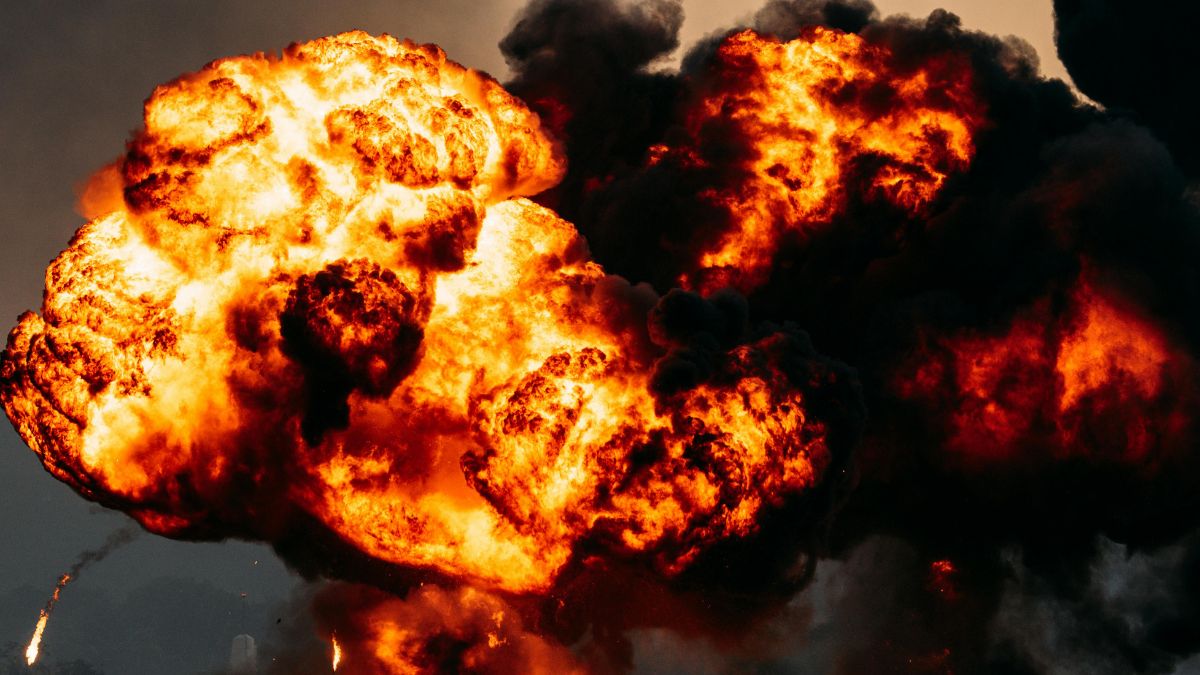
The first and seismically largest blast occurred on September 18, 2024, when Ukrainian long-range strike drones targeted Russia’s 107th Arsenal of the Main Missile and Artillery Directorate in Toropets. Swarms of domestically built ‘Liutyi’ unmanned aerial systems penetrated deep into Tver Oblast, igniting reinforced warehouses storing guided bombs, artillery ammunition, and ballistic missiles. Regional monitoring stations registered a light earthquake measuring 2.8 on the Richter scale as a fireball erupted hundreds of meters into the night sky.
Another globally recognized explosion occurred across the Kerch Strait on October 8, 2022, striking at the core of Russian logistics in occupied Crimea. Fixed surveillance cameras broadcast by CNN captured the blinding moment a truck laden with 21 tons of disguised explosives detonated on the road bridge. The blast collapsed two vehicular spans into the water and ignited seven fuel tankers on an adjacent freight train, severely degrading southern military resupply routes for months.
In December 2023, the port of Feodosia witnessed a fierce naval blast when Ukrainian Air Force ‘Su-24’ jets launched ‘Storm Shadow’ cruise missiles against the Russian landing ship ‘Novocherkassk’. Intelligence assessments indicated the ‘Ropucha’ class vessel was actively unloading munitions, likely including guided aerial bombs or drone components. The resulting secondary explosion vaporized large sections of the vessel and hurled metal shrapnel across the harbor, leaving only a sunken, charred hull at the waterline.
Russian precision strikes have also triggered vast detonations across Ukrainian rear infrastructure, most notably in the city of Pavlohrad on the night of May 1, 2023. Russian air-launched cruise missiles targeted an industrial railway hub, striking stored solid rocket propellant associated with decommissioned Soviet-era ballistic missiles. The instantaneous fireball generated an immense shockwave recorded by dozens of residential cameras, causing extensive structural damage across the surrounding district.
Just two weeks later, on May 13, 2023, Russian ‘Shahed-136’ loitering munitions struck an ammunition facility near Khmelnytskyi in western Ukraine. The impact touched off a violent chain reaction among stored Cold War-era munitions, producing a distinctive mushroom cloud visible from tens of kilometers away. Multiple high-definition dashcams captured the towering fireball and the expanding blast wave, illustrating how concentrated explosive stores remain highly vulnerable to persistent aerial surveillance.
These documented detonations demonstrate the harsh realities of modern standoff warfare, where hardened storage facilities offer diminishing protection against accurate guidance systems. As long-range loitering munitions and cruise missiles continue to proliferate, dispersal and concealment have become essential tactical imperatives for battlefield survival. For military planners worldwide, the footage emerging from Ukraine provides an unmistakable lesson on the lethal consequences of concentrated logistics.