Boeing-Owned Spirit Defense Joins FQ-42 Drone Fighter Production
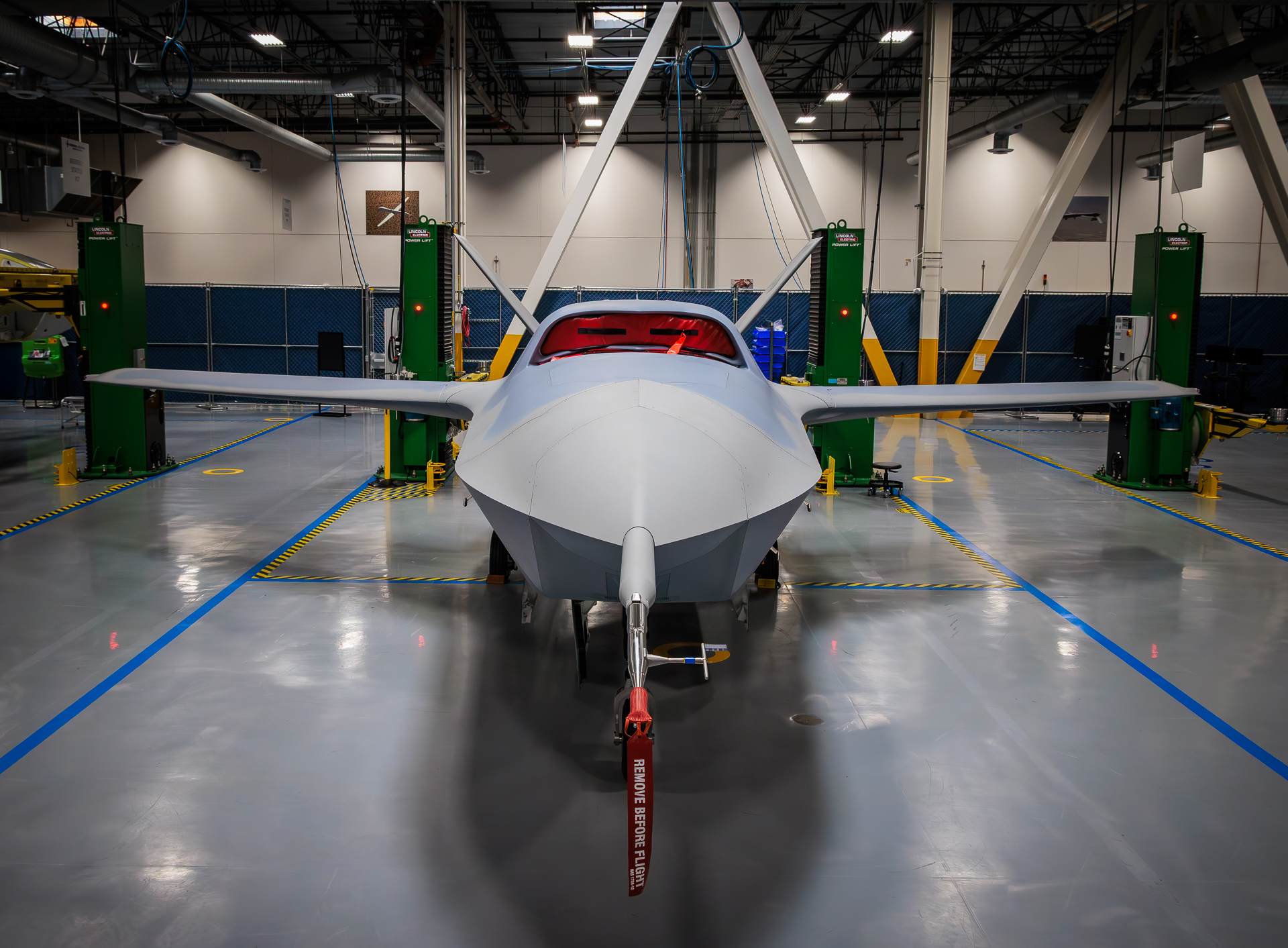
An advanced uncrewed fighter can pass flight tests and still face a more conventional constraint: how to build enough airframes without depending on one manufacturing path. General Atomics Aeronautical Systems announced on October 23 that Boeing-owned Spirit Defense will support production of the U.S. Air Force’s FQ-42 Vengeance.

The arrangement adds manufacturing capacity and reduces General Atomics’ reliance on its own factories for the aircraft’s airframe. Spirit Defense will serve as a fuselage design-build partner, supporting work from design through production. No production start date, output target, contract value or delivery schedule was disclosed, leaving the size and timing of Spirit’s contribution unresolved.
General Atomics won an Air Force contract in June to produce the FQ-42, a purpose-built uncrewed fighter intended to operate as a semi-autonomous partner to crewed aircraft. The company had manufactured its uncrewed-aircraft lineup by itself since its founding in 1992, including the MQ-9A Reaper, MQ-1C Gray Eagle, MQ-20 Avenger and MQ-9B SkyGuardian and SeaGuardian.
Bringing in Spirit Defense changes that long-standing production model. General Atomics President David R. Alexander said the additional capacity provides the “production resilience” the Air Force wants as it expands its Collaborative Combat Aircraft program.
More capacity does not automatically mean a second complete production line
Production resilience describes a program’s ability to continue building aircraft when one supplier, facility or process encounters a disruption. Adding another manufacturer can spread equipment, workforce and facility demands across a broader industrial base. It can also create another route for increasing output when demand grows faster than one company can accommodate internally.
Spirit Defense’s role reduces the risk associated with General Atomics remaining the only airframe manufacturer, but the available details do not show that every potential single point of failure has been removed. The FQ-42 still depends on engines, electronics, materials, software and other suppliers or processes that have not been identified in the announcement. Nor is it clear whether Spirit will build complete fuselages independently or share particular assemblies and production steps with General Atomics.
That boundary is important when judging the immediate production effect. General Atomics facilities have been described as tooled to build roughly six collaborative aircraft per month, but Spirit’s added rate has not been stated. The partnership therefore establishes industrial depth without yet providing enough information to calculate total monthly capacity.
Spirit Defense President and CEO Keith Schrader said the Boeing company would bring manufacturing expertise and established capabilities to the program. Spirit is headquartered in Wichita, Kansas, and provides engineering, design-build manufacturing and lifecycle support for defense programs. For the FQ-42, that experience is being applied specifically to the fuselage rather than presented as a takeover of the entire aircraft program.
Modularity extends beyond the factory
The FQ-42 uses a modular design intended to accelerate the integration of mission systems and autonomy software. General Atomics says its software architecture has already been demonstrated in live flights involving multiple airframes. In February, the company reported that a YFQ-42A completed a semi-autonomous mission using third-party software from Collins Aerospace, with a human operator sending commands from the ground for more than four hours.
That separation between aircraft and mission software reflects the Air Force’s wider effort to avoid locking the program into one supplier for every major element. Multiple companies have been selected to work on mission-autonomy software, while General Atomics and Anduril are producing competing aircraft for the first program increment.
The manufacturing partnership applies a similar principle to physical production: an aircraft designed for scalable deployment needs more than a successful prototype and adaptable software. It also needs tooling, skilled labor, quality controls and supplier capacity that can sustain repeatable output.
The Air Force has said it intends to have 500 combat-ready semi-autonomous systems by 2032 as part of an eventual 1,000-aircraft fleet. Meeting ambitions on that scale makes manufacturing architecture a program requirement rather than a background concern. Spirit Defense gives the FQ-42 a broader airframe-production base, but the first meaningful measure of that added resilience will be the production rate and delivery schedule that General Atomics and the Air Force have not yet released.
| More aerospace and engineering stories, right in your MSN feed. Follow AMI on MSN |
By Stephen Wallace — Editor for AMI’s aerospace integration and unmanned mobility coverage, focused on drone manufacturing, VTOL systems, autonomous networks, and air-ground mobility links.