Presidential Boeing 747-8 Makes Two White House Passes, Briefly Stops Reagan Traffic
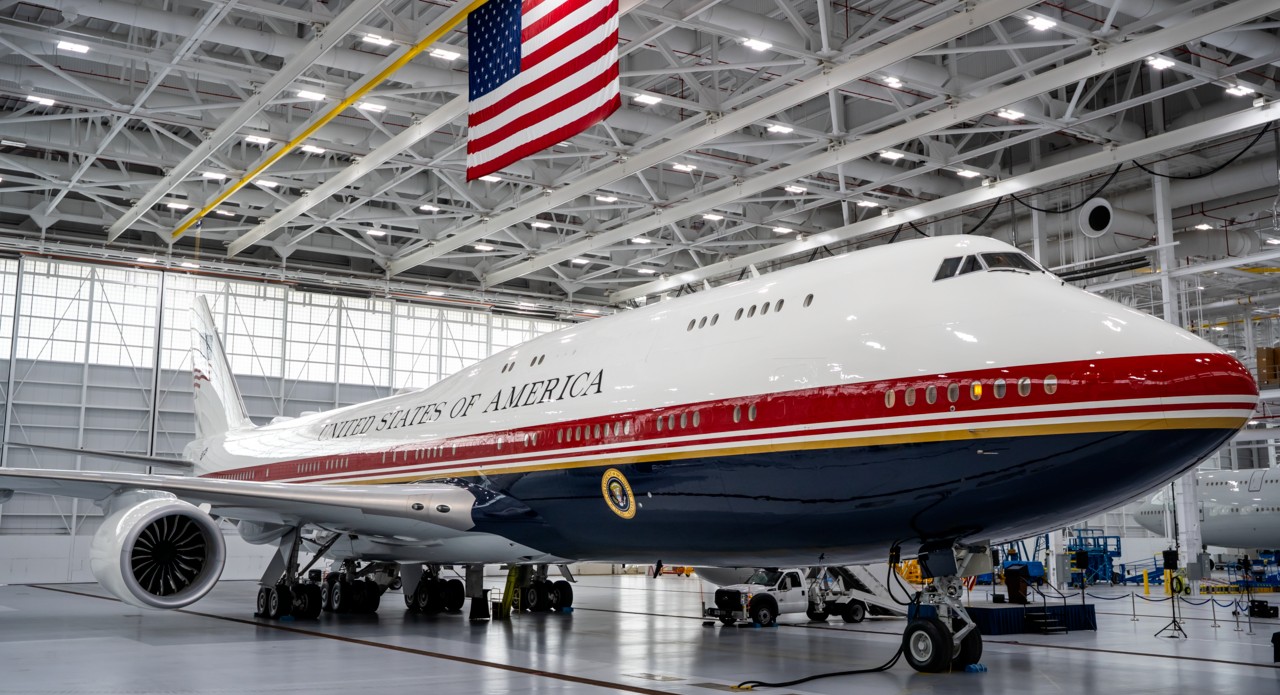
A Qatar-origin Boeing 747-8 serving as a bridge presidential aircraft made two passes over the White House on October 29, briefly stopping traffic at Ronald Reagan Washington National Airport. The coordinated flyover was part of a Halloween gathering expected to draw about 6,000 guests, but nearby residents received little time to distinguish the planned appearance from an unexpected low-flying aircraft.
An AlertDC notification announced a military flyover over the National Mall only 21 minutes before the first recorded pass. The 747 approached from the south and returned in the opposite direction about two minutes later, according to flight-tracking information cited by The Washington Post. The Federal Aviation Administration confirmed that the operation had been coordinated with the agency and that Reagan National received a brief ground stop to accommodate it.
The airport interruption illustrates the operational cost of putting an unusually large aircraft into tightly controlled capital-area airspace. A ground stop keeps affected flights on the ground rather than adding airborne traffic to an area that temporarily cannot accept normal movements. Even a short restriction can disturb departure and arrival sequencing, although no authoritative total for affected flights was provided with the FAA confirmation.
Washington flyovers require substantially more coordination than an ordinary airport movement. The capital contains some of the country’s most restricted airspace, including the 15-mile-radius Flight Restricted Zone. For comparison, a 2024 general-aviation procession over the National Mall involved months of preparation and permission from 11 government agencies. The District of Columbia National Guard’s public guidance also says aerial-event requests require FAA approval, reflecting how ceremonial flights must be integrated with security restrictions and civil traffic.
The aircraft itself made the October appearance difficult to miss. A Boeing 747-8 is approximately 250 feet long with a 224-foot wingspan. Its span is nearly 29 feet greater than that of the current VC-25A presidential aircraft, giving observers below a broader and more visually imposing silhouette than the familiar presidential 747.
Four General Electric GEnx-2B67B turbofan engines add to that presence. Each engine is rated at 66,500 pounds of takeoff thrust, for a combined rated total of 266,000 pounds. That figure is not the thrust produced during the passes; actual output would have varied with throttle setting and operating conditions. It does, however, indicate the scale of the propulsion system moving through an urban soundscape.
Each GEnx engine has a fan about 104.7 inches in diameter. The engine family incorporates carbon-fiber composite fan blades and combustion technology intended to improve efficiency while reducing noise and emissions. Those measures cannot make a four-engine widebody inconspicuous during a ceremonial pass. Perceived sound depends on factors including power, altitude, aircraft direction and the observer’s position, while the sheer fan area and number of engines distinguish the 747-8 from most aircraft routinely seen around Washington.
Some observers described the jet as appearing extremely low, including one estimate of no more than 100 feet. That was an eyewitness impression, not an official altitude measurement. Flight-tracking data placed the aircraft between roughly 400 and 1,000 feet while it was over Washington. Another observer reported being able to read “USAF” beneath a wing, an indication of apparent proximity rather than a verified measure of altitude.
The aircraft had already appeared over Washington during July 4 celebrations, so the October operation was not its first ceremonial use above the capital. Large 747 flyovers also have precedent: a modified 747 carrying Space Shuttle Discovery crossed the Washington area at approximately 1,500 feet in April 2012.
What set the Halloween passes apart was the combination of a very large four-engine aircraft, two rapid crossings and a short public-warning window. Air traffic coordination was completed, but public notification arrived only minutes before the first pass. In highly restricted airspace, technical authorization can make a flyover orderly for controllers while still leaving people beneath it surprised and requiring Reagan National to pause normal traffic until the 747 had cleared the event.
| More aerospace and engineering stories, right in your MSN feed. Follow AMI on MSN |
By David Whitaker — Associate editor for AMI’s aerospace and drone systems desk, translating flight systems, aircraft programs, spaceflight, and UAV developments into accessible technical stories.