

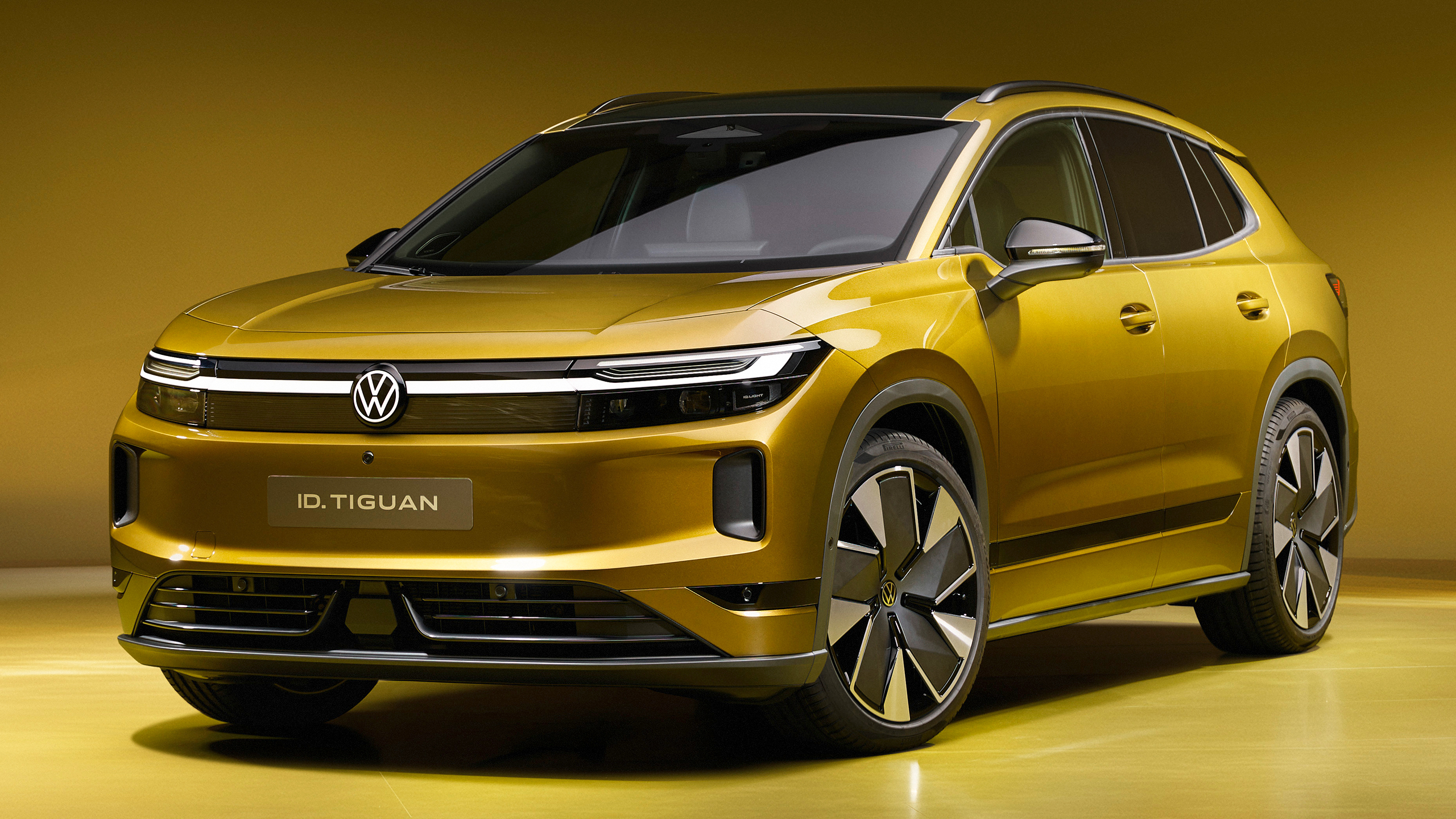
Volkswagen ID. Tiguan Replaces ID.4 With Physical Controls, 373-Mile Claimed Range
Volkswagen is replacing the ID.4 and Europe’s ID.5 with a more conventional electric SUV and reversing course on some touch-sensitive cabin controls. Scheduled for a European launch in early 2027, the Volkswagen ID. Tiguan combines physical climate and steering-wheel controls with three powertrains and up to 373 miles, or 600 kilometers, of preliminary WLTP range.
The change is broader than a new model name. Where the ID.4 and ID.5 used softer crossover shapes, the ID. Tiguan adopts a more upright SUV body and conventional pull-style exterior door handles. Volkswagen is effectively bringing its electric and combustion-powered SUV lines under the familiar Tiguan identity, although gasoline, diesel and hybrid Tiguan models will continue alongside the electric version.
Three powertrains, two battery sizes
Volkswagen has specified three European powertrain configurations. The entry version pairs a 58.0-kilowatt-hour battery with a 188-horsepower rear-wheel-drive system. A larger 77.0-kWh battery supports either a 281-hp rear-wheel-drive configuration or a 295-hp all-wheel-drive version.
The claimed maximum range of 373 miles applies under Europe’s Worldwide Harmonized Light Vehicles Test Procedure and depends on configuration. It is not a US Environmental Protection Agency estimate, and actual range will vary with speed, temperature, equipment, passenger load, terrain and battery condition. The number therefore describes the most range-favorable European configuration rather than a guaranteed driving distance or a directly comparable US rating.
Towing capacity also changes with battery selection. Volkswagen lists up to 3,968 pounds for the 58.0-kWh model and 4,409 pounds for both 77.0-kWh versions. Those figures make the larger-battery models more capable on paper, while all configurations retain the packaging and mass tradeoffs inherent in using the battery for both propulsion and sustained towing.
Physical controls return, but screens remain prominent
The interior represents a clear response to criticism of screen-dependent vehicle controls. Basic climate functions move to a physical button bar, while the multifunction steering wheel replaces touch-sensitive inputs with buttons. An illuminated center-console controller handles volume and track or station selection.
This is not a retreat from displays. The dashboard includes a 10.0-inch driver screen and a 15.0-inch central infotainment screen. An optional 12.0-inch passenger display described as a first for a European Volkswagen uses a privacy mode intended to keep its content outside the driver’s view.
The mixed approach reflects a wider human-factors shift. Euro NCAP’s 2026 testing protocols reward direct physical inputs for essential functions because well-positioned buttons and switches can reduce the distraction associated with navigating touchscreen menus. The ID. Tiguan’s climate and steering-wheel changes do not establish a safety rating for the vehicle, but they align its interface more closely with that direction.
More utility, with market details still open
Practical additions include a 1.1-cubic-foot front trunk and as much as 18.9 cubic feet of cargo space behind the rear seats. Vehicle-to-load capability can power external electrical devices through an adapter connected to the charging port. Standard one-pedal driving allows strong deceleration through accelerator-pedal operation.
An available system called Connected Travel Assist supports assisted highway lane changes and recognizes traffic lights. Volkswagen says the system can stop the vehicle at red lights within its operating limits; the driver remains responsible for supervising it.
European buyers will see Trend, Life, Style and R-Line trims. Volkswagen lists German pricing from €42,695, with presales dated from October 13 in Germany and several other European countries.
North America remains a separate product decision. Volkswagen says the ID. Tiguan is planned to succeed the ID.4 there, but it has not announced timing, prices, charging specifications or the regional powertrain lineup. Those details will determine whether American buyers receive the same batteries and claimed capability or simply the same more conventional name, body and control philosophy.
| More aerospace and engineering stories, right in your MSN feed. Follow AMI on MSN |
By Thomas Caldwell — AMI’s senior editor for mechanical and mobility engineering, covering vehicle electronics, systems integration, electrification, chassis systems, propulsion, and safety policy.