California Approves $772.1 Million Siemens Package for Three High-Speed Trains
California has approved a $772.1 million Siemens Mobility package for three seven-car high-speed trains, associated testing and certification, and 10 years of fleet support. The California High-Speed Rail Authority board voted unanimously on October 28, committing substantial public funding to an initial fleet of just 21 cars. Up to $63.7 million for import duties sits outside the contract, potentially raising the combined commitment to $835.8 million.
The largest point of clarification is that $772.1 million is not the price of the trains alone. The rolling-stock hardware accounts for $281.7 million, or an average of approximately $93.9 million per trainset and $13.4 million per car. Published contract reporting assigns about $284.1 million to 10 years of full maintenance and $206.3 million to escalation, taxes and other charges, including testing and certification. Earlier procurement figures described the support allocation as $281.1 million, but the approved-contract breakdown reports $284.1 million.
Why the per-car figure needs boundaries
The $13.4 million hardware average is useful because it separates the physical fleet from long-term services and risk allowances. It is not, however, a complete measure of value or a clean basis for ranking international train orders. California is buying only three trainsets in its initial order, limiting the opportunity to spread design, engineering and certification expenses across a larger fleet.
One published comparison calculated that the California hardware price per car is 2.85 times the figure derived from Deutsche Bahn’s 2023 purchase of 17 eight-car Velaro MS trains. That German contract covered 136 cars rather than 21 and specified trains with a 320-kilometer-per-hour design speed, compared with 350 kilometers per hour for California’s AP220. The California figure was also calculated at 86% above a cited $7.2 million average for Russia’s developing EVS360.
Those gaps merit scrutiny, but they do not establish that California is paying 2.85 times as much for equivalent equipment. Order quantity, train configuration, currency conversion, safety requirements, included engineering and the maturity of each design can materially change a per-car result. The proposed option price illustrates the scale effect: as many as 19 additional AP220 trainsets could be ordered for $62.1 million each, or about $8.9 million per car roughly one-third below the initial fleet’s hardware average.
The package buys integration, not only vehicles
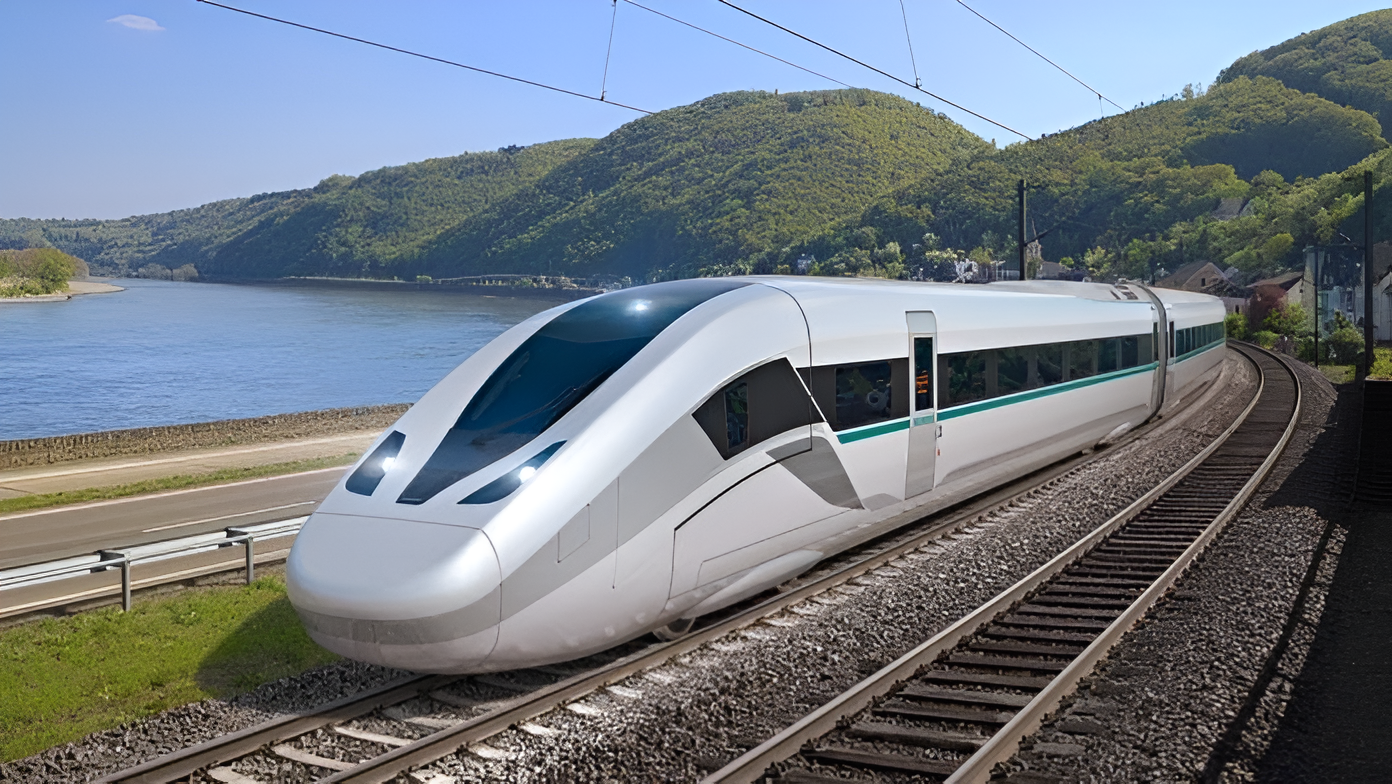
The American Pioneer AP220 is planned as a seven-car electric multiple unit based on Siemens’ Velaro Novo platform. Distributed traction places powered equipment across the train rather than concentrating propulsion in a locomotive. The planned specification also includes an aluminum carbody, regenerative braking, more efficient motors, batteries for emergency movement and essential functions, and underfloor covers intended to protect equipment from ballast thrown up at speed.
California’s trains must also satisfy federal safety requirements for high-speed passenger equipment. Testing and certification therefore connect the vehicles to the track, electrical supply, signaling, operating procedures and maintenance system. For an inaugural fleet on a new railway, that integration work is a material part of the procurement rather than an optional accessory. It also helps explain why comparing only the number of cars can obscure what the public agency is purchasing.
The 10-year support term covers maintenance, spare parts and staff training, with possible five-year extensions that could take support to 30 years. That structure transfers some early fleet-support responsibility to the manufacturer, but it also means a large portion of the initial commitment pays for availability, technical knowledge and parts coverage over time. Assessing fairness will ultimately require performance requirements and service outcomes, not simply dividing the total contract by three trains.
Imported components create a separate cost exposure
The three initial trains are expected to be built in Germany. The Federal Railroad Administration previously issued California a Buy America nonavailability waiver for specified high-speed-rail products, including aluminum car shells, after finding that qualifying domestic sources were unavailable. The waiver did not remove domestic-content rules for the project’s construction materials, and the authority estimated that more than 98% of direct project expenditures would still go to domestically sourced products and labor.
The separate $63.7 million duty reserve is therefore important to the full public-cost picture. It is outside the approved $772.1 million contract and is an allowance rather than part of the $281.7 million hardware value. Published commentary has linked it to tariffs introduced in 2025, but the available contract reporting does not conclusively establish the reserve’s precise policy basis.
Design and schedule development can now proceed following board approval. The first trains are expected to reach California for dynamic testing around 2030, while the procurement roadmap places acceptance in the third quarter of 2032 and passenger service on the initial Merced-to-Bakersfield route in 2033. The long interval means California’s $835.8 million potential commitment will be judged not only by three delivered trains, but by whether the certification, training, maintenance and system-integration spending produces a fleet ready when the railway is.
| More aerospace and engineering stories, right in your MSN feed. Follow AMI on MSN |
By Thomas Caldwell — AMI’s senior editor for mechanical and mobility engineering, covering vehicle electronics, systems integration, electrification, chassis systems, propulsion, and safety policy.