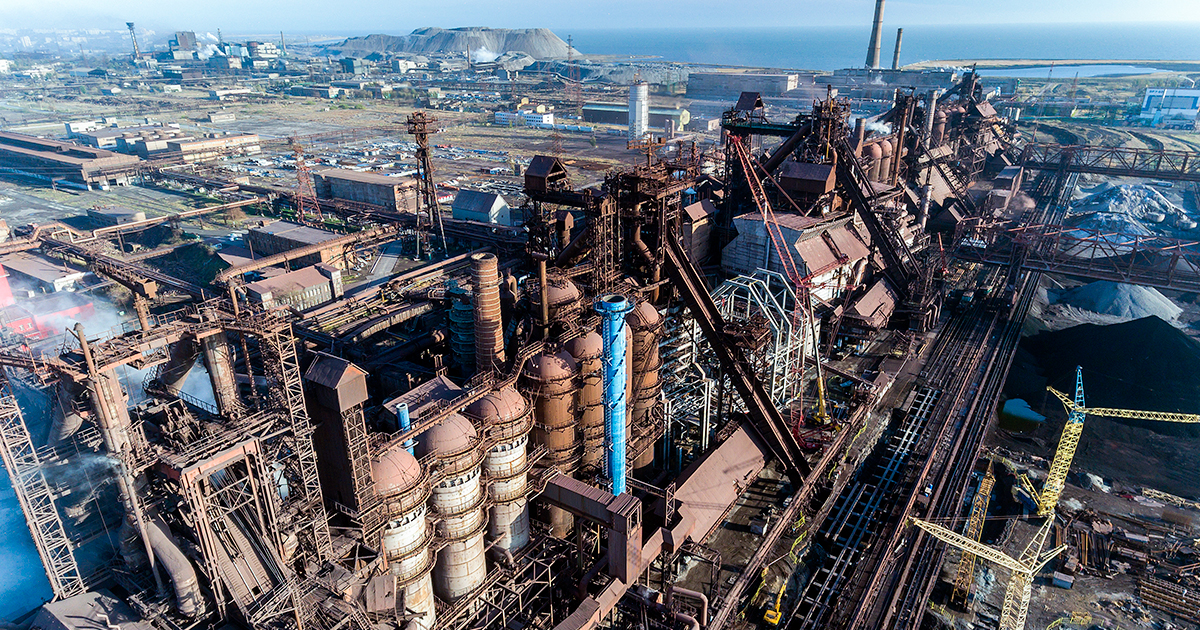
Russian Strikes Close Kamet Steel as Black Sea Port Arrivals Plunge 90%
Ukraine’s industrial economy is being squeezed at two critical transfer points: the factories that turn raw materials into exportable products and the ports that move those products to customers. Kamet Steel, a major complex in Kamianske that produced more than a quarter of the country’s steel in 2025, remains closed after five ballistic missiles struck the site on September 5. At the same time, only 21 ships arrived at Ukraine’s Black Sea ports in August, about 90% fewer than a year earlier, according to Lloyd’s List Intelligence.
The immediate losses are steel production and vessel capacity, but the effects propagate through a much larger system. Kamet Steel employed thousands of people producing steel and pig iron for domestic construction. It also supplied semi-finished material to a Metinvest facility in Bulgaria serving European markets. Metinvest says strikes have stopped its steel production, while other major Ukrainian producers have also halted operations.
A steel mill cannot necessarily continue operating simply because some furnaces or rolling equipment remain intact. Power loss or damage to critical supporting infrastructure can require the entire complex to stop while engineers assess equipment, environmental and worker-safety risks. Metinvest CEO Yuriy Ryzhenkov said the company was clearing debris and evaluating whether its facilities could be restarted safely.
That shutdown reaches beyond the plant gate. Kamet Steel CEO Oleksandr Tretyakov identified construction, mining, engineering, energy and logistics among the affected sectors. Mines lose a major customer, construction firms lose domestic material, and railways lose bulk freight. European rolling operations supplied with Ukrainian semi-finished steel must also operate without their normal vertically integrated feedstock.
Rail is particularly exposed because heavy commodities historically formed a large portion of Ukrainian freight. Before the full-scale invasion, rail handled 60% to 75% of the country’s cargo turnover and supported grain, steel and construction-material exports, according to the OECD’s 2026 infrastructure review. When steel output stops, the railway loses traffic and revenue at the same time that it faces substantial repair and investment requirements.
River routes cannot replace deep-water ports ton for ton
Agriculture faces a different constraint with a similar result. It generates up to 60% of Ukraine’s foreign-currency earnings, but sharply reduced Black Sea traffic has pushed more cargo toward the lower-capacity Danube network. That diversion keeps some exports moving, although river dimensions, water levels and port capacity impose firm limits.
The Sulina Channel is too shallow for the largest vessels, and ships can wait days to enter or leave the Danube. Drought has further reduced available depth. Volodymyr Scavinskyi, trade director at agricultural exporter Nibulon, said a typical barge load has fallen from 1,500 tons to between 800 and 900 tons. Each trip therefore carries roughly 40% to 47% less cargo while many voyage-related costs remain.
The resulting price penalty is substantial. Scavinskyi said moving one ton of corn from central Ukraine to Spain could cost as much as $150, compared with as much as $50 earlier in 2026. HarvEast commercial director Olena Shelest said the Danube ports of Reni and Izmail can handle only about 15% to 20% of Ukraine’s overall export volumes. About 60% of HarvEast’s sales previously traveled through Black Sea ports.
Lower crop prices compound the transport problem. Shelest put corn at around $130 per ton, down from an average of $210 to $230 last year. HarvEast is storing wheat in silo bags while waiting for prices to stabilize, but it needs to sell by year’s end to finance another planting season. If export revenue remains constrained, lower spending on seed and fertilizer could reduce future yields, extending a logistics disruption into the next production cycle.
Industrial losses are reaching the national budget
The combined pressure is now visible in Ukraine’s economic forecasts. The central bank expects the economy to contract 0.4% in 2026, reversing its previous projection of 1.8% growth, and raised its inflation forecast from 10% to 12.5%. Its assessment linked weaker performance to attacks on production and logistics as well as disruption at seaports.
The fiscal margin is narrow because Ukraine already spends about 40% of gross domestic product on defense. Roksolana Pidlasa, head of parliament’s budget committee, put the 2026 funding gap at just under $25 billion and warned that failure to cover it would threaten salaries for teachers and doctors, pensions and hospital operations.
Restoring output therefore requires more than repairing isolated equipment. Steel plants need safe power and infrastructure, railways need paying freight, farms need affordable access to ships, and Danube ports need enough depth and handling capacity to carry larger loads. Until those links recover, the closure of a plant responsible for more than a quarter of Ukraine’s 2025 steel and a roughly 90% fall in Black Sea port arrivals will continue to constrain revenue far beyond the factory and waterfront.
| More aerospace and engineering stories, right in your MSN feed. Follow AMI on MSN |
By Thomas Caldwell — AMI’s senior editor for mechanical and mobility engineering, covering vehicle electronics, systems integration, electrification, chassis systems, propulsion, and safety policy.