White House Completes Marine One Heliport to Protect South Lawn Grass
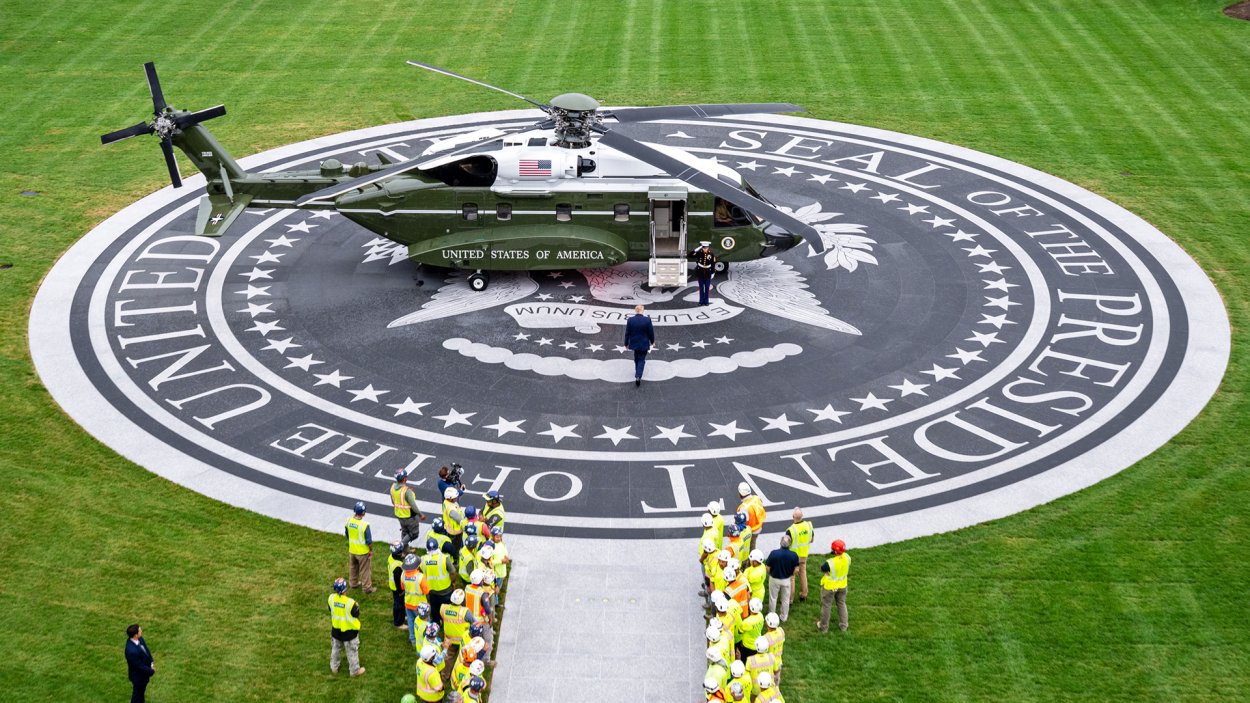
The White House has presented a permanent Marine One heliport on the South Lawn as complete, turning a reported plan to protect the grass from newer presidential helicopters into finished aviation infrastructure. The landing surface was shown alongside a restored south facade and new South Entrance.
Reports of the project first emerged in May, when the permanent surface was described as a way to help prevent newer Marine One helicopters from scorching the lawn. That purpose gives the project an unusual engineering constraint: accommodating repeated rotorcraft operations while limiting damage to the landscape of one of the country’s most recognizable historic properties.
The completion formed part of a broader announcement about restoration of the White House exterior. President Donald Trump said the north and south facades had accumulated wear and damage and that missing or deteriorated walls and ornamentation had been restored. He said the work would give the building “many decades of additional life.”
Construction of the heliport was visibly underway by August, when Trump toured the site and signed a granite slab. He said his signature and those of project leaders would be placed on the back of the eagle in the U.S. seal, leaving the inscriptions concealed after the work was finished.
A permanent answer to a recurring surface problem
Helicopter operations concentrate heat, exhaust flow and rotor-driven air over a relatively small area. A permanent landing surface can separate those recurring loads from turf, reducing direct exposure of the grass and providing a defined operating area. In this case, however, no measurements have been released showing the temperature, exhaust conditions or extent of the reported scorching associated with the newer aircraft.
Other important design details also remain undocumented. The available information does not identify the heliport’s materials, dimensions, drainage provisions, load criteria, contractor or construction cost. It also does not explain whether the surface incorporates any specialized thermal-management treatment or relies primarily on replacing exposed grass with a durable hard surface.
Those omissions limit any assessment of how the heliport balances aircraft operations with preservation of the South Lawn. Drainage, surface durability and maintenance access are consequential at a site that must function as both an operating presidential facility and a historic landscape. Without drawings, specifications or performance data, the confirmed engineering result is narrower: a permanent landing area planned in response to reported lawn damage has now been completed.
Construction also affected where Marine One operated
The return to permanent White House infrastructure follows a period in which construction shifted presidential helicopter departures to a temporary location at the Ellipse. That temporary arrangement became relevant to a separate aviation-safety issue involving communications with Ronald Reagan Washington National Airport.
Preliminary findings described by WJLA said an air-traffic-control transmitter lacked the required line of sight while Marine One was operating from the Ellipse. The transmitter was subsequently relocated, and a new procedure provides controllers with advance notice when the president is walking toward Marine One. The helicopter crew’s existing three-minute warning before departure remains part of the process.
The heliport completion and the revised notification procedure address different system boundaries. One concerns the physical interface between a helicopter and a historic lawn; the other concerns coordination between presidential flights and nearby commercial traffic. Together, they illustrate how even a short helicopter movement from the White House depends on ground infrastructure, radio coverage and procedural coordination operating as one system.
The White House also discussed a separate ballroom and “Military Complex” project, describing it as on schedule and within budget, but no supporting figures were provided. For the aviation work, the concrete milestone is already visible: Marine One operations now have a completed permanent South Lawn surface intended to keep newer presidential helicopters from scorching the grass.
| More aerospace and engineering stories, right in your MSN feed. Follow AMI on MSN |
By Thomas Caldwell — AMI’s senior editor for mechanical and mobility engineering, covering vehicle electronics, systems integration, electrification, chassis systems, propulsion, and safety policy.