Satellite Images Show Badly Damaged Su-57 in Russia’s 21-Jet Fleet
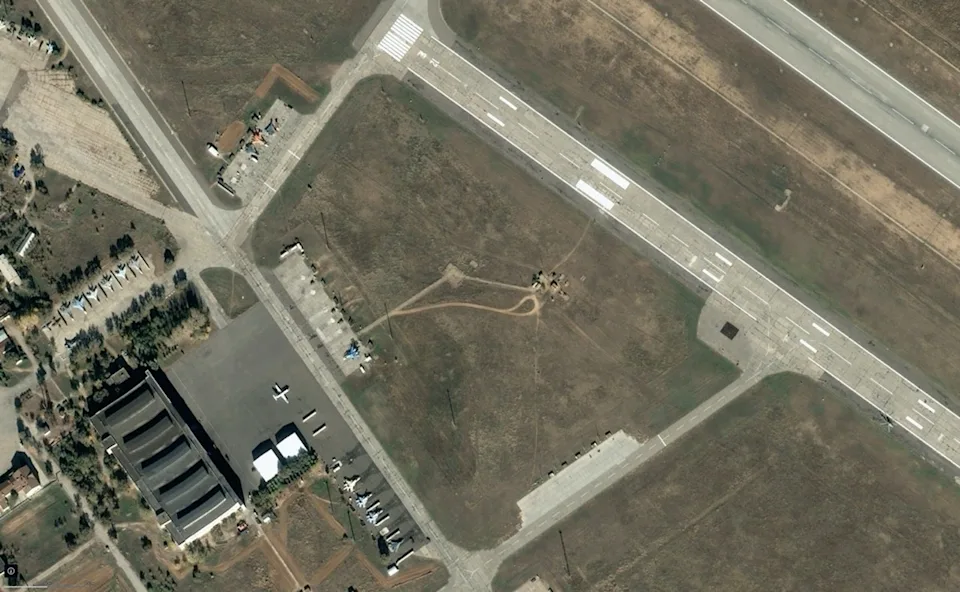
A heavily damaged Russian Su-57 fighter appears on scorched ground in commercial satellite imagery from Akhtubinsk airfield, potentially sidelining or removing one aircraft from a fleet estimated at only about 21 operational jets. The imagery establishes visible damage to a scarce aircraft, but it does not establish how the damage occurred.
Ukraine’s GUR military intelligence agency said the Su-57 “exploded” on October 29 while its engines were starting at the airfield in Russia’s Astrakhan region. Russia’s Defense Ministry did not respond to a request for comment reported by Newsweek, and the explosion account has not been independently confirmed.
What changed between the images
The clearest evidence comes from the change over two days. Satellite imagery dated October 28 shows two Su-57s and an older fighter parked on an apron. In imagery from two days later, that apron is empty, while a heavily damaged Su-57 can be seen nearby in a patch of scorched earth.
That sequence supports a narrow but consequential conclusion: at least one Su-57 suffered serious visible damage at Akhtubinsk. It does not show the initiating event, identify a failed component or determine whether the aircraft can eventually be repaired. Assessing internal structural, engine or systems damage from an overhead commercial image would require more information than the imagery provides.
The status of the second Su-57 is also unknown. No account provided here explains where it went after appearing on the apron on October 28. Its absence from the later image is therefore an unresolved part of the timeline, rather than evidence that it was damaged as well.
The engine-start claim remains unverified
GUR also said Su-57 engines can “explode or undergo catastrophic destruction” when supplied with low-quality jet fuel. The agency did not directly identify poor-quality fuel as the cause of this incident, however. No publicly established finding connects fuel, maintenance, an engine defect or an external event to the burned aircraft.
That leaves a substantial gap between the physical result visible from orbit and the claimed mechanism. Investigators would ordinarily need aircraft records, debris inspection, engine data and accounts from personnel to distinguish among possible causes. None of those findings has been made public in the information available here.
Why one aircraft carries unusual weight
The Su-57 is a twin-engine supersonic fighter that Russia presents as its most sophisticated and difficult-to-detect combat aircraft, positioned as a rival to the U.S. F-35 and F-22. Some Western aviation experts dispute whether its stealth characteristics are sufficient to place it firmly in the fifth-generation category, but there is less ambiguity about the fleet’s limited scale.
The International Institute for Strategic Studies estimated that Russia had approximately 21 operational Su-57s at the start of 2026. At that fleet size, one aircraft represents close to 5% of the operational inventory. With each Su-57 estimated to cost roughly $150 million, a write-off would also represent a substantial material loss, although the imagery alone cannot determine whether this airframe is beyond repair.
Small fleets face consequences beyond the loss of a single aircraft. Each unavailable airframe can reduce the pool available for missions, testing, training or maintenance rotation. Russia has used Su-57s for long-range strikes against Ukraine while generally keeping them beyond Ukrainian air defenses, making fleet availability relevant even when the aircraft are not operating near the front lines.
Russia said in September that its air force had received several upgraded two-seat Su-57s featuring what the Defense Ministry called a “new technical design,” without detailing the changes. Those deliveries may expand or alter the fleet, but they do not resolve the condition of the burned aircraft at Akhtubinsk.
The next decisive facts would be an official Russian account, a documented cause and a determination of whether the damaged Su-57 can return to service. Until then, the images show one badly damaged fighter in a very small fleet and leave the location and condition of the second Su-57 unexplained.
| More aerospace and engineering stories, right in your MSN feed. Follow AMI on MSN |
By David Whitaker — Associate editor for AMI’s aerospace and drone systems desk, translating flight systems, aircraft programs, spaceflight, and UAV developments into accessible technical stories.