SpaceX Catches Starship After 14 Orbits but Loses Its Booster
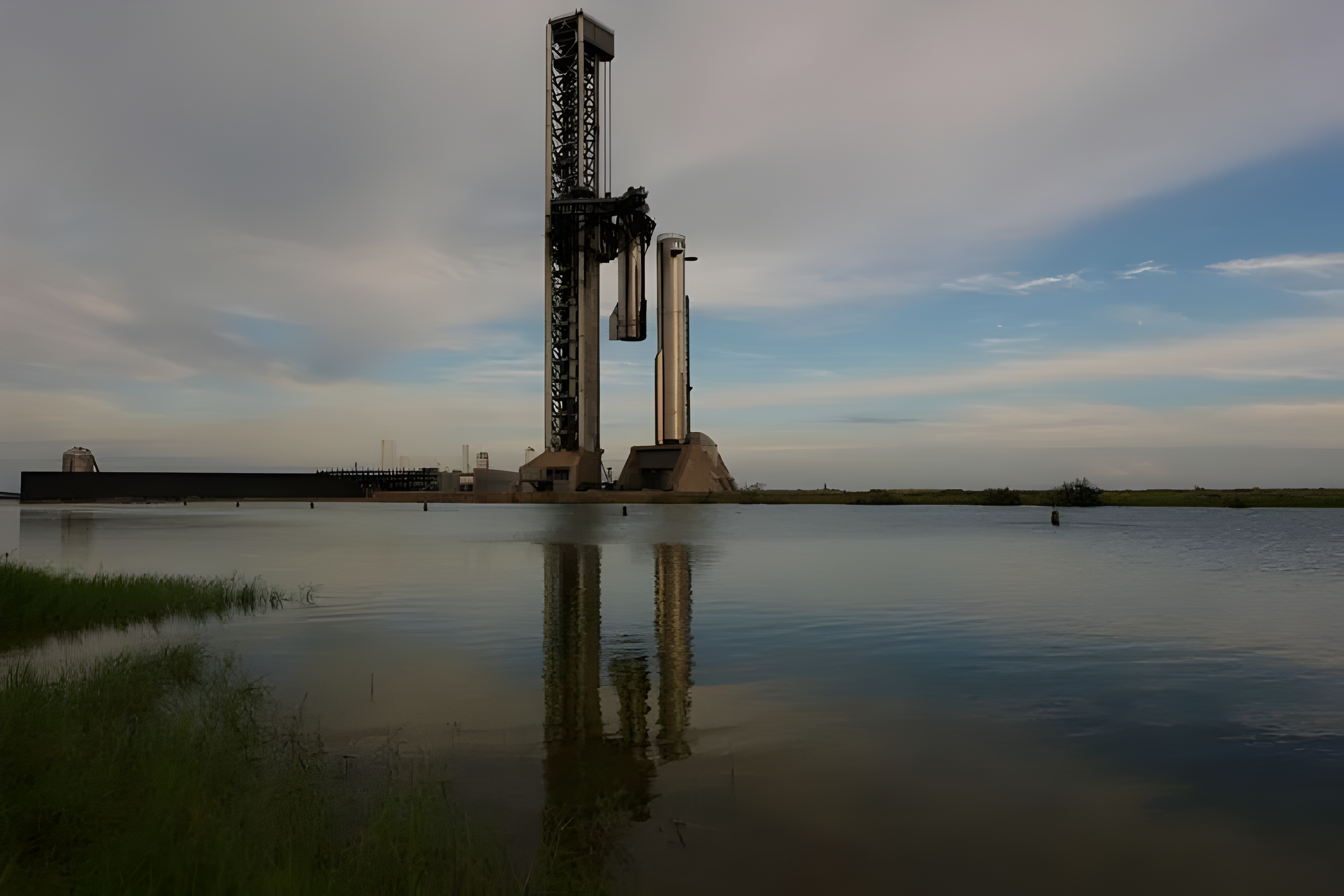
SpaceX has now caught both halves of its giant rocket system but not during the same flight. On Saturday, November 14, the company recovered a Starship upper stage at its Starbase launch tower in Boca Chica, Texas, for the first time, completing a 22.5-hour Flight 15 mission that included 14 Earth orbits. The Super Heavy booster, however, aborted its own return and exploded shortly before reaching the Gulf of Mexico.
That split outcome captures where the program stands. Catching an orbital spacecraft directly at its launch site demonstrated a central part of SpaceX’s reuse strategy. Losing the booster means the company still has not recovered both stages on one mission, the more complete test of whether Starship can become a routinely reusable transportation system.
Flight 15 lifted off at 4:47 p.m. Central on Friday. Super Heavy separated from Starship about two minutes later, but its boost-back burn ended early. SpaceX director Kate Tice said initial indications pointed to a low fuel mass alarm, adding that engineers were still investigating the root cause.
According to Tice, the booster autonomously followed its safety protocols and protected the launch pad rather than continuing an unsuitable tower approach. It descended toward the Gulf and exploded before splashdown. Starship continued the mission and deployed 26 V3 Starlink satellites.
Starship returned to the tower instead of the ocean
After its 14 orbits, the ship restarted one of its six Raptor engines for a 10-second reentry burn at about 2:20 p.m. Central. Its windward side entered the atmosphere behind approximately 18,000 hexagonal ceramic heat-shield tiles, which protect the stainless-steel vehicle from reentry heating.
Starship approached Starbase over the Gulf, initially descending in the horizontal “belly-flop” attitude used to manage speed and position. Near the tower, it fired its engines, rotated upright and lowered itself between the launch tower’s chopstick-like mechanical arms. The ship came to rest in the Mechazilla structure at 3:29 p.m. Central.
“We caught a Starship and now everything changes,” SpaceX’s Dan Huot said at the conclusion of the mission broadcast. The catch was unquestionably a new recovery capability for the program, but the next engineering question is what condition the spacecraft was in after landing and how much work it will require before it can fly again.
A catch alone does not deliver rapid reuse
A tower recovery eliminates landing legs on the spacecraft and returns the vehicle directly to launch infrastructure. In principle, that could reduce hardware mass and avoid the transport operation required after a distant landing. The design also concentrates recovery duties in the tower, which must position its arms around a descending vehicle and support it after engine shutdown.
Rapid reuse requires more than reaching those arms. SpaceX is studying and modifying Starship’s 18,000 heat-shield tiles in hopes that they will not need replacement between flights. Tile condition is especially consequential because the shield covers a large area with thousands of individual components, each exposed to thermal and mechanical loads during ascent and reentry.
SpaceX’s ultimate goal is to immediately land the rocket and launch it again, just like an airplane, Tice said. Flight 15 demonstrated the landing and catch portion of that objective. It did not demonstrate immediate relaunch, minimal refurbishment or simultaneous recovery of the booster and ship.
The distinction is visible in SpaceX’s existing Falcon 9 architecture. Falcon 9 recovers its first stage, but the upper stage that places payloads into orbit is discarded. Starship is intended to extend recovery to the orbital stage as well, a much harder task because that spacecraft must survive reentry before returning to the launch site. SpaceX plans eventually to retire Falcon 9 and use Starship to support further expansion of the Starlink constellation.
NASA also has a direct stake in the vehicle’s progress. The agency has awarded SpaceX $2.9 billion in contracts for lunar-lander variants supporting Artemis crewed missions. NASA currently plans Artemis III as a two-week demonstration in low Earth orbit, including docking tests involving Orion and test versions of SpaceX’s Starship and Blue Origin’s Blue Moon landers.
Flight 15 therefore closed one major recovery gap while leaving another in plain view. Starship returned from 14 orbits, deployed its satellites and reached the tower arms; Super Heavy’s low-fuel alarm ended the attempt to bring the entire two-stage system home together.
| More aerospace and engineering stories, right in your MSN feed. Follow AMI on MSN |
By David Whitaker — Associate editor for AMI’s aerospace and drone systems desk, translating flight systems, aircraft programs, spaceflight, and UAV developments into accessible technical stories.