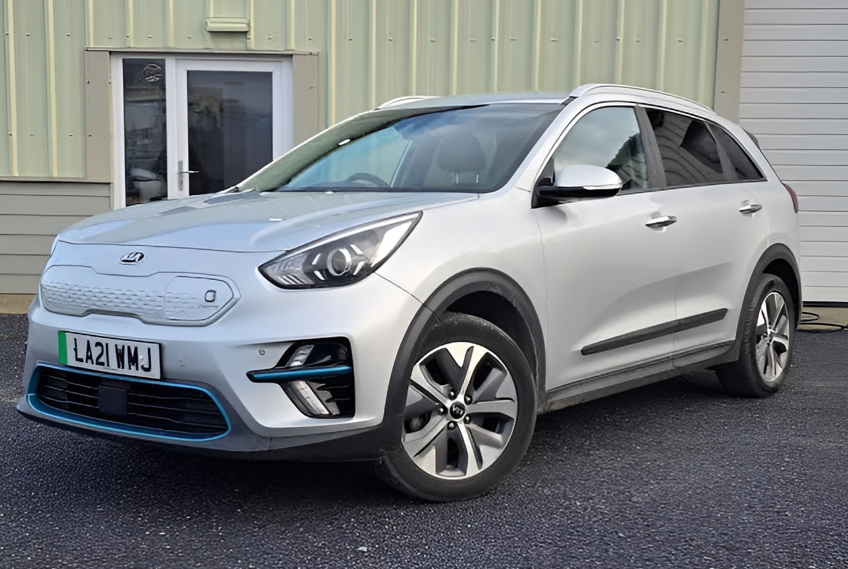
265,000-Mile Kia Niro EV Reports 100% Battery Health, but Reserve Can Hide Degradation
A 2021 Kia Niro EV with more than 265,000 miles recorded a stored battery state of health reading of 100% in two separate assessments. Yet that apparently perfect score can coexist with some capacity loss because the battery-management system calculates health against the pack’s usable capacity rather than all of its original gross capacity.
The former taxi was purchased unseen at auction for £4,100 ($5,429), including fees. After using it for several months, owner Alex said it “still drives remarkably well” and reported achieving 250 to 260 miles per charge. Those owner-reported figures are encouraging for a car with this mileage, although they are not a controlled range test and will vary with speed, weather, cabin heating and other operating conditions.
Why 100% does not necessarily mean no degradation
An initial diagnostic scan performed with the Car Scanner app and a Bluetooth adapter returned the 100% health figure. A professional Vault Test assessment subsequently retrieved the same stored value and found very well-balanced cell voltages.
The key is the reference point behind the percentage. Figures cited during the assessments put the pack at 67.5 kilowatt-hours of gross capacity and 64 kilowatt-hours of advertised usable capacity. Kia’s official 2021 Niro EV specifications list battery energy at 64 kilowatt-hours.
Vault Test representatives explained that the stored health calculation uses 64 kilowatt-hours as its reference. The difference between gross and usable capacity gives the control system room to protect the cells at the upper and lower charge limits. It also means some capacity above the 64-kilowatt-hour reference can disappear before the displayed state of health drops below 100%.
That reserve is useful engineering, not a defect in itself. Lithium-ion packs generally avoid operating at their absolute electrochemical limits because those extremes can accelerate wear and leave less margin for safe control. The consequence for diagnostics is that a rounded or capped 100% reading is not equivalent to a direct measurement showing that every original kilowatt-hour remains available.
Cell balance and charging history add context
The well-balanced cell voltages are another favorable result. Large voltage differences can indicate that parts of a pack are behaving differently, limiting how fully the battery can charge or discharge. Good balance does not quantify total remaining capacity, but it shows that the cell groups were operating consistently during the assessment.
The car’s stored records provided unusually extensive operating context: 22,757 hours and 1,955 charging sessions, including 402 rapid-charging sessions. About 88% of the recorded charging energy came from lower-powered charging. Alex also noted that the Kia uses active battery cooling.
Those details matter because battery aging depends on more than mileage or the number of rapid charges. Charging power, cell temperature, time spent at high or low charge, operating load and calendar age interact. Research associated with the National Renewable Energy Laboratory found that higher-current charging can increase battery temperature and that thermal management is needed to prevent high-temperature excursions. A simple rapid-charge count therefore cannot establish how much degradation occurred in this Kia.
Range adds another piece of evidence, but it also needs context. The owner’s reported 250 to 260-mile results compare favorably with Kia’s original specification of 239 miles. Driving conditions and measurement methods prevent that comparison from proving the pack exceeds its original usable capacity. It does, however, suggest that the car continued to provide substantial practical range at the time described.
The battery is only one part of a high-mileage EV
The Kia was not free of mechanical concerns. Noise associated with the motor and reduction-gear bearings remained unresolved, while the car had already undergone servicing, an inspection and repairs that included a replacement reversing camera. Electric vehicles eliminate many combustion-engine components, but they still rely on bearings, gears, cooling hardware, suspension parts, brakes and electronic systems that accumulate wear.
The mileage also sits far beyond Kia’s current advertised 10-year or 100,000-mile EV battery coverage. At this stage, condition matters more than a warranty-era assumption about durability.
A rigorous assessment of a high-mileage EV therefore requires several signals together: the stored health value, measured cell balance, charging and operating history, repeatable real-world range and the condition of the motor and reduction gear. This Niro’s 100% reading is striking, but its protected capacity reserve and unresolved drivetrain noise show why one dashboard or diagnostic percentage cannot represent the condition of the entire vehicle.
| More aerospace and engineering stories, right in your MSN feed. Follow AMI on MSN |
By Thomas Caldwell — AMI’s senior editor for mechanical and mobility engineering, covering vehicle electronics, systems integration, electrification, chassis systems, propulsion, and safety policy.