Panama Files Criminal Port Complaint as CK Hutchison Seeks $3.5 Billion
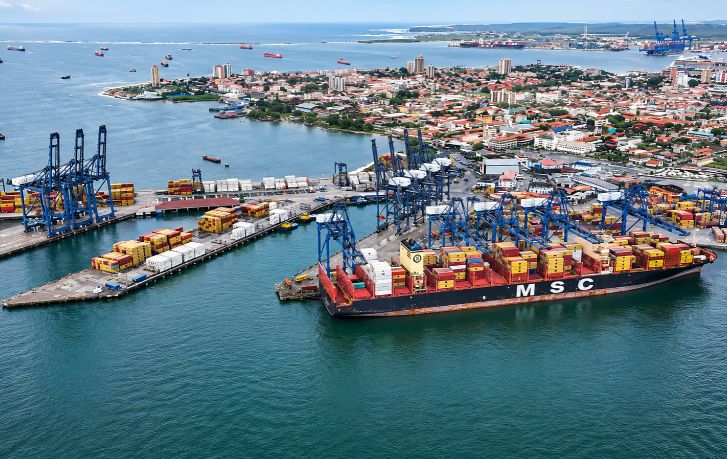
Panama’s Comptroller General has filed a criminal complaint involving CK Hutchison subsidiary Panama Ports Company and former Panama Maritime Authority officials over the concession for the ports of Balboa and Cristobal. The filing adds a criminal-investigation track to an already complex transition: replacement companies are temporarily operating both ports, while CK Hutchison is pursuing international claims for approximately $3.5 billion in damages.

The complaint was lodged with Panama’s Public Prosecutor’s Office and concerns possible irregularities in the concession. It covers Panama Ports Company as well as former Maritime Authority board members and administrators who served between 2014 and 2023 and participated in drafting and approving the extended contract. The specific alleged irregularities have not been identified, and the complaint represents the start of a prosecutorial process rather than a finding of criminal liability.
The filing is based on a financial and compliance audit of the original concession contract, which was approved under Law No. 5 of January 16, 1997, together with its addenda. The audit examined the period from January 2, 2014, through December 31, 2024. Panama Ports Company had managed Balboa and Cristobal since receiving the concession in 1997, creating an operating arrangement that lasted nearly three decades.
The concession’s legal basis changed decisively on January 29, 2026, when Panama’s Supreme Court declared Law No. 5 unconstitutional. The ruling extended to the contract’s addenda, its extension and acts connected to that extension. A renewal granted in 2021 had already attracted criticism over its terms and the benefits Panama received.
Temporary operators preserve continuity
After the court decision, President José Raúl Mulino ordered the Panama Maritime Authority to occupy temporarily the property required to keep Balboa and Cristobal operating. That step separated the legal dispute from the immediate engineering and logistics requirement: cargo-handling systems, labor coordination, vessel schedules and landside connections could not simply stop while Panama determined a permanent contractual structure.
APM Terminals, a subsidiary of A.P. Moller-Maersk, received a temporary contract of up to 18 months to operate Balboa. MSC’s Terminal Investment Limited, commonly called TiL, received a corresponding temporary contract for Cristobal. Both companies brought their own management teams rather than retaining Panama Ports Company as the operating authority.
The transitional contracts maintain port availability, but they do not settle the longer-term questions surrounding investment, equipment planning and operating responsibility. APM Terminals has said it wants to continue managing Balboa permanently, although Panama has indicated that a permanent arrangement would require a tender. The company’s current role remains temporary, as detailed in its comments on the Balboa transition.
An 18-month operating horizon can support continuity, but it is a limited foundation for major capital commitments. Port operators make long-cycle decisions involving cranes, yard equipment, information systems, maintenance programs and workforce planning. A temporary manager must keep those systems reliable without knowing whether it will control the terminal long enough to recover new investment. That creates a practical boundary between maintaining present service and planning future capacity.
A separate multibillion-dollar dispute remains
CK Hutchison has filed international claims seeking approximately $3.5 billion in damages over the canceled concession. That figure is a claim, not an award, and its resolution is separate from the criminal complaint. The parallel proceedings therefore address different questions: prosecutors can examine possible wrongdoing connected with the contract, while international proceedings consider CK Hutchison’s demand for compensation.
Panama Ports Company has also accused Panamanian authorities of unlawfully seizing assets and documents during the takeover. President Mulino has rejected that allegation. Neither that dispute nor the damages claims changes the current operating arrangement at Balboa and Cristobal, which remain under their respective temporary managers.
Panama has thus maintained immediate port operations after overturning the concession’s legal foundation, but the replacement structure is still provisional. Before the temporary contracts expire, the country must establish a durable operating framework while the criminal inquiry and CK Hutchison’s roughly $3.5 billion claim proceed on separate tracks.
| More aerospace and engineering stories, right in your MSN feed. Follow AMI on MSN |
By Thomas Caldwell — AMI’s senior editor for mechanical and mobility engineering, covering vehicle electronics, systems integration, electrification, chassis systems, propulsion, and safety policy.