


Lake Mead Refill Could Restore Power, but Revised Accounting Still Shows Deficit
Revised Colorado River accounting strengthens the central warning behind any rapid Lake Mead recovery: a higher reservoir could restore Hoover Dam generating capacity and ease water cuts without bringing the river’s long-term supply and use into balance. Reclamation changed how Lower Basin consumptive uses and losses were calculated in 2024 and 2025 and recalculated the historical series, according to a Colorado River Science accounting review. The revisions mean any estimate of the basin’s deficit should identify what kinds of water use and loss it counts.

The possibility of a fast refill remains hypothetical, not a forecast. It would take several exceptionally wet and snowy winters, with enough runoff reaching the river to exceed current consumption and replenish storage. Lake Mead has risen quickly before, gaining nearly 47 feet in wet 2011 and about 27 feet during 2023, but repeating such gains over multiple years would be a substantially more demanding hydrological event.
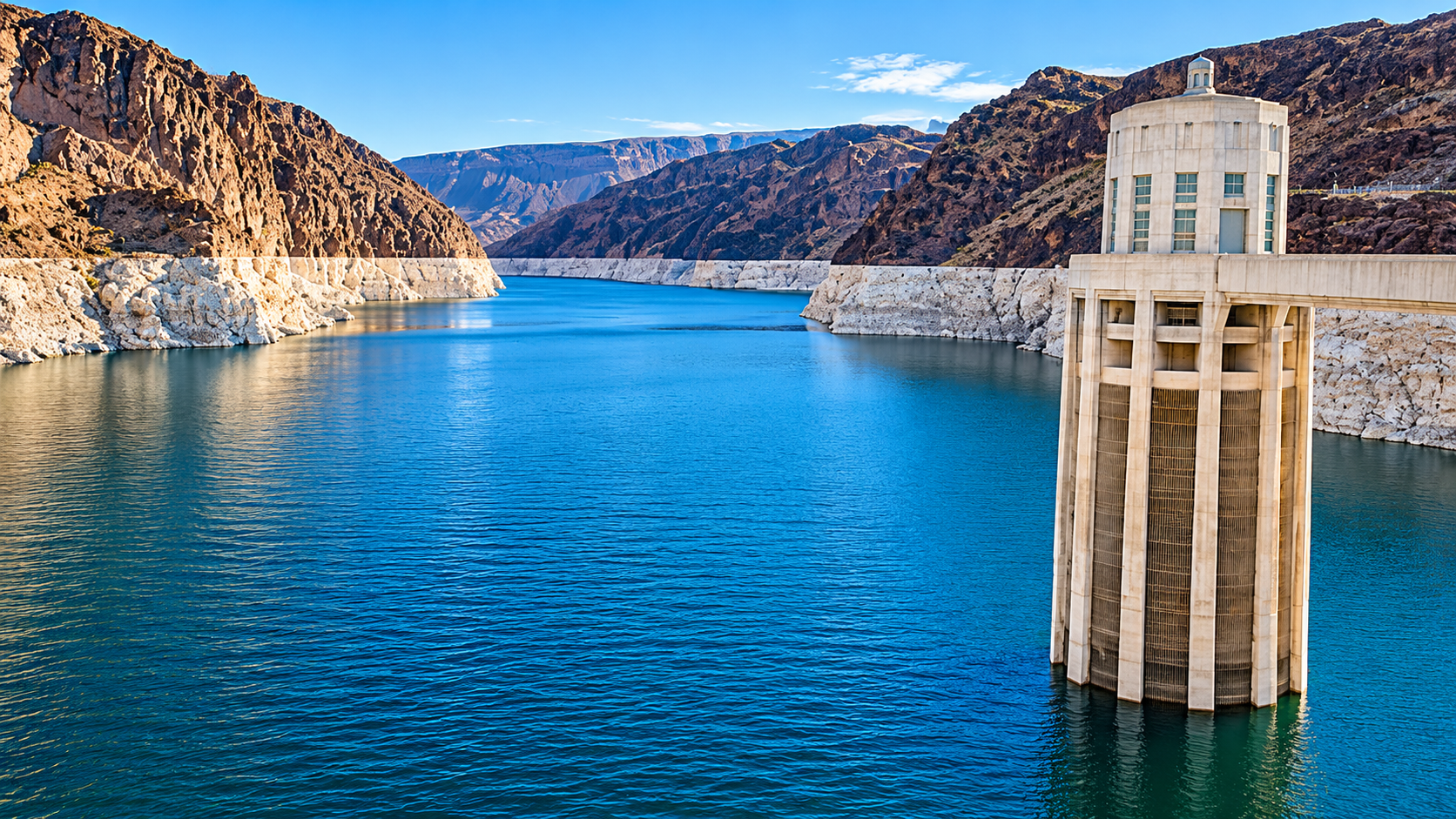
If it happened, the benefits would be immediate and measurable. Lake Mead has been described at roughly one-third full and around 180 feet below its 1,229-foot full-pool elevation. A sustained rise would increase the operating margin for water deliveries, improve recreation access and give Hoover Dam more hydraulic head the vertical distance and associated pressure that drive water through its turbines.
Higher water would restore Hoover Dam’s power margin
Hoover Powerplant has 17 main turbines and a nameplate capacity of approximately 2.07 million kilowatts, according to the Bureau of Reclamation’s Hoover Dam facts and figures. As Lake Mead falls, reduced hydraulic head limits turbine performance and eventually makes generating units unavailable.
Around a reservoir elevation of 1,035 feet, most of the 17 turbines can no longer operate, cutting generating capacity by roughly 70%. Generation would stop near 950 feet. A rapid rise would reverse that progression: more turbines could return to their usable range, and higher head would improve the plant’s available output.
Actual electricity production would still depend on scheduled water releases and grid requirements. Restored capacity does not mean all turbines would operate continuously. It would, however, recover flexible hydroelectric capability for customers in Arizona, Nevada and California while moving the plant farther from its low-water operating limits.
Water cuts are tied to elevations, not appearances
Lake Mead’s elevation also controls shortage tiers. The cited trigger levels are 1,075, 1,050 and 1,025 feet, with progressively deeper reductions affecting Arizona, Nevada and Mexico as the reservoir descends. A refill that crossed those thresholds in the opposite direction could ease or end corresponding cuts under the applicable operating rules.
The 2023 rise demonstrated the mechanism on a smaller scale by moving the system into a less severe shortage tier and sparing Arizona some reductions the following year. A larger recovery would restore more stored-water margin, but delivery decisions would remain governed by federal operating plans, interstate arrangements and the U.S.-Mexico treaty.
Recreation would respond visibly as well. Rising water would improve access around ramps and marinas left behind by the receding shoreline. It would gradually cover the white mineral ring and resubmerge boats, a World War II-era landing craft and the ruins of St. Thomas, which was deliberately flooded in the 1930s. Those changes would be conspicuous, but they would measure reservoir elevation rather than sustainable river balance.
Why the accounting revision matters
“Consumptive use” generally means water diverted for a beneficial purpose minus return flows available downstream. “Losses” can include reservoir evaporation, but accounting systems do not always include the same categories. Reclamation’s figures cover anthropogenic uses and reservoir evaporation, while a separate 2024 basinwide analysis also included evapotranspiration from riparian and wetland areas.
That methodological difference helps explain why estimates of the structural deficit can vary. The scenario considered here uses an estimate of roughly 1.2 million acre-feet per year, but it should not be treated as a universal constant independent of definitions and reporting methods. The more durable finding is that basin consumption has generally remained above available flow, requiring stored water to close the gap.
Congressional research illustrates the scale of that mismatch. Natural Colorado River flows averaged about 14.6 million acre-feet annually from 1906 through 2024, but only about 12.4 million acre-feet from 2000 through 2024. Consumptive use fell from 13.8 million acre-feet in 2021 to 13.3 million in 2024, while flows over that period averaged approximately 11.9 million acre-feet.
A fuller Lake Mead would therefore be valuable stored inventory, not evidence that recurring income and recurring demand had aligned. It could restore turbines, reduce immediate cuts and reopen shoreline access. If conservation weakened because the reservoir looked healthy again, the same structural gap could begin drawing that recovered storage back down.
| More aerospace and engineering stories, right in your MSN feed. Follow AMI on MSN |
By Thomas Caldwell — AMI’s senior editor for mechanical and mobility engineering, covering vehicle electronics, systems integration, electrification, chassis systems, propulsion, and safety policy.



