Artemis III Crew Debate Puts NASA Selection Process in Focus
It is unusual enough for a NASA mission crew to attract significant attention on its own, but this time, NASA’s Artemis III crew has sparked an unusually heated discussion. However, what should be considered a significant aerospace news story is the way a major human spaceflight program assigns its crew members to technically different missions.

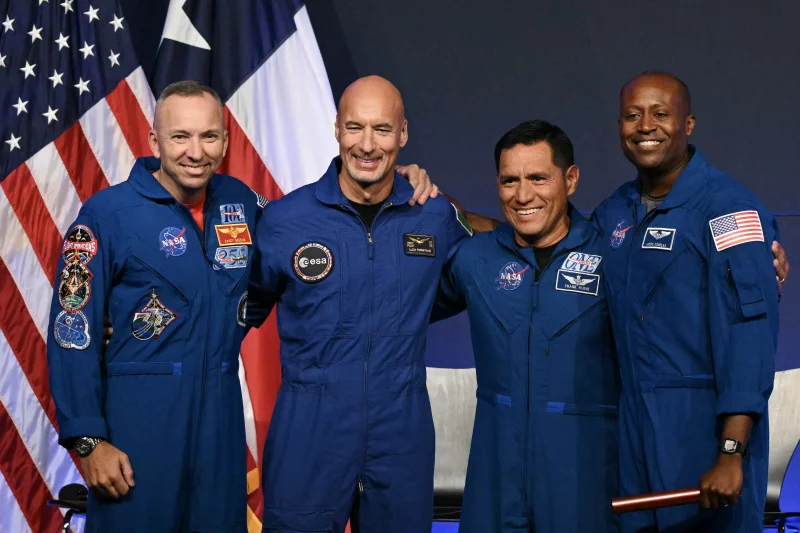
All four crew members selected for Artemis III Randy Bresnik, Frank Rubio, Luca Parmitano, and Andre Douglas are male astronauts. The fact received criticism since the Artemis mission has gained a very special reputation, mostly due to its association with the first-ever woman’s mission to the Moon. Furthermore, it came right after the successful completion of Artemis II with female astronaut Christina Koch.
However, NASA explained the situation with a simple statement. The crew selection was done according to the mission requirements and not for any political reasons. NASA administrator Jared Isaacman said that assignments were made according to the mission needs, adding that some women from NASA’s astronaut corp might already be busy with other programs like International Space Station missions or Artemis flights.
Such explanation is quite logical when considering the current mission profile of Artemis III. It is important to mention that this mission is not a landing mission to the Moon. NASA has reassigned Artemis III to become an orbit test flight with rendezvous and docking between the Orion and test models of commercial human landing systems of Blue Origin and SpaceX. Therefore, Artemis III becomes more of an integration mission, rather than Moonshot. All kinds of interfaces, spacecraft’s software, communication between spacecraft and crew training should be done before the next risky Artemis missions.
As it can be seen from NASA’s official mission update, the crew will train with Orion spacecraft immediately, as well as take part in development and operations of the test landers. Bresnik has a good background of participation in exploration programs as an assistant to the chief of the Astronaut Office for exploration. Parmitano has already served as a commander on the station and is also a test pilot. The same goes for Rubio and his long-duration flights, while Douglas has experience in systems engineering and autonomous systems, as well as was already backup and closeout crew for Artemis II.
From the readiness perspective, such combination provides an explanation of why NASA insists on the expertise, development of particular programs and availability. The mission becomes not only high-profile, but also schedule sensitive mission for NASA. NASA says that the work on Orion integration is currently going on, including the docking system of the spacecraft which will be used for the first time and SLS processing is going on, while the mission depends on coordination of two separate commercial landers’ development.
However, the backlash highlighted one more problem. NASA has not provided any detailed explanation of its approach to this question. Typically, the crew selection is conducted by the Chief of the Astronaut Office along with other representatives of Johnson Space Center, and former NASA officials have mentioned that it could also depend on the flight requirements, astronaut rotations expectations, and temporary medical issues. Therefore, it is clear that NASA’s approach is a combination of the engineering and human resources management as well as timing.
This fact is even more relevant for Artemis than for the usual orbit mission, since Artemis missions acquire a huge prestige. Currently, NASA has 37 active astronauts available for flight assignment, including 15 women. In such circumstances, the all-male Artemis III crew became a symbol of something bigger. Even though the mission is an orbit test, the label Artemis gives a mission a great public significance as the mission’s representation.
There is also another structural reason why the discussion won’t be going away. Artemis is no longer a NASA spacecraft flying a standalone mission. Instead, it became a campaign with the use of SLS, Orion, European Service Module, commercial lunar landers, docking system maturation and training flow which has to coincide with ISS obligation and lunar goals in the future. When NASA mentions the availability, it means a real operational factor. However, as long as NASA does not reveal its approach and weighting of different factors, external observers can only guess how the readiness, fairness, and visibility are balanced.
Therefore, this is the main lesson from the Artemis III case. The crew NASA chose looks reasonable for a demanding orbit test mission. However, in the program designed to carry both the technical risk and national prestige, the transparency of the process plays a key role. If Artemis is going to be both an engineering campaign and a public exploration program, NASA may need to clarify the crew selection process.
By David Whitaker — Associate editor for AMI’s aerospace and drone systems desk, translating flight systems, aircraft programs, spaceflight, and UAV developments into accessible technical stories.