Standard Bots expands New York production for no-code industrial robots
Robotics supplier Standard Bots is upscaling a uniquely manufacturing-first robotics approach in the Big Apple, combining greater in-house production capabilities with a deployment strategy focused on demonstrating the technology rather than the more common robot programming. In the US industrial setting, this approach is relevant because the bottleneck of any robotics project is rarely the robot itself, but how fast the deployment can be achieved.
The company said it had secured a $200 million Series C funding round and was expanding its Glen Cove, New York factory to 70,000 square feet. The company’s stated aim was to increase the number of robots designed, assembled, and deployed from this facility. This particular move is important because in the US market of robots, domestic production capabilities are still scarce. According to the International Federation of Robotics, the United States made up 68% of robot installations in the Americas region in 2024, while importing most of the robots from Japan and Europe.
From a mechanical perspective, what is interesting about this approach is the extent of vertical integration, according to the company. Standard Bots said it designs almost all of its own parts, including actuators, and assembles every single product in-house. Actuators are one of the most important components of robots in terms of their mechanical and thermal performance. Ownership of such a part gives a company a chance to iterate more in terms of performance optimization of its robots. Without reliance on external component roadmaps, the supplier can change things about its robots that will lead to greater reliability and efficiency.
Standard Bots also said that by 2027 it aims to manufacture everything in America, from metal inputs to finished robots. That is indeed an ambitious goal, but from a practical standpoint, the importance lies in shortened loops between product design and deployment and better quality control. Feedback from field deployment is crucial in robotics, and especially in industrial applications, where any application of a robotic system is prone to uncover edge cases in applications like machining, welding, palletizing, grinding, fastening, dispensing, assembly, and inspection.
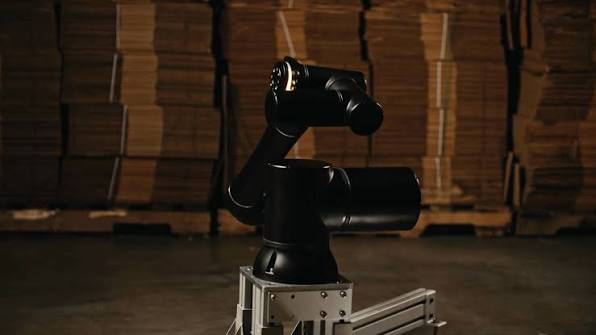
Standard Bots’ product offering includes AI-native robot arms and industrial humanoids that can be trained by demonstration and observation. No coding is needed to program the products. This particular product offering corresponds well with trends in industrial robotics aimed at reducing automation barrier associated with complex programming and deployment. Suppliers are increasingly trying to reduce the time, effort, and skills required to integrate a robot with other elements of production through various AI-assisted solutions. Despite this effort, widespread implementation of robots remains difficult due to deployment barriers, including integration efforts and technical validation.
This is where the focus on usability of Standard Bots’ solutions can prove to be equally important as the manufacturing approach. Robots that can be taught to do something by demonstration will greatly change the dynamics of deployment for manufacturers lacking in-house expertise in automation. Moreover, such an approach will allow for easier task re-assignment in case the production mix changes. This does not mean that the need for fixing, safety design, process validation, and maintenance planning is eliminated but makes it easier to deploy the system.
The company said that it is currently deploying its robots to hundreds of American firms in almost all states, working in oil and gas, automotive, aerospace, and data center segments. Some named clients include Sunoco, Lockheed Martin, Amazon, NASA, and the US Army. For aerospace and other high-mix industrial applications, this customer coverage is particularly relevant as it indicates that the company is developing tasks where not only repeatability and uptime but the ease of setup are crucial.
There is also the scale claim worth considering: Standard Bots said that it is on track to deliver 10% of all new U.S. industrial robot deployments by the next year. While this rate of growth will certainly depend on demand, there are also other factors to consider, including production volumes, field serviceability, integration, and maintenance capabilities. These are among the most important elements of robotics but not the flashiest ones.
This context should not be overlooked because the global robotics market structure is stable despite recent shipments volatility, and the US market keeps looking for ways to automate more without increasing the burden of deployment. The formula proposed by Standard Bots is not a smarter robot but an industrial robot system that is easier to control. The company seeks to achieve this with ownership of more components of the robot, in-house assembling, and easier training.
This is the important story from the engineering point of view for US manufacturers. If robot suppliers manage to combine actuator-level design control, in-house assembly, and lower-friction training methods, they might do not just sell hardware but shorten the gap between robot delivery and actual useful deployment.
By Jonathan Barrett — Editor for AMI’s future mobility and autonomous systems section, with two decades covering robotics, e-mobility, drone-vehicle convergence, and transport mechanical systems.