Lava Regiment Says Robot Autonomously Handled 93% of 12-Mile Supply Run
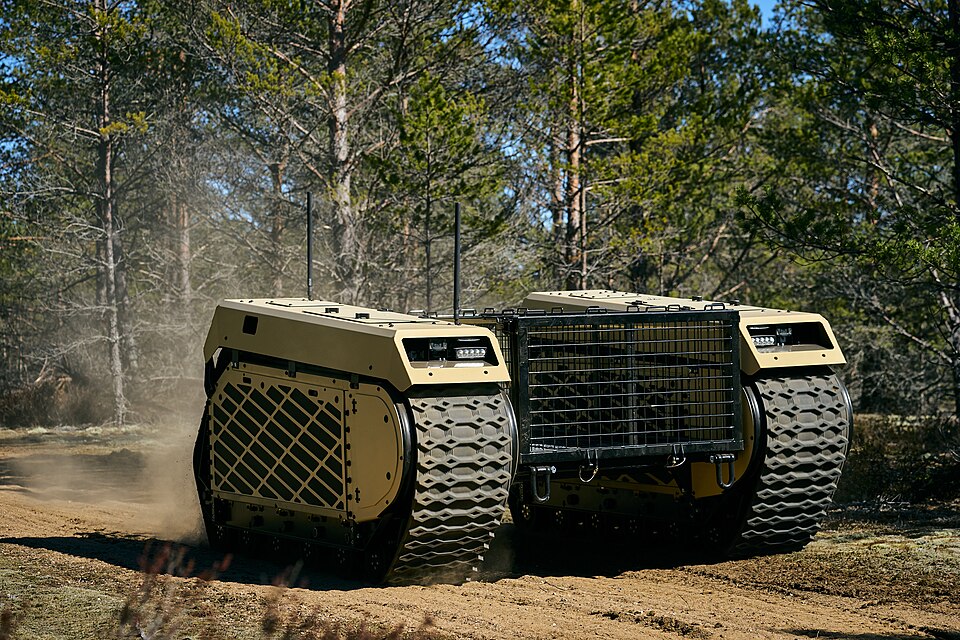
Ninety-three percent is the central figure in a logistics mission reported by the Lava Unmanned Systems Regiment, part of the Khartiia Corps of Ukraine’s National Guard. The unit says a ground robot autonomously covered nearly all of a 20-kilometer, or roughly 12-mile, cargo run and return journey under combat conditions.

The robot delivered its cargo and returned to its starting point, according to the regiment. A human operator took control for 1.4 kilometers, leaving 18.6 kilometers to the autonomous navigation system. The unit characterized the run as the first of its kind under combat conditions, though that first of its kind status is its own assessment.
What the 93% figure represents
The mission was not an unprepared robot independently exploring unknown ground. Before the cargo run, a separate ground robot equipped with light detection and ranging technology, or LiDAR, mapped the route and surrounding terrain in three dimensions. That map gave the supply robot a structured representation of the path before it departed.
During the run, onboard cameras detected obstacles while an artificial-intelligence navigation system guided the vehicle. The arrangement divided the autonomy task into two stages: advance sensing created the route model, and onboard perception then helped the moving robot respond to what it encountered.
This is an important distinction in assessing the result. Prior mapping can reduce uncertainty and help a robot plan its movement, but the onboard system still has to localize the vehicle against that map, interpret camera information and issue steering or propulsion commands as conditions change. The robot therefore combined prepared environmental data with real-time sensing rather than depending on either one alone.
The 1.4 kilometers under human control mark the present operating boundary. The available account does not identify what prompted those interventions, so it cannot establish whether terrain, perception, route ambiguity or another condition required manual driving. It does show that the human remained part of the control loop and available to take over.
From continuous driving to supervision
Battalion commander Andrii Kopach described the operator’s changed role directly: The biggest change is that the operator is no longer a driver but a dispatcher. Instead of issuing commands throughout the journey, the operator monitored the robot and intervened when needed.
That division of labor can matter as much as the autonomous distance. Continuous remote driving consumes an operator’s attention and requires a sufficiently dependable stream of control and sensor data. Intermittent supervision shifts more perception, navigation and actuation decisions onto the vehicle, potentially allowing personnel to concentrate on exceptions rather than routine movement.
Research into military robot management has previously identified workload and communications bandwidth as constraints when people coordinate robotic assets. The Lava Regiment now wants one person to oversee multiple robots, but the completed mission demonstrated supervision of one vehicle, not a validated multi-robot capability. Scaling from one supervised machine to several also raises questions about interface design, alert prioritization and how often individual robots request help.
Autonomy reduces but does not remove dependencies
Kopach said greater onboard autonomy could reduce dependence on “a constant control link,” including satellite communications such as Starlink. That benefit has immediate relevance because recent restrictions disrupted Starlink and Starshield services in Ukraine before service was reported to have returned to normal, according to Reuters.
A robot capable of continuing along a mapped route without continuous steering commands is less tightly coupled to an uninterrupted connection. Communications would still be needed for monitoring, updates and human intervention, but every meter would not necessarily depend on a live driving command.
The reported result remains a single unit’s account of one completed mission. Autonomous ground mobility can vary substantially with terrain, weather, illumination and vehicle characteristics. A 2026 NATO Science and Technology Organization report notes that fully autonomous systems able to function without human intervention do not yet exist and calls for quantitative methods to assess their mobility across difficult environments.
The regiment also hopes to extend autonomy to casualty evacuation, where reliability and intervention demands would carry greater consequences, but it has not announced that as an operational capability. For now, the measured advance is narrower and concrete: a robot reportedly completed 18.6 kilometers of a 20-kilometer logistics journey autonomously, while the remaining 1.4 kilometers showed exactly where human control was still required.
| More aerospace and engineering stories, right in your MSN feed. Follow AMI on MSN |
By Jonathan Barrett — Editor for AMI’s future mobility and autonomous systems section, with two decades covering robotics, e-mobility, drone-vehicle convergence, and transport mechanical systems.