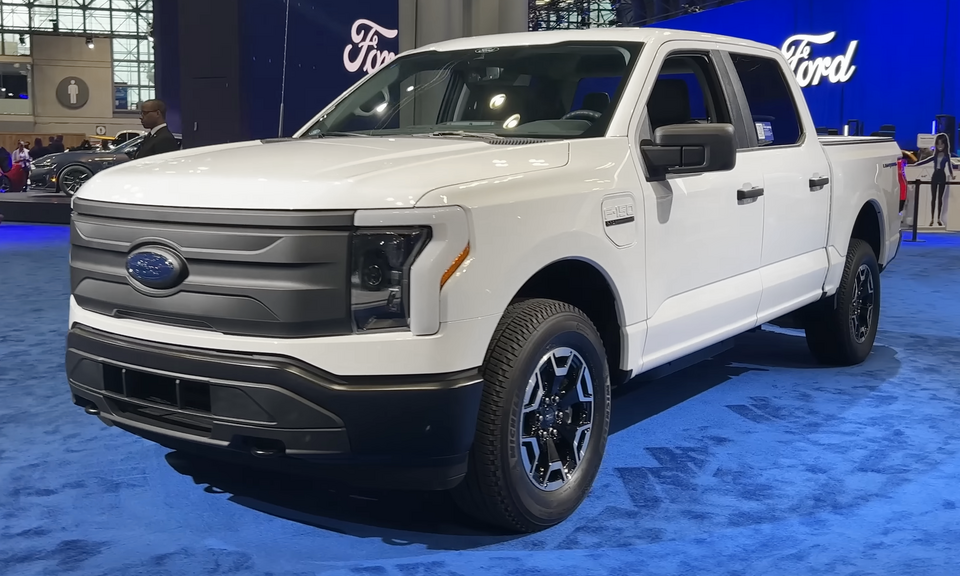
Ford F-150 Lightning Completes 329-Mile Trip Without Charging Despite Generator Failure
At highway speed, the hitch-mounted generator on Martin Meek Jr.’s Ford F-150 Lightning does not produce enough electricity to hold the battery at a steady charge. It instead reduces how quickly the battery drains a partial offset that proved sufficient for a 329-mile winter towing trip without a charging stop, although a fuel-pump failure forced about 30 minutes of roadside work.

The Kansas owner’s removable system, called Everdrive, pairs a Ford-branded, Pulsar-built tri-fuel generator with a Ford Charge Station Pro. The generator is rated for 20,000 continuous watts, while Meek reported that approximately 18.3 kilowatts reached his 2023 F-150 Lightning Lariat Extended Range after conversion losses.
That output is substantial for mobile charging but well below the truck’s estimated highway demand. If the Lightning consumes about 35 kilowatts while traveling at 70 mph, an 18-kilowatt contribution still leaves approximately 17 kilowatts coming from the battery. Meek said generation and consumption can balance near 40 mph, but at normal highway speeds the arrangement extends driving time rather than creating unlimited range.
A difficult towing test
For the outbound leg in central Kansas, Meek began with a full battery and towed an empty trailer for about 155 miles. Temperatures were in the mid-40s, headwinds reached 25 to 30 mph, and he generally maintained 65 to 70 mph. The truck arrived with 25% battery remaining and displayed energy economy of 1.1 miles per kilowatt-hour.
Under those conditions, the generator was estimated to have provided roughly 50 miles of additional range cushion. That is meaningful because towing, cold weather, aerodynamic drag and highway speed can combine to raise an electric pickup’s energy demand. The Lightning’s Extended Range battery has 131 kilowatt-hours of usable capacity and an EPA-rated range of 320 miles, but that rating does not describe this demanding towing scenario.
The return leg exposed the other side of the conversion. With a disabled Tesla loaded on the trailer, a leaking fuel-pump diaphragm flooded the carbureted generator. Meek worked on it for approximately half an hour in hail and rain before restarting it. He then reduced speed to about 55 mph and completed the 329-mile round trip without stopping to charge. He estimated that relying on a charger instead would have required a two-hour detour.
Charging dependence becomes mechanical dependence
The trip demonstrates a workable energy balance for this particular truck, route and owner-built installation. It also shows that removing a charging stop does not remove system dependencies. The truck now relies on a combustion engine, fuel supply, carburetor, fuel pump, electrical conversion hardware, charger and mounting structure in addition to its battery-electric drivetrain.
Fuel consumption was not reported, so the trip cannot establish the system’s operating cost or energy efficiency. Noise was measurable: cabin sound at 70 mph increased from approximately 73 to 76 decibels with the generator running. The custom heavy-wall carrier also extended about 32 inches behind the truck, adding packaging, clearance and load-management considerations. Meek relocated the license plate to keep it visible.
Exhaust management is another fundamental constraint. The generator’s combustion engine can run on gasoline, propane or natural gas, and portable-generator exhaust contains carbon monoxide. The Consumer Product Safety Commission warns that portable generators must be operated outside and their exhaust directed away from occupied spaces and openings. A vehicle-mounted application therefore requires careful attention to exhaust routing, airflow, nearby people and operating environments rather than treating the generator as an ordinary piece of cargo.
Compatibility also varies by model year. The 2022 and 2023 Extended Range Lightnings can accept 19.2-kilowatt AC charging, according to Ford information cited in the test account, closely matching the reported generator output. The 2024 model is limited to 11.5 kilowatts, which would reduce how much of the same generator’s available output the truck could use.
Meek targeted spring or summer 2026 for kits priced at an estimated $5,000 to $6,000, but no kit was found listed for sale at the time covered here. Availability, installation requirements and broader operating constraints therefore remain unresolved. For now, the strongest result is narrower: one Lightning finished a demanding 329-mile towing trip without plugging in, but the roadside fuel-pump repair showed exactly what is exchanged for that charging independence.
| More aerospace and engineering stories, right in your MSN feed. Follow AMI on MSN |
By Thomas Caldwell — AMI’s senior editor for mechanical and mobility engineering, covering vehicle electronics, systems integration, electrification, chassis systems, propulsion, and safety policy.