Navy Super Hornet Flies With Two Blackbeard Hypersonic Missiles, Goal Is Four
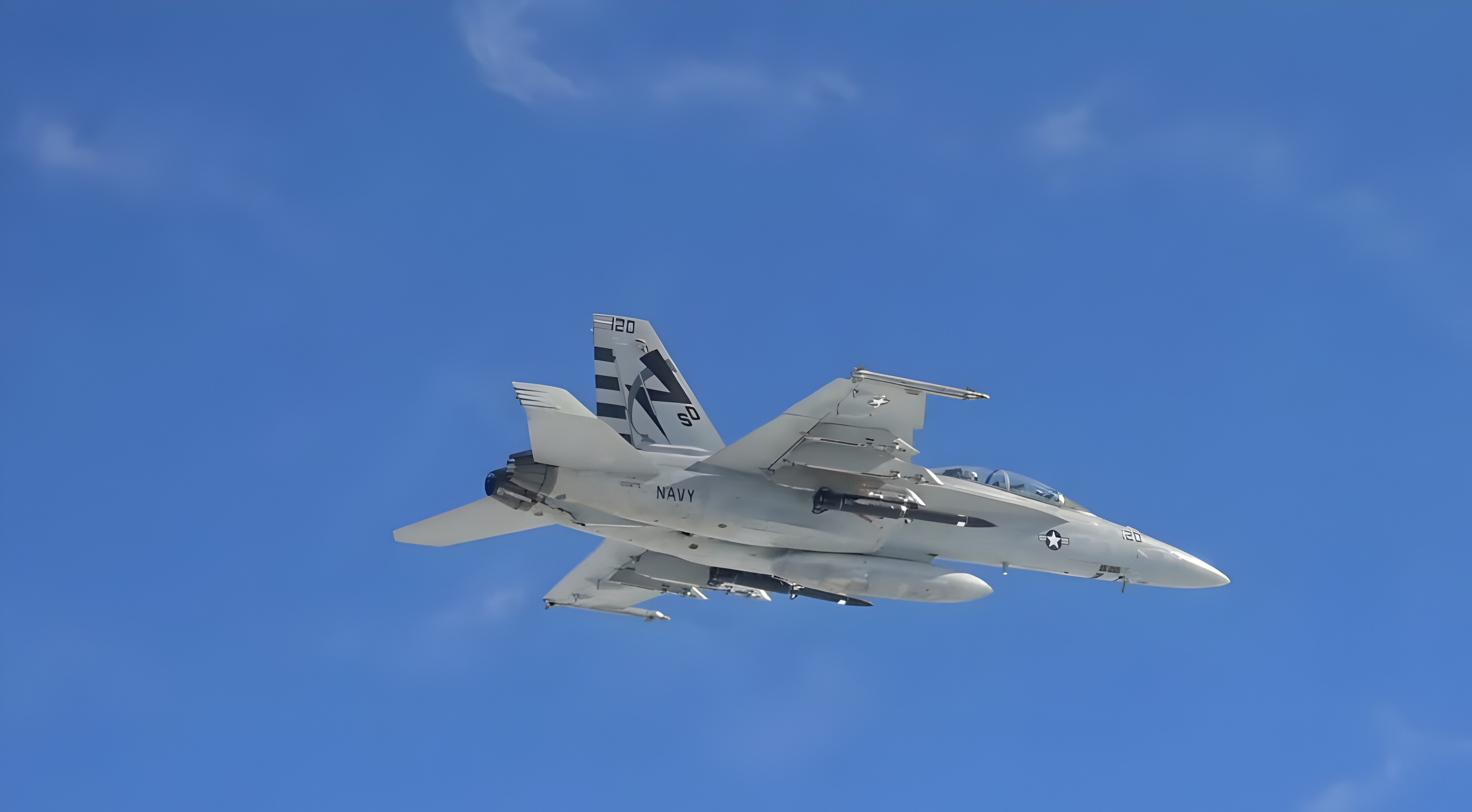
A U.S. Navy F/A-18E/F Super Hornet has completed a developmental flight carrying two Blackbeard hypersonic test missiles, moving the proposed pairing beyond drawings and ground displays. Neither missile was released during the September 18 sortie from Naval Air Station Patuxent River, and the Navy still plans additional flights and live-fire evaluations before the weapon can enter operational use.
The longer-term objective is more ambitious: as many as four Blackbeards on each Super Hornet. That would turn a familiar carrier fighter into a platform for multiple maneuvering missiles designed to exceed Mach 5, but the two-missile captive-carry flight was an early integration test rather than a demonstration of the full planned load.
The September flight focused on how the aircraft behaved with the added weight and external configuration of two missiles beneath its wings. Captive-carry work allows flight-test teams to gather data on the combined aircraft-and-store arrangement before progressing to release and powered-flight trials. A Navy presentation had shown two Blackbeard test articles mounted on a Super Hornet in August, but flying the configuration introduced the aerodynamic and structural conditions that cannot be fully reproduced by a static installation.
Those conditions are central to the integration effort. An externally carried weapon changes an aircraft’s drag, mass distribution and loads, while its physical placement must remain compatible with the fighter and its other systems. The September sortie established that the Navy could take the two-missile configuration into the air for developmental evaluation; it did not test separation from the aircraft, missile propulsion or maneuvering performance.
Blackbeard’s intended speed and atmospheric maneuverability are the features behind the Navy’s interest. The missile is designed to travel faster than Mach 5 while maneuvering in flight, characteristics intended to make interception more difficult. Carrying four would also give one aircraft more available weapons than the demonstrated pair, although the evidence released so far does not show that the complete four-missile configuration has flown.
The program is backed by several procurement actions. The Navy awarded Castelion a $105 million agreement in April to advance integration with the Super Hornet, followed by a June purchase of 50 pre-production missiles for $23.4 million. A September production agreement was valued at up to $200 million; USNI News reported that it covers 444 missiles. Those figures show the scale being contemplated, but production agreements and pre-production purchases are not confirmation that hundreds of operational weapons have already been delivered.
Chief of Naval Operations Adm. Daryl Caudle examined Blackbeard during an October 28 visit to Air Test and Evaluation Squadron 23 at Patuxent River, the unit responsible for weapons testing there. The next technical steps remain more consequential than the inspection: further developmental flights, followed by live-fire evaluations that include preparations for testing in the Indo-Pacific.
Castelion is also working to extend Blackbeard beyond Navy carrier aviation. The company is pursuing compatibility with the Army’s HIMARS ground launcher and has begun adapting the missile for the Air Force’s F-16 under a research agreement. It also intends to demonstrate a launch from Saronic’s Marauder unmanned surface vessel in 2027.
If those efforts progress, Blackbeard could eventually share a common missile design across carrier fighters, land launchers, another combat aircraft and an unmanned naval vessel. For now, the clearest verified advance is narrower: a Super Hornet has flown with two missiles attached. Reaching the Navy’s four-missile objective still requires the integration program to prove the larger load and advance from carriage testing to safe release and live fire.
| More aerospace and engineering stories, right in your MSN feed. Follow AMI on MSN |
By David Whitaker — Associate editor for AMI’s aerospace and drone systems desk, translating flight systems, aircraft programs, spaceflight, and UAV developments into accessible technical stories.