Navy’s E-6 Trails Five Miles of Wire to Reach Submarines as Replacement Arrives
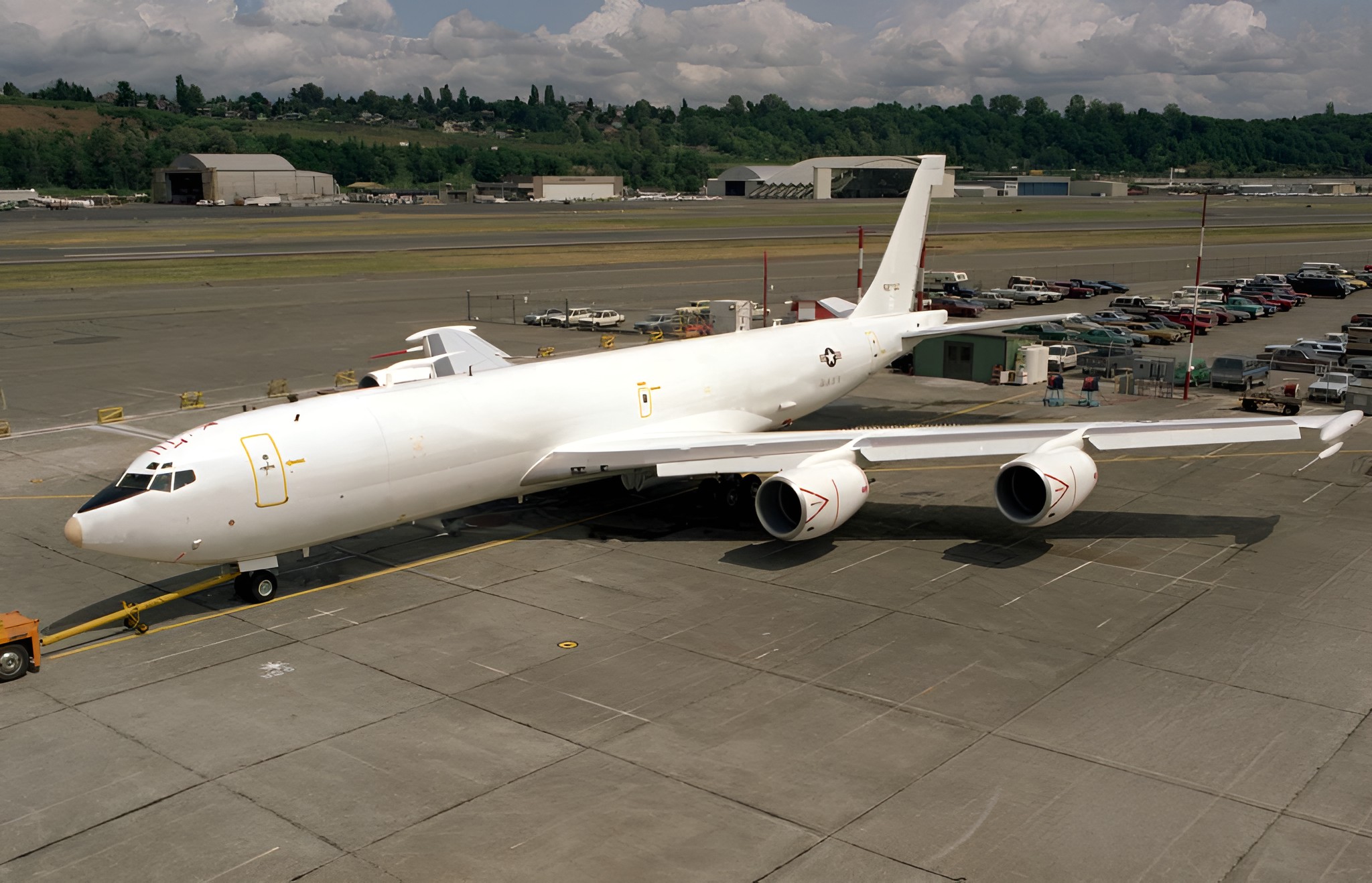
A wire roughly five miles long unspools behind the Navy’s Boeing E-6 Mercury while the aircraft flies a carefully controlled circular pattern. The unusual arrangement turns the aircraft into an airborne very-low-frequency transmitter capable of messaging ballistic-missile submarines beneath the ocean.

That trailing-wire system is the defining hardware behind the E-6’s submarine-communications mission. Ordinary radio signals do not penetrate seawater effectively, but very-low-frequency signals transmitted at enormous wavelengths can reach a short distance below the surface. A submerged submarine operating at shallow depth can trail its own receiving antenna and collect the message without depending on conventional radio links.
The tradeoff is limited data capacity. Very-low-frequency communication is suited to short, essential messages rather than high-bandwidth voice or imagery. Generating the signal from an aircraft also requires an antenna far longer than the E-6 itself, which is why the wire must be deployed into the airstream rather than contained inside the airframe.
The aircraft is part of the antenna system
The wire cannot simply stream horizontally behind the jet. The aircraft uses a slow, banked circular flight pattern that allows the antenna to hang closer to vertical, improving the geometry needed for transmission. Maintaining that arrangement makes aircraft handling, altitude and speed part of the communications system rather than merely a way to transport it.
Putting the transmitter in the air provides another advantage: mobility. An airborne relay can disperse, move toward the ocean area where submarines are operating and continue broadcasting if fixed ground transmitters are unavailable. The Navy describes the E-6B as both a communications relay and a survivable strategic airborne command post.
The E-6 began as a replacement for the Navy’s earlier EC-130Q Hercules aircraft. Boeing derived the E-6A from the commercial 707, and the Navy accepted the first aircraft in 1989. The later E-6B added the Looking Glass airborne command-post mission, giving the fleet responsibilities beyond submarine communications. The current force consists of 16 aircraft.
That combination placed two demanding missions on a large jet with useful speed, altitude and payload capacity. It also tied those missions to the Boeing 707, an aircraft family that has been out of production for decades. As the E-6 fleet ages, maintaining its airframes and supporting a shrinking legacy supply chain has become increasingly difficult.
The first replacement airframe has arrived
The Navy accepted its first C-130J-30 on October 15, 2026, starting the physical transition toward the E-130J Phoenix II. The newly built aircraft is still a basic transport airframe. Northrop Grumman must convert it with specialized communications equipment before ground and developmental flight testing can begin.
The move returns the submarine relay mission to the Hercules family, but it is not a direct duplication of the E-6B. The E-130J is intended to take over the Navy’s submarine-communications role, while the broader Looking Glass airborne command-post function will move to a separate Air Force effort.
The Navy plans 31 E-130Js, including six developmental aircraft and 25 production models, compared with 16 E-6Bs. Three aircraft are currently under contract. Northrop Grumman won the $3.5 billion replacement deal in 2024, while Collins Aerospace is supplying the very-low-frequency communications system.
Changing airframes introduces a substantial integration problem. The C-130J-30 is smaller than the 707-based E-6B, and contractors are modifying existing mission systems to reduce their weight. Antenna installation also requires structural changes. A critical design review is expected in late 2027, with a production decision and transition into low-rate production projected for 2029.
The turboprop replacement will not match the E-6’s jet speed or altitude, but it brings a current production line, a broad maintenance network and access to more airfields. Those support advantages address the central weakness of the Mercury fleet: a vital communications package is still flying aboard an airliner design whose production ended decades ago. The first C-130J delivery begins that migration, but the five-mile antenna and its demanding airborne geometry still have to work on the new platform before the E-130J can assume the mission.
| More aerospace and engineering stories, right in your MSN feed. Follow AMI on MSN |
By David Whitaker — Associate editor for AMI’s aerospace and drone systems desk, translating flight systems, aircraft programs, spaceflight, and UAV developments into accessible technical stories.