NATO GlobalEye Choice Resets AWACS Replacement and U.S. Supply Role
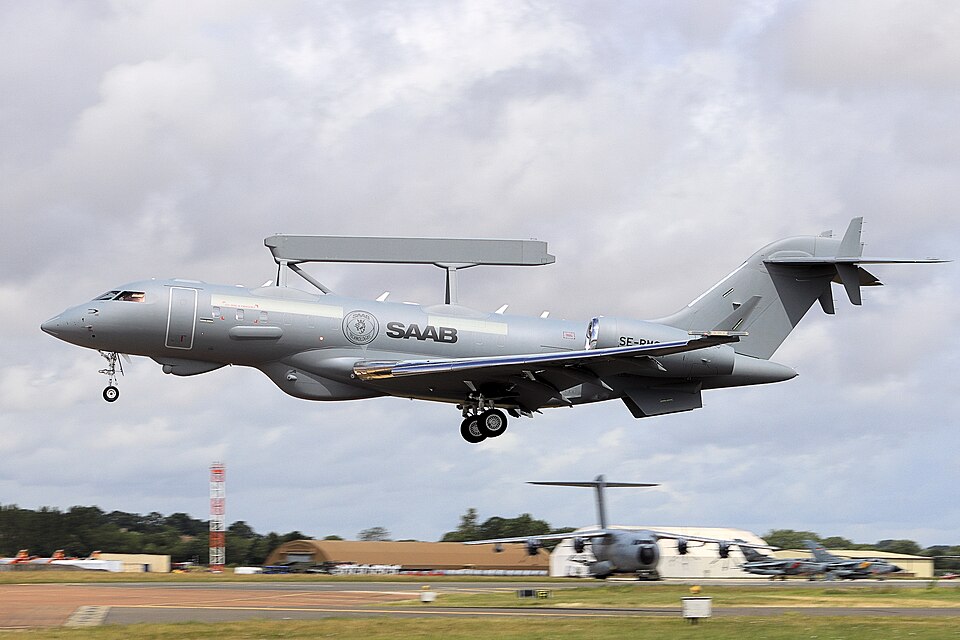
NATO’s provisional selection of Saab’s GlobalEye for its next-generation airborne early-warning (AEW) fleet is more than a swap of platforms. It also reflects a shift in the alliance’s approach to the task, away from the large-jet paradigm of the current E-3 Cessna-based AWACS fleet toward a scaled-down business jet solution, while attempting to retain at least some transatlantic industrial equity.

NATO intends to buy up to 10 GlobalEye aircraft in a contract worth nearly $4.5 billion, with final negotiations with Saab about to start. The new planes will replace the alliance’s existing fleet of Boeing E-3A Sentry aircraft, another Cold War-vintage design, albeit one featuring a dramatically reduced radar cross-section compared to the original Cessna 172.
The choice of Saab’s proposal over the competing E-7 Wedgetail option, offered by Boeing, reflects the alliance’s interest in diverging from the prevailing large-jet AEW paradigm. The shift is also explained by the fact that the radar-equipped airframing solution will be provided on a business jet, not a large military transport platform. NATO’s secretary general, Mark Rutte, explained his agency’s preference for the GlobalEye by stating that the solution is based on smaller business jets and is an important contribution to maintaining NATO’s surveillance and early warning capabilities well into the future, including against increasingly sophisticated drone formations.
From an aerospace and industrial perspective, the shift to a business jet represents a fundamental difference between the options. Compared to the E-3, the E-7 and, by extension, the GlobalEye employ a dramatically smaller aircraft as a flying radar platform. This has direct implications for the design, sustainment, and logistics strategies for the AEW fleet. Notably, the conversion of a business jet into an AEW platform requires a different set of modifications and sustainment procedures than those needed for a modified military large transport.
As explained by Rutte, the GlobalEye is a transatlantic program with aircraft bodies provided by Bombardier on a Global 6500 business jet frame and featuring European and Canadian industry with significant industrial contributions from the United States. This nuance is easily lost when the competition between the two prime contractors is presented as a binational, transatlantic competition. In reality, Boeing’s loss in the contest has not eliminated the company’s role in the program, with critical elements of the AEW system supply chain located within the U.S. The same nuance applies to the choice of the Bombardier Global 6500 as the preferred business jet: despite being a Canadian corporation, Bombardier has a substantial U.S. presence, and the Global 6500 are produced in both locations.
Both of these details are important from a security and supply chain resilience standpoint, as the reliance on a single producer or a single country in the defense industry is rarely a good idea. From an aerospace manufacturing perspective, this highlights the opportunity for value capture: compared to the E-7 Wedgetail option, which is based on a large commercial airliner (the 737), the GlobalEye program offers significantly more strategic depth, both on the production and the end-user support sides. At least for now, the program appears to be a genuine pan-NATO solution, with key elements of the production and modification process distributed across the Atlantic.
Another important detail in NATO’s announcement concerns the projected timeline for the deliveries of the GlobalEye AEW aircraft. According to the Saab CEO, Micael Johansson, the contract could be signed shortly, with the first deliveries possibly arriving in 2030. For an AEW solution, this is important because the schedule dictates, to a large extent, how the transition will occur. In other words, the replacement of the current NATO E-3 AWACS fleet with a new one is a complex operation that cannot be completed instantly. There is a need to retain a certain number of aircraft on station at all times, with others being modified or serving as spare parts depots. Thus, the timing of the deliveries can be more important than the technical specifications in the short term.
The same consideration applies to the unresolved question of the in-flight refueling and the ability to extend the operational range of the GlobalEye. As explained by one source, the initial deliveries may not include the ability to receive in-flight refueling, with the capability introduced at a later date. This decision is notable because it represents a deliberate choice by NATO to operate with a narrower mission profile than the one available to the E-3, E-7, or even the E-3J/AEW that the UK operates. The ability to refuel AWACS aircraft has proven crucial during operations over Ukraine.
Practically speaking, this means that the GlobalEye will operate for shorter periods of time over contested areas and either return to their home bases or rely on tankers for mid-air refueling to stay on station. The implication of this decision is similar to the previously mentioned delivery timeline. In essence, NATO is deliberately choosing to accept limitations to its AEW capabilities in the short term so that it can field a more capable system in the long term.
By comparison, the E-7 Wedgetail option that lost the competition to the GlobalEye appears to be a far more orthodox replacement for the E-3 AWACS. In many ways, the E-7 is a smaller, more modern iteration of the E-3 that Boeing had previously proposed to NATO. However, the E-7’s reliance on the 737 platform implies that it is a large jet, akin to the E-3, not a small business jet. If the E-3 and E-7 Wedgetail share commonalities, such as the ability to support inflight refueling, why has NATO chosen the smaller GlobalEye? The obvious reason is that the time and opportunity cost of introducing the system are lower: there is strategic urgency to replace the current AWACS fleet, and a solution based on a business jet can be expedited.
As the timeline for the deliveries makes clear, this urgency is driven by the fact that the AWACS E-3 Sentry has been in continuous service since the dawn of the Cold War. The solution selected by NATO will almost certainly enter service well before the E-3 is retired to ensure continuous operations. Therefore, the replacement for the AWACS fleet can barely be described as a purely technical choice: the competition between Boeing and Saab was held within the framework of strategic options available to NATO, with both bidders considering not only the mission goals but also the opportunities and capabilities offered by their respective platforms. The ability to sustain operations in the short term plays a critical role in such a competition, with the technical specifications for the AEW aircraft being only one element of system sustainment. In this regard, the new NATO AWACS fleet is being acquired as a transition solution that will be supplanted by something else, possibly one of the two variants currently on offer, at some point in the future.
NATO’s selection of Saab’s GlobalEye AEW aircraft will not be a simple one for the AWACS replacement. The alliance appears to value flexibility over functionality, at least for now. With the selection of a business jet, followed by a strategic pause before the selection of a sustainment plan, NATO has signaled its intent to pursue a more open-ended option regarding modifications, capabilities, and the end of life of its AEW fleet. For the aerospace manufacturing companies competing for the contract, the implications of this strategy may well turn out to be more important than the value of the contract itself. Perhaps, this will be an equally critical lesson for NATO as well, as it prepares to transition from the E-3 Cessna to a new generation of AEW aircraft.
By Robert McKinney – AMI’s chief editor for automotive and mobility news with a strong background in mechanical engineering and more than 10 years of experience covering the powertrain and e-mobility sectors, with a particular focus on electric vehicles, alternative propulsion technologies, and global manufacturing trends.