




De Havilland’s 10-Aircraft Annual Limit Delays French Water Bombers Until 2028
De Havilland Aircraft of Canada’s current production limit of about 10 firefighting aircraft per year means France will wait until at least 2028 for its first two new DHC-515 water bombers. De Havilland strategy chief Jean-Philippe Cote told AFP on July 28 that the first French pair is scheduled for 2028-2029, while another two aircraft ordered in June 2026 are scheduled for 2032-2033. The delay leaves France operating 12 aerial water bombers as it confronts severe wildfires.

The schedule reflects more than a slow final-assembly line. De Havilland is rebuilding an industrial system that went dormant when Bombardier stopped producing the earlier CL-415 in 2015. Production did not restart until 2024, after an initial order covering 22 aircraft for European customers gave the program enough demand to proceed. The order book has since grown to 40 aircraft.
That nine-year interruption removed more than completed aircraft from the market. It also broke continuity among tooling, skilled labor and suppliers. De Havilland had to return more than 50,000 distinct parts to production and choose replacements for suppliers that no longer existed. Each restored component must arrive with the required quality, documentation and production timing before it can support a stable assembly rhythm.
A specialized airframe remains labor-intensive
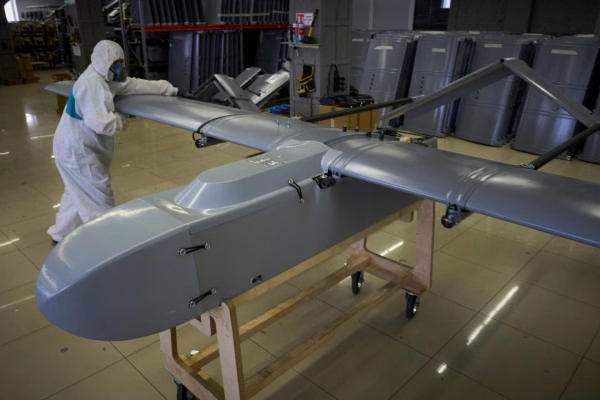
At De Havilland’s Calgary plant, workers were manually drilling and riveting DHC-515 fuselages. Operations director Victor Ocadiz described every fuselage hole and rivet as manual work. The relative lack of automation is one factor limiting the factory to approximately 10 aircraft annually.
Manual assembly should not be treated as the sole cause of the delivery schedule, however. Automated drilling and fastening can raise repeatability and throughput on large production runs, but installing such equipment requires capital, tooling development and sufficient volume to justify it. The DHC-515 is a specialized amphibious aircraft with an order book measured in dozens, not the hundreds or thousands typical of major commercial-aircraft programs.
The larger constraint is production-system maturity. A line can only move as quickly as its slowest critical part, inspection or skilled process. Restoring 50,000 part numbers after nearly a decade creates thousands of opportunities for supplier qualification, lead times and quality escapes to interrupt flow. Increasing the number of assembly workers would not by itself solve a shortage of approved components upstream.
The order book illustrates the scale problem. Forty aircraft at a steady rate of 10 per year represent four years of production in simple arithmetic. That calculation is not a delivery forecast: early aircraft must still pass assembly and testing milestones, customers occupy different positions in the sequence, and a restarted line may not immediately sustain its stated ceiling. Greece is expected to receive the first DHC-515 in early 2028, ahead of the first French pair.
Progress is visible, but testing still lies ahead
De Havilland has joined the cockpit and hull of the first aircraft, completed its mid-fuselage and produced the first wing box. Final assembly is expected to begin in 2026, with the first delivery still targeted for 2028. Separate program reporting places the intended first flight in late 2027 or early 2028.
Those milestones matter because a restarted aircraft program must prove more than its ability to fabricate large structures. Integration, ground work and flight testing remain between assembled sections and an operational aircraft. De Havilland’s 2028-2029 window for France is therefore firmer than claims that the two airplanes will arrive in specific months. France’s interior minister cited April and November 2028, but De Havilland did not confirm those months.
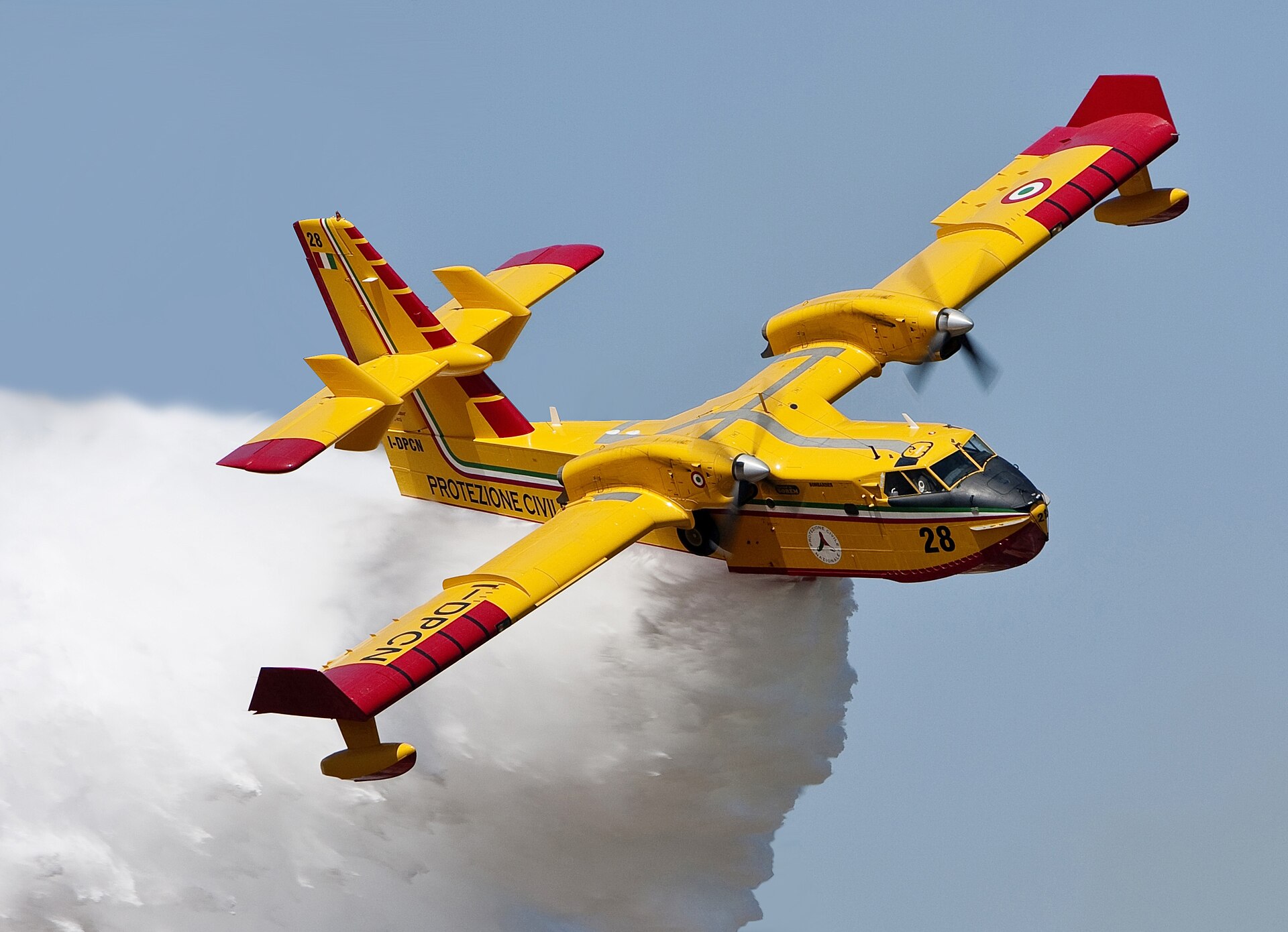
The DHC-515’s operational appeal explains why customers are willing to enter a long queue. The purpose-built amphibian can collect almost 6,000 liters of water in 12 seconds while moving across a suitable lake. It also updates the established Canadair design with modern avionics, improved corrosion protection and maintainability changes intended for a demanding water-and-fire environment.
Rebuilding the line may also support approximately 160 older Canadair aircraft still operating worldwide, divided roughly evenly between Europe and North America. Some are more than 30 years old. Returning components and suppliers to active production can improve parts availability for those fleets even before every new DHC-515 is delivered.
For France, the immediate consequence is still a multiyear wait for additional aircraft. For the wider Canadair fleet, the more durable result may be the restoration of an entire support base. The DHC-515 ramp shows why restarting a specialized aircraft is not simply a matter of reopening factory doors: the airframe, workforce, suppliers and test program all have to recover together.
By David Whitaker — Associate editor for AMI’s aerospace and drone systems desk, translating flight systems, aircraft programs, spaceflight, and UAV developments into accessible technical stories.


