Zwicky Survey AI Finds Dormant Supermassive Black Hole 30,000 Light-Years Off-Center
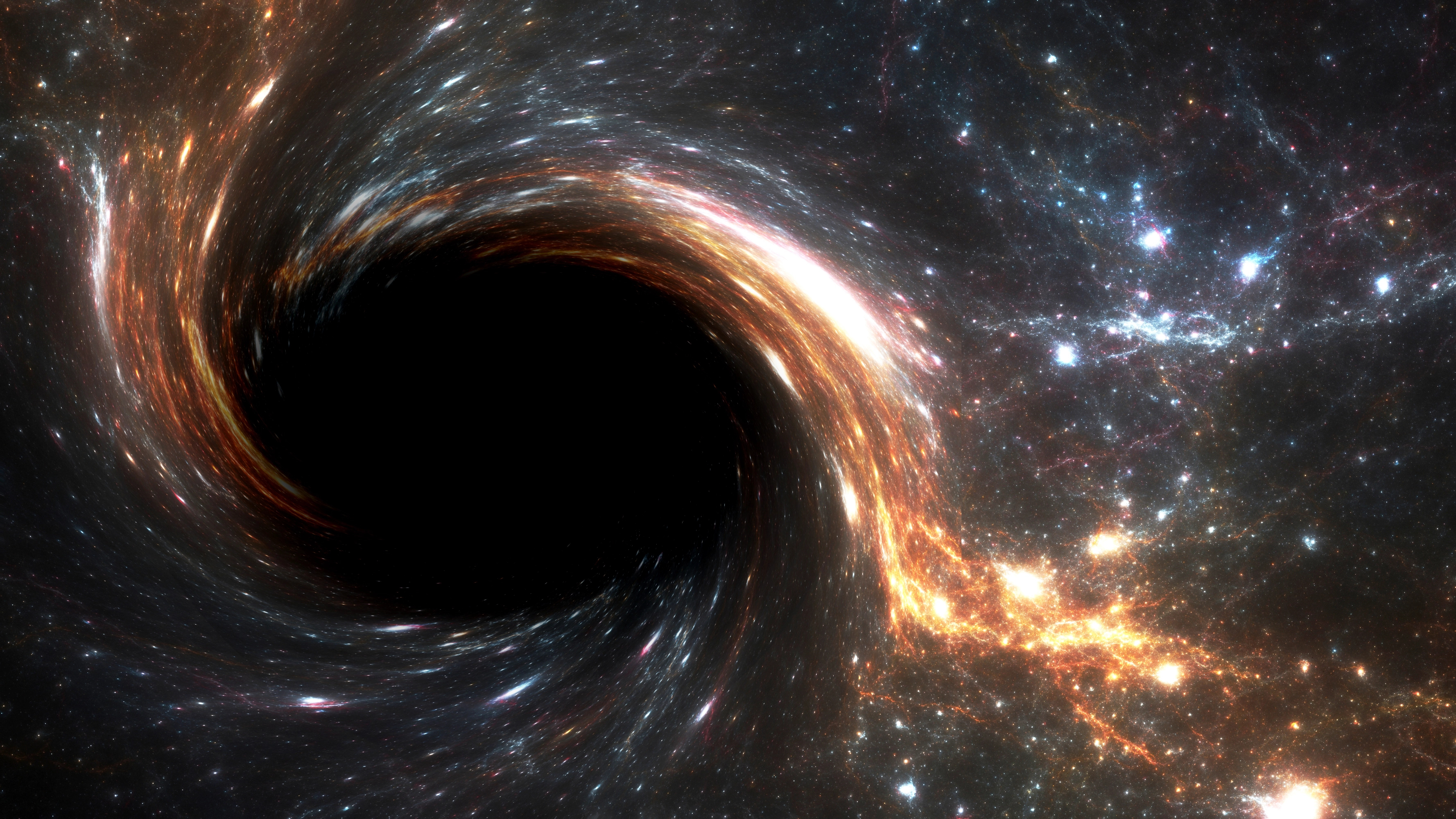
A star’s destruction exposed something astronomers normally could not see: a dormant supermassive black hole about 30,000 light-years from the center of its apparent host galaxy. An artificial-intelligence classifier found the flare in data from the Zwicky Transient Facility, turning a brief change in brightness into one of the strongest known cases of a wandering black hole.

The object’s location is the central mystery. Supermassive black holes are generally associated with galactic centers, yet this one sits 9.3 kiloparsecs from the nucleus, with no visible Milky Way-like galaxy around it. The findings published in The Astrophysical Journal Letters on July 27, 2026, leave two possible merger histories under investigation rather than declaring either one settled.
A rare flare inside a crowded data stream
The trail began with the Zwicky Transient Facility, a wide-field survey using telescopes at Palomar Observatory in California. It scans the northern sky every two days and records hundreds of thousands of changing celestial sources nightly. That volume makes manual inspection impractical and turns candidate selection into a data-processing problem as much as an observing problem.
Researchers trained an AI program to recognize the evolving light pattern of a tidal disruption event, which occurs when a star passes close enough to a black hole for extreme gravity to pull it apart. Heated stellar debris then produces a luminous but temporary signal. The classifier began operating in August 2025 and identified this event, designated TDE 2025abcr, three months later.
The speed of that result matters, but not because AI independently proved that a wandering black hole existed. Machine learning performed the initial triage: it located an unusual candidate among a large stream of transient events without assuming that the flare had to originate in a galactic nucleus. Astronomers then needed observations across multiple wavelengths to determine what had produced it.
Follow-up separated the flare from competing explanations
The event presented several characteristics associated with a tidal disruption flare, including a blue optical continuum, broad hydrogen and helium emission lines, bright ultraviolet emission and very soft X-rays that faded quickly. Spectroscopy and other observations found no signs that the apparent host contained an active galactic nucleus capable of explaining the flare.
NASA’s Neil Gehrels Swift Observatory contributed ultraviolet and X-ray measurements, while ground-based telescopes supplied optical data. Together, those observations supported the tidal disruption classification despite the event’s unusual position.
The light curve indicates that the disrupting black hole has a mass of roughly one million Suns, comparable in scale to the supermassive black hole at the Milky Way’s center. For a massive but inactive object with little surrounding material, the destroyed star effectively served as a temporary beacon. Without that chance encounter, the black hole could have remained dark and absent from conventional searches based on persistent radiation.
The location points toward a merger, but not one history
The projected 30,000-light-year offset makes TDE 2025abcr especially significant. Astronomers had previously identified tidal disruption events outside galactic centers, but this is described as the first inactive black hole found at such a large distance from a galactic core and the farthest-offset event of its kind discovered optically.
One proposed origin begins with a smaller galaxy merging into a larger one. The larger system could strip away nearly all of the smaller galaxy’s stars while leaving its dense core and supermassive black hole in the outskirts. That would explain why an object normally formed and hosted in a galactic center now appears to have little visible galaxy around it.
A second possibility involves an interaction among three black holes following multiple mergers. Their gravitational dynamics could have expelled the lightest member from the center. The current observations do not establish which scenario occurred, and they do not prove whether another black hole remains active or inactive in the apparent host’s nucleus.
Additional observations of the fading flare and its surroundings may reveal whether a sparse stellar remnant accompanies the black hole, helping researchers test the stripped-galaxy explanation against dynamical ejection. The team is also continuing its AI-assisted search for more off-center events.
Future wide-field surveys, including those from the Vera C. Rubin Observatory, are expected to produce a much larger pool of transient candidates. Actual wandering-black-hole detection rates remain unmeasured, but TDE 2025abcr establishes the essential search method: stop assuming every star-shredding flare belongs at a galaxy’s center, let software examine the full survey stream, and use rapid follow-up to determine what briefly lit up in the dark.
By David Whitaker — Associate editor for AMI’s aerospace and drone systems desk, translating flight systems, aircraft programs, spaceflight, and UAV developments into accessible technical stories.