NASA Plans More Than 20 Robotic Landings Before Moon Base Supports Humans
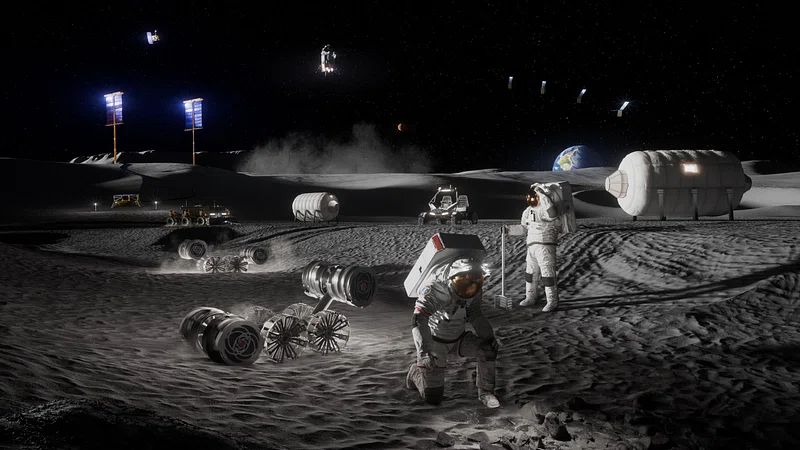
More than 20 robotic Moon landings are the foundation of NASA’s current plan for a durable outpost near the lunar South Pole. The agency’s Phase I architecture through 2029 uses uncrewed missions to deliver instruments, test infrastructure and build operational experience before the proposed Moon Base supports astronauts.

That number matters because a lasting outpost cannot depend on one successful landing. NASA needs recurring cargo delivery, autonomous touchdown capability, communications, surface power and mobility systems that work under actual lunar conditions. The program’s commercial approach distributes that work across multiple missions and suppliers rather than asking one spacecraft to establish the entire network.
Four landers tackle different parts of the system
Blue Origin, Firefly Aerospace, Intuitive Machines and Voyager Technologies are preparing prominent missions within the buildup. They are not simply delivering interchangeable cargo boxes. Their spacecraft address different payload classes, destinations and infrastructure requirements.
Blue Origin’s Blue Moon MK1 lander has completed an environmental campaign that included thermal-vacuum testing at NASA’s Johnson Space Center. Its structure, propulsion elements and avionics are assembled, with further integration and testing still ahead. The first MK1 mission, Endurance, is expected to demonstrate precision landing and autonomous operation while characterizing the lunar environment.
Those capabilities are central to repeatability. Surface infrastructure cannot be assembled reliably if each cargo flight arrives with excessive landing uncertainty or requires extensive intervention from Earth. Endurance remains a planned demonstration, however, not proof that the complete delivery system is operational.
Firefly Aerospace’s Blue Ghost Mission 2 combines its lander with the Elytra orbital spacecraft in a 22-foot-tall configuration. Planned as the first American landing on the Moon’s far side, the mission is intended to carry three NASA payloads. Elytra adds the ability to deploy payloads in lunar orbit as well as support delivery to the surface, widening the mission beyond a conventional lander profile.
Intuitive Machines is assembling Trinity, the Nova-C lander for its third lunar landing mission. Trinity is planned to deliver five NASA payloads, six commercial payloads and one civil payload while investigating Reiner Gamma. The mission is also expected to deploy Altus-1, a lunar data-relay satellite carrying three payloads.
The relay satellite illustrates an important constraint on the broader architecture: cargo on the ground is useful only if operators can communicate with it consistently. Lunar communications become particularly consequential as missions spread beyond locations with straightforward links to Earth.
Voyager Technologies’ Griffin-1 is undergoing testing at NASA’s Jet Propulsion Laboratory in Southern California ahead of a scheduled late-2026 launch. The infrastructure-class lander is expected to carry the largest commercial payload yet delivered to the lunar surface. Five NASA payloads are planned for installation on Astrolab’s FLIP rover, linking cargo delivery with surface mobility and longer-duration operations.
Surviving the lunar night remains a systems test
NASA is separately working with Northrop Grumman on three planned surface demonstrations using power and avionics technology originally developed for Gateway’s Habitation and Logistics Outpost module. The demonstrations are expected to examine survival through lunar night, shared surface power, avionics and related capabilities.
This is more than a component-reuse exercise. A surface outpost requires power and data interfaces that can serve multiple assets, rather than isolated payloads carrying entirely independent support systems. Shared infrastructure can reduce duplication, but it also raises the importance of compatible interfaces and dependable operation across missions from different suppliers.
The more-than-20-landing architecture should therefore be read as a test sequence and supply-chain plan, not as 20 equivalent successes already secured. Environmental qualification on Earth reduces risk, while only lunar operations can show how landing, deployment, power, communications and mobility perform together over time.
NASA’s commercial model also leaves room for missions to change. The agency and Draper recently terminated a separate $73 million lunar delivery task order after lander redesign delays pushed its projected landing into 2030 or 2031. NASA said it remained committed to finding future rides for the mission’s completed science instruments. That case underscores why a recurring delivery architecture needs multiple providers and rebooking options, not merely a long mission count.
Through 2029, the decisive progression will be from individual landings to connected operations: cargo arriving repeatedly, surface assets communicating, mobile systems moving payloads and power hardware enduring harsh lunar cycles. Until those functions are demonstrated together, NASA’s South Pole outpost remains an architecture under construction rather than a base ready for people.
By David Whitaker — Associate editor for AMI’s aerospace and drone systems desk, translating flight systems, aircraft programs, spaceflight, and UAV developments into accessible technical stories.