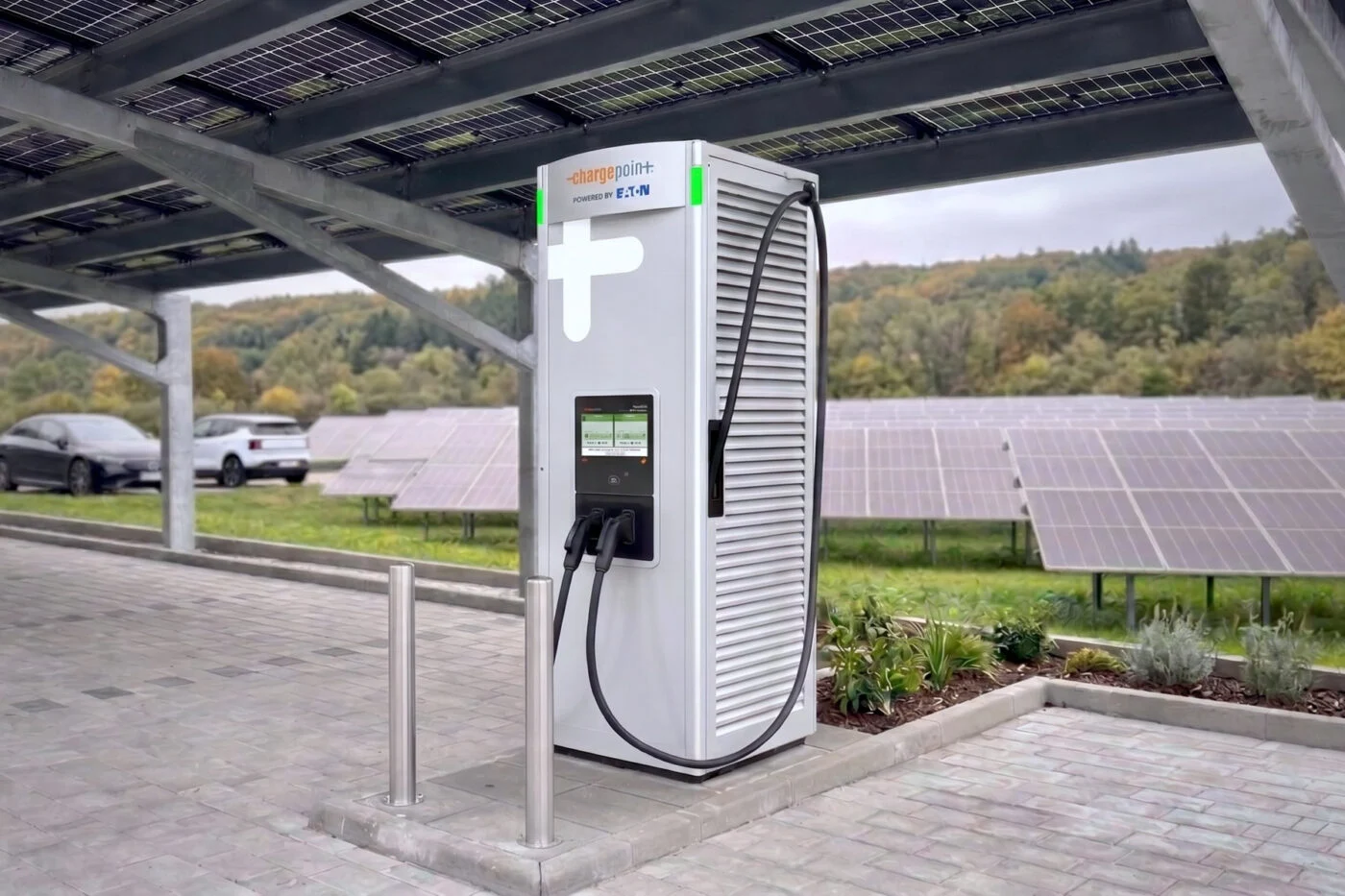
ChargePoint Forecasts Sub-$1,500 Home Chargers by Shifting Power Conversion Into EVs
The expensive component separating many electric vehicles from practical home-backup duty is not necessarily the battery. It is the additional power-conversion equipment installed at the house. ChargePoint expects a bidirectional AC home charger priced below $1,500 could avoid that external inverter by assigning the conversion work to the vehicle itself.

That price is a company forecast, not a released product or a complete installed-system quote. ChargePoint senior manager Eduardo Guraieb also forecasts that automakers will introduce compatible vehicle models within roughly a year. Broad deployment still depends on vehicle software, certified hardware, communication standards and utility interconnection requirements.
External inverter versus onboard conversion
A conventional Level 2 home charger supplies 240-volt AC electricity. Power electronics aboard the EV convert that incoming power to the DC electricity stored by the battery. In the vehicle-to-home systems described by Guraieb, the process works differently on discharge: the vehicle returns DC power, so a separate home inverter must turn it into household AC.
That DC-return architecture adds more than a wall-mounted charging unit. It requires the external inverter, switching equipment and professional installation. Guraieb placed the combined parts-and-labor cost at approximately $13,000 to $15,000, while the broader estimate starts at $12,000. At that level, using an EV as occasional household backup becomes difficult to justify on equipment cost alone.
Bidirectional AC charging changes the system boundary. The vehicle converts battery DC back to AC before electricity leaves the charging connection, eliminating the separate home inverter. ChargePoint expects the associated home charger to cost more than a conventional one-way unit but less than $1,500. That figure applies to the planned charger, however; it does not establish the final cost of switching hardware, electrical work, permits or utility-required equipment.
Existing power electronics do not guarantee compatibility
Guraieb said most EVs already contain hardware capable of converting power in both directions. “They already have the equipment in there to be hardware-capable of converting the power back and forth,” he said. But there’s also a software component. That’s what cars don’t currently have.
That distinction matters. Hardware capability does not mean an existing EV can safely export power simply through a software command. Different onboard-charger components may be required, and the available information does not identify which current models could qualify for a future over-the-air update. Automakers also must validate thermal behavior, power limits, battery-management coordination and control logic for each supported vehicle architecture.
The charger and vehicle must continuously coordinate rather than merely reverse current flow. Guraieb said their communication negotiates how much battery power to release in response to household demand. ISO 15118-20 provides part of that communication framework, including power negotiation. A July 2026 amendment described by the Charging Interface Initiative added AC distributed-energy-resource services intended to strengthen bidirectional interaction and smart energy management.
Certification is the other half of interoperability
Communication rules alone do not certify an EV and charger for connection to a U.S. electrical system. UL Standards & Engagement released UL 1741 Supplement SC in May 2026 for AC bidirectional charging equipment used with vehicles carrying bidirectional onboard inverters designed and tested to SAE J3072. The pathway allows the charger to act as an oversight supervisor and is intended to reduce dependence on certifying every vehicle-and-charger combination as one matched system.
Existing U.S. approaches remain uneven. California and Maryland have defined pathways for matched multipiece systems, while other utility and state rules are still evolving. Exporting power in parallel with the grid also introduces interconnection requirements beyond those involved in isolated home-backup operation. A system approved to energize a disconnected house therefore should not be assumed to have approval for vehicle-to-grid service.
The comparison explains both the opportunity and the constraint. Moving conversion aboard the EV can remove one of the costliest boxes from the home installation, but it transfers more responsibility to vehicle engineering, software validation and cross-manufacturer controls. ChargePoint’s sub-$1,500 forecast becomes meaningful only when a certified charger, a specifically supported vehicle and the applicable utility rules all meet at the same driveway.
By Robert McKinney — Editor-in-Chief for AMI’s automotive and mobility coverage, with a mechanical engineering background and a decade reporting on powertrain systems, EV innovation, and global vehicle manufacturing.