Perseids Peak at 100 Meteors an Hour on Dark Eclipse Night
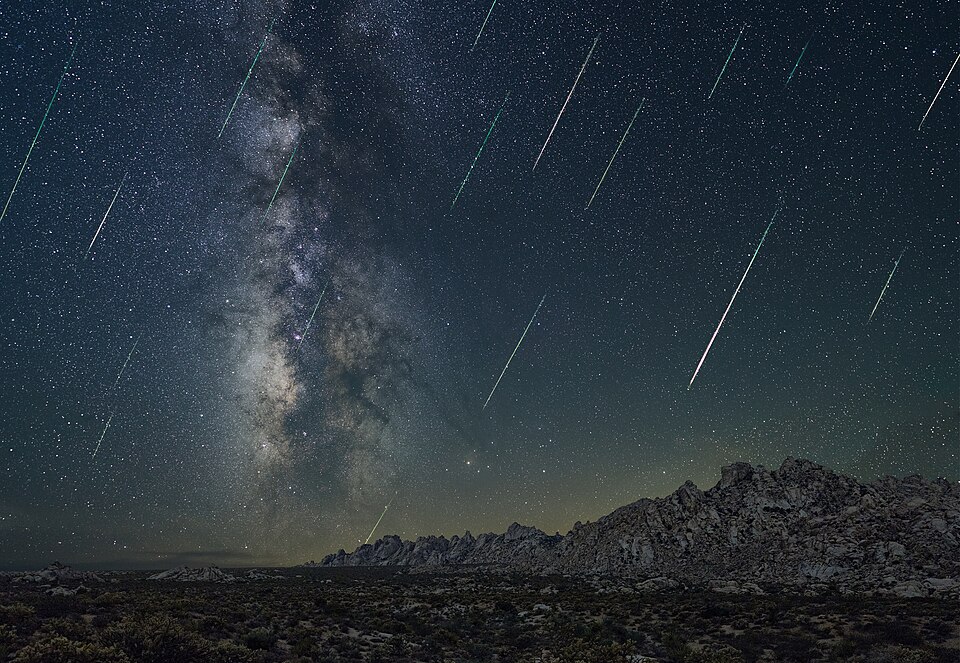
Two different orbital encounters are lining up on Aug. 12. Earth is crossing a stream of comet debris that produces the Perseid meteor shower, while the Moon is moving directly between Earth and the Sun to produce a total solar eclipse. The events do not cause each other, but their shared timing creates an unusual observing window: the Perseids could produce up to 100 meteors per hour under ideal conditions, and the new moon leaves the overnight sky free of bright moonlight.

The meteor shower peaks from Wednesday evening, Aug. 12, into the early hours of Thursday, Aug. 13. NASA’s August skywatching guidance describes the skies as ideally dark because the peak falls on the new moon. That benefit extends well beyond the eclipse path, giving observers across much of the Northern Hemisphere a better chance of seeing faint meteors that moonlight could otherwise wash out.
Comet debris, not the eclipse, creates the Perseids
The Perseids occur when Earth passes through a debris stream left by comet 109P/Swift-Tuttle, which was discovered in 1862. Tiny pieces of comet material enter the atmosphere at high speed and produce bright streaks as they disintegrate. Some become fireballs unusually bright meteors capable of leaving glowing trails.
The shower appears to radiate from the constellation Perseus, which gives the Perseids their name. That apparent origin is a perspective effect, much like parallel lines seeming to converge in the distance. Meteors can flash across any part of the sky, so observers do not need to stare directly at Perseus.
The quoted rate of as many as 100 meteors per hour is an upper-end figure, not a guarantee for every backyard. It assumes favorable weather, a genuinely dark location, an unobstructed sky and good positioning of the shower’s radiant. Clouds, artificial lighting, haze and restricted sightlines can reduce the visible count substantially. The new moon removes one major source of natural sky brightness, but it cannot correct the other limitations.
Totality follows a much narrower ground track
The eclipse has a separate mechanism and a far more restricted viewing area. Totality occurs only where the Sun, Moon and Earth align closely enough for the Moon to obscure the Sun completely. On Aug. 12, that narrow path crosses parts of Greenland, Iceland, northern Russia, the Atlantic Ocean, northern Spain and a small corner of Portugal.
Other Northern Hemisphere locations, including parts of the United States from Alaska to North Carolina, can experience a partial eclipse rather than totality. Anyone viewing a partial phase must use certified eclipse glasses or another safe solar viewer whenever any portion of the Sun remains visible. Regular sunglasses are not sufficient, and cameras, binoculars and telescopes require solar filters made for the front of their optics.
The eclipse’s daytime darkness should not be treated as a dependable meteor-viewing opportunity. Locations where totality occurs near sunset may have a chance to see a meteor during the brief dark interval, but that outcome is not established. Totality is short and geographically constrained, while the Perseid peak is an overnight event visible across a much broader region. Observers interested in both therefore need two plans rather than one.
Dark adaptation matters after the eclipse ends
For the meteor shower, Northern Hemisphere viewing is generally best in the hours before dawn from a dark, open location. NASA recommends allowing 20 to 30 minutes for eyes to adjust to the darkness. Looking at a bright phone screen during that period can interrupt the adaptation that helps the eye detect dim streaks.
Most Southern Hemisphere observers face a geometric disadvantage because the Perseids’ radiant generally remains below the horizon. In the north, the radiant climbs higher as the night progresses, improving the viewing geometry even though meteors can appear anywhere overhead.
Missing the precise peak does not end the opportunity. The Perseids have been active since mid-July and should remain visible for roughly two more weeks. The highest potential rates belong to the Aug. 12-13 peak, however, when the absence of moonlight gives the shower its most important advantage one available across a much larger area than the Moon’s narrow path of totality.
By David Whitaker — Associate editor for AMI’s aerospace and drone systems desk, translating flight systems, aircraft programs, spaceflight, and UAV developments into accessible technical stories.