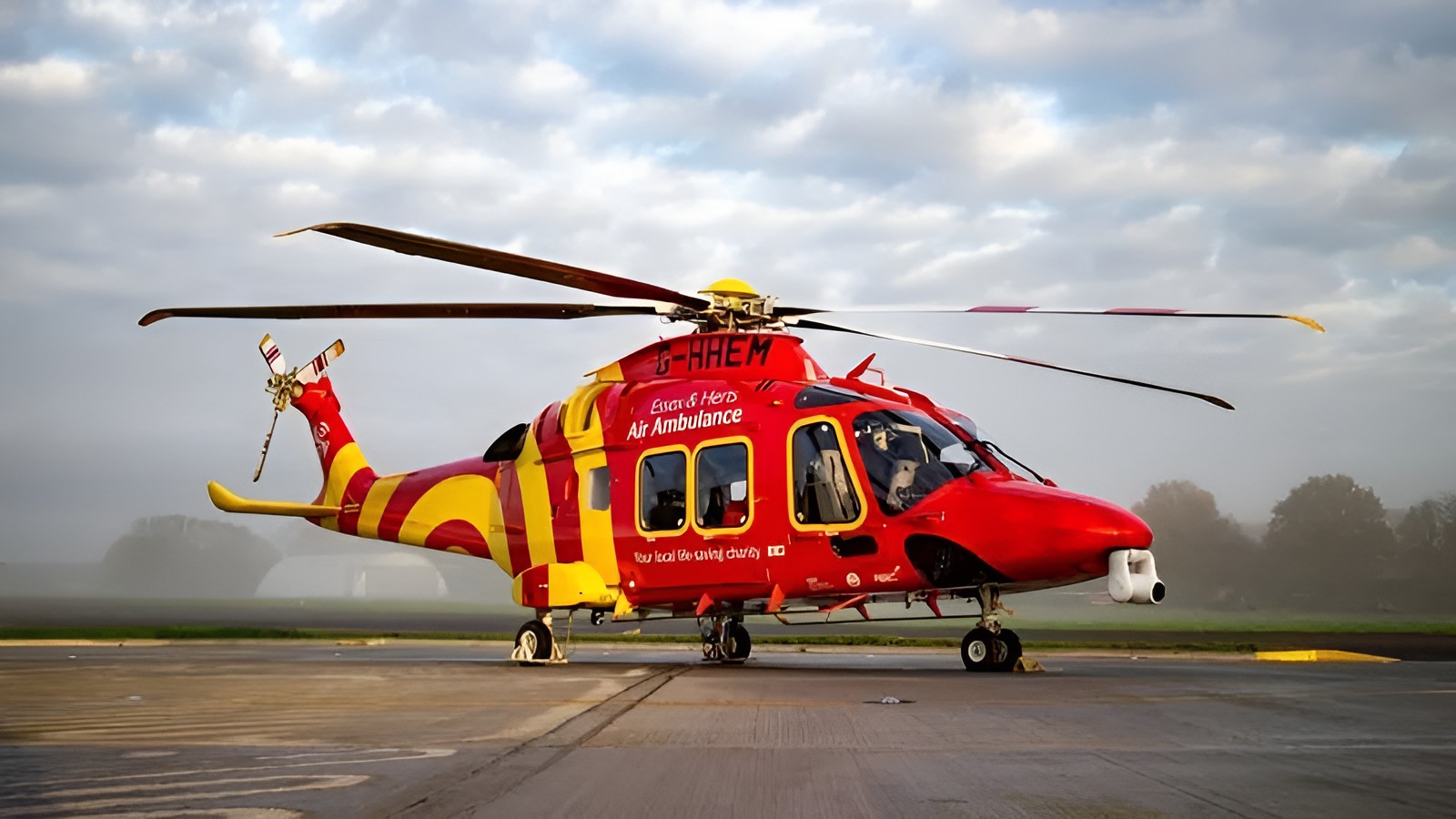
Essex & Herts Air Ambulance downwash seriously injures woman 30 metres away
A woman standing outside her home in Southend on Sea, Essex, was knocked over and seriously injured by an Essex & Herts Air Ambulance helicopter’s downwash on 28 February. She was approximately 30 metres, or 98 feet, from the aircraft, but a hedgerow prevented the pilot from seeing her.
The helicopter had just completed a medical emergency response and was departing from a field beside London Southend Airport’s car park at 18:08 GMT. The woman had gone outside after hearing its engines start. About 50 seconds after the aircraft began its vertical climb, the airflow from its rotor reached her position and blew her over. A relative came to her aid, and she was subsequently taken to hospital.
Other people had gathered to watch the departure but were not affected. The 47-year-old pilot, who had almost 4,000 flight hours, left without knowing anyone had been hurt and later landed at North Weald Airfield. The operator learned of the injury four days later from the woman’s relative.
Why 30 metres did not settle the risk
The investigation focused on an important limitation of distance-based assumptions: rotor wash does not spread across every site in a uniform circle. The pilot said he had not seen the woman and, in hindsight, had considered 30 metres a safe distance. The Air Accidents Investigation Branch took no action against the charity.
Investigators found that the nearby physical layout may have altered the airflow. Buildings and a car could have produced a funnel effect that increased the speed of the downwash where the woman was standing. That remained a possible contributing factor rather than a confirmed cause.
A helicopter generates lift by accelerating air downward through its main rotor. Near the ground, that flow turns outward and becomes a strong horizontal stream. Its strength and direction depend on the aircraft, its operating condition, wind and the surrounding terrain or structures. Vertical takeoffs are particularly relevant because the helicopter is producing substantial lift while remaining over a relatively concentrated area.
The hedgerow created a second problem independent of the airflow itself: visibility. It separated the woman from the pilot’s view while doing nothing to guarantee that rotor wash would remain on the helicopter’s side of the obstacle. The result was a bystander within the affected area whom the crew did not know was there.
A distance is guidance, not a universal boundary
Australian Civil Aviation Safety Authority guidance for light helicopters recommends a minimum 30-metre downwash safety distance around a surface-level landing site, with people, property and parked vehicles kept clear. The same guidance says that distance may need to be extended beneath the flight path or for operating techniques that create stronger local disturbances, including a vertical portion of takeoff.
That recommendation does not establish that 30 metres is safe or unsafe in every case. It illustrates why the Southend incident cannot be reduced to one radius: aircraft weight and rotor loading matter, but so do the departure profile, wind, buildings, vehicles and whether the public can enter areas hidden from the crew.
A broader Australian Transport Safety Bureau review of hospital helicopter sites found that rotor wash changes direction and can accelerate when it encounters terrain or structures. The review also identified incidents in which crews were unaware at the time that pedestrians had been injured. Those findings reinforce the operational challenge presented in Southend: the hazard can extend beyond the obvious landing area and beyond what pilots can directly observe.
Essex & Herts Air Ambulance responded by reminding its pilots about downwash hazards, including their presence during takeoff as well as landing. The incident leaves a concrete planning constraint for operations from improvised or built-up sites: a nominal stand-off distance cannot account by itself for concealed bystanders and locally channelled airflow.
| More aerospace and engineering stories, right in your MSN feed. Follow AMI on MSN |
By David Whitaker — Associate editor for AMI’s aerospace and drone systems desk, translating flight systems, aircraft programs, spaceflight, and UAV developments into accessible technical stories.