Navy Shows 1,500-Pound Missile Inside F-35C With 250-Mile-Plus Reach
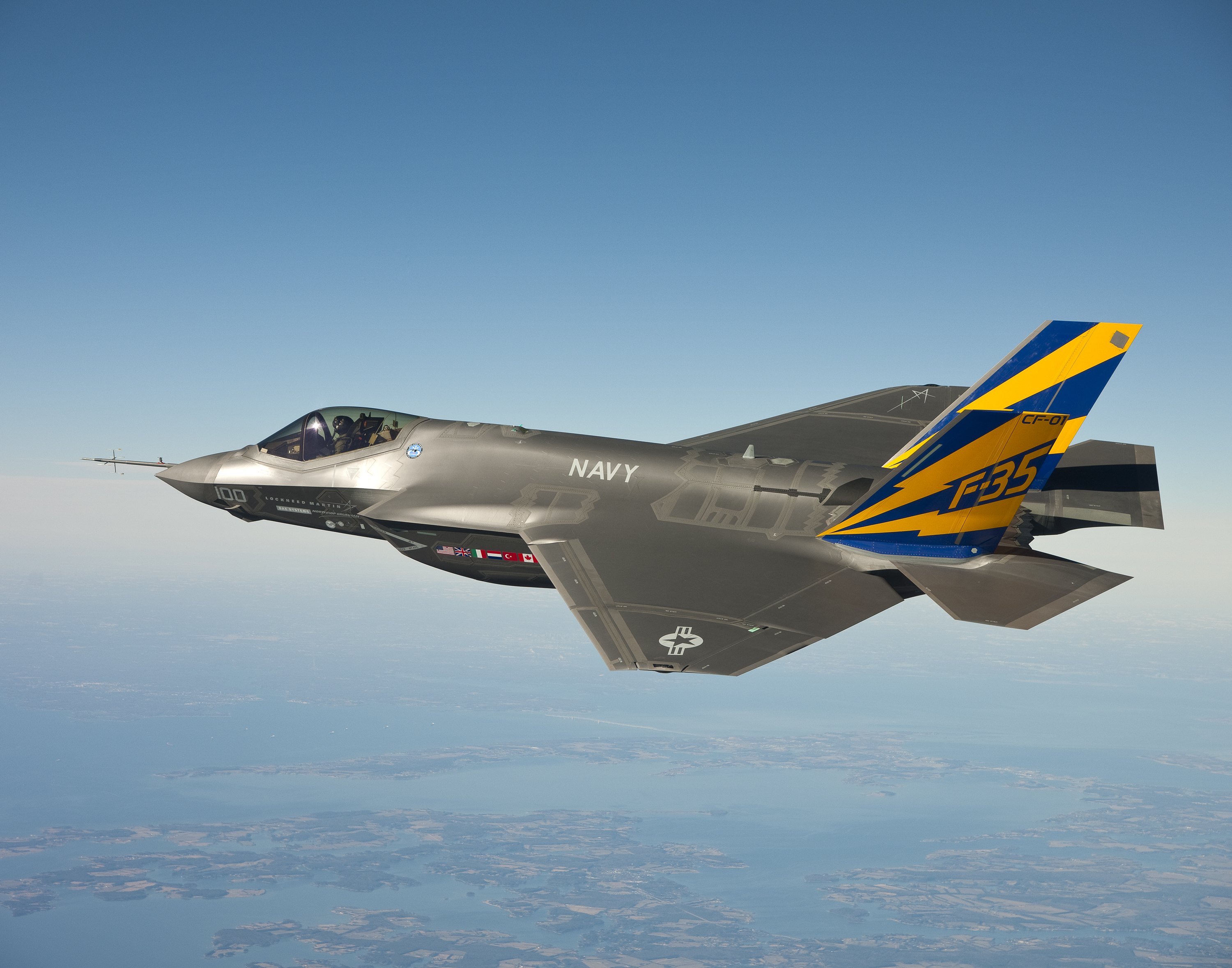
The Navy has disclosed a long-range air-to-air missile that differs from its other extended-range weapons in one critical respect: it fits inside the carrier-based F-35C. Released imagery shows two Raytheon AIM-424 Malice missiles in an internal weapons bay, potentially giving the fighter substantially greater reach without requiring external carriage.

The Navy’s official AIM-424 fact file, updated August 22, lists a range exceeding 250 nautical miles, equivalent to 288 statute miles or 463 kilometers. The service unveiled the program at the Tailhook Association convention in Reno, Nevada, and also released imagery of an F/A-18E/F Super Hornet carrying four missiles externally.
Internal fit separates Malice from the Navy’s larger missile
Range is only part of the engineering story. The Navy already fields the AIM-174B Gunslinger, an air-launched derivative of the ship-based Standard Missile-6. That weapon gives the Super Hornet a large, long-range interceptor, but it must be mounted outside the aircraft.
The AIM-424 is shorter, lighter and considerably narrower across its wings than the AIM-174B. Malice is listed at 13.5 feet long, 13.5 inches in diameter and 26.2 inches across the wings, with a weight of approximately 1,500 pounds. The AIM-174B is 16.5 feet long, has the same body diameter, spans 42.7 inches and weighs 1,830 pounds.
Those dimensional differences purchase a significant platform benefit. External weapons add exposed surfaces and radar-reflective geometry to an aircraft. Internal carriage lets the F-35C retain the weapons configuration used to minimize its radar signature. It also avoids placing a large missile in the external airflow, although the Navy has not released aerodynamic, range or handling data for an operational F-35C configuration carrying Malice.
The contrast illustrates why fitting within a weapons bay can matter as much as a missile’s headline range. AIM-174B provides a long-range option on the Super Hornet, while AIM-424 appears designed to bring comparable mission reach into a package compatible with the Navy’s stealth fighter. The disclosed F-35C fit is therefore more consequential than simply adding another externally carried weapon to the carrier air wing.
A large increase over the established baseline
For scale, a commonly cited estimate for the AIM-120D Advanced Medium-Range Air-to-Air Missile is about 100 statute miles, or 87 nautical miles. Its actual performance depends on conditions and remains sensitive, but that public estimate places the AIM-424’s stated figure in a substantially different range class.
The forthcoming AIM-260 is also expected to outrange the AIM-120, although its performance is classified. That leaves the public record incomplete: the Navy has disclosed enough to establish Malice’s physical dimensions, intended platform generations and claimed range category, but not enough to make precise comparisons among the newest missiles.
The AIM-424 uses a solid-propellant rocket motor and carries a blast-fragmentation warhead. The Navy describes it as a next-generation weapon for fourth-, fifth- and sixth-generation aircraft. The released configurations directly connect it with the Super Hornet and F-35C, while a future Navy fighter could also be a candidate. No detailed integration schedule has been announced.
Nor does a weapons-bay fit by itself establish fleet readiness. Aircraft integration normally must progress beyond dimensional compatibility to cover safe carriage, separation, software, avionics interfaces and operational testing. The Navy has not published results confirming the AIM-424’s full performance or disclosed when it will become operational.
That uncertainty sets the boundary around the announcement. The public specifications could be deliberately imprecise, and the missile’s true performance remains classified. What the Navy has confirmed is still notable: a roughly 1,500-pound missile with a listed reach beyond 250 nautical miles has been packaged for internal F-35C carriage. The next decisive milestone will be evidence that this striking physical fit can become a validated, fielded carrier-air-wing capability.
| More aerospace and engineering stories, right in your MSN feed. Follow AMI on MSN |
By David Whitaker — Associate editor for AMI’s aerospace and drone systems desk, translating flight systems, aircraft programs, spaceflight, and UAV developments into accessible technical stories.