FCC Satellite Uplink Proposal Opens Part 15 Access With Interference Limits
The Federal Communications Commission is considering a significant expansion of unlicensed-spectrum use, but not an unrestricted one. Its new proposal would let ordinary devices transmit to satellites in two widely used frequency ranges while requiring those uplinks to accept interference and avoid causing harmful interference. Satellite transmissions back to devices the harder coexistence problem have not been approved or proposed for immediate authorization.
The FCC adopted the Notice of Proposed Rulemaking on August 6, 2026, opening a proceeding on direct-to-device satellite communications in spectrum governed by Part 15 of its rules. The proposed Earth-to-space allocations cover 2.400-2.4835 GHz and 5.725-5.850 GHz. The adopted proceeding, which omitted the more complicated 902-928 MHz band considered in an earlier draft, now asks industry and other stakeholders to establish whether the remaining framework can operate without undermining existing users.
Uplinks start with familiar device limits
For transmissions from terrestrial devices to satellites, the FCC generally proposes retaining existing Part 15 power limits. These links would operate on an unprotected, non-interference basis: users could not claim protection from other operations, and their equipment could not cause harmful interference to authorized services.
That approach could reduce the regulatory and hardware burden of adding a satellite path to U.S.-market devices. It does not, however, settle whether limits developed around terrestrial use are sufficient when the intended receiver is in orbit. The proceeding asks specifically whether existing restrictions on power, antenna gain, bandwidth and out-of-band emissions are adequate for satellite communication.
Those questions matter at the systems-integration level. Device makers would need to demonstrate that an uplink remains compliant across antenna orientation, production variation and operating conditions. Satellite operators would simultaneously have to close the link within those terrestrial-device constraints. A permissive allocation is useful only if the radio, antenna, protocol and spacecraft receiver can form a reliable connection without acquiring an expectation of interference protection.
Downlinks change the interference geometry
The FCC is treating the reverse path more cautiously. It is seeking comment on possible downlinks in the 5.8 GHz band and other frequencies within the 5 GHz and 6 GHz ranges, but it has not proposed authorizing them at this stage.
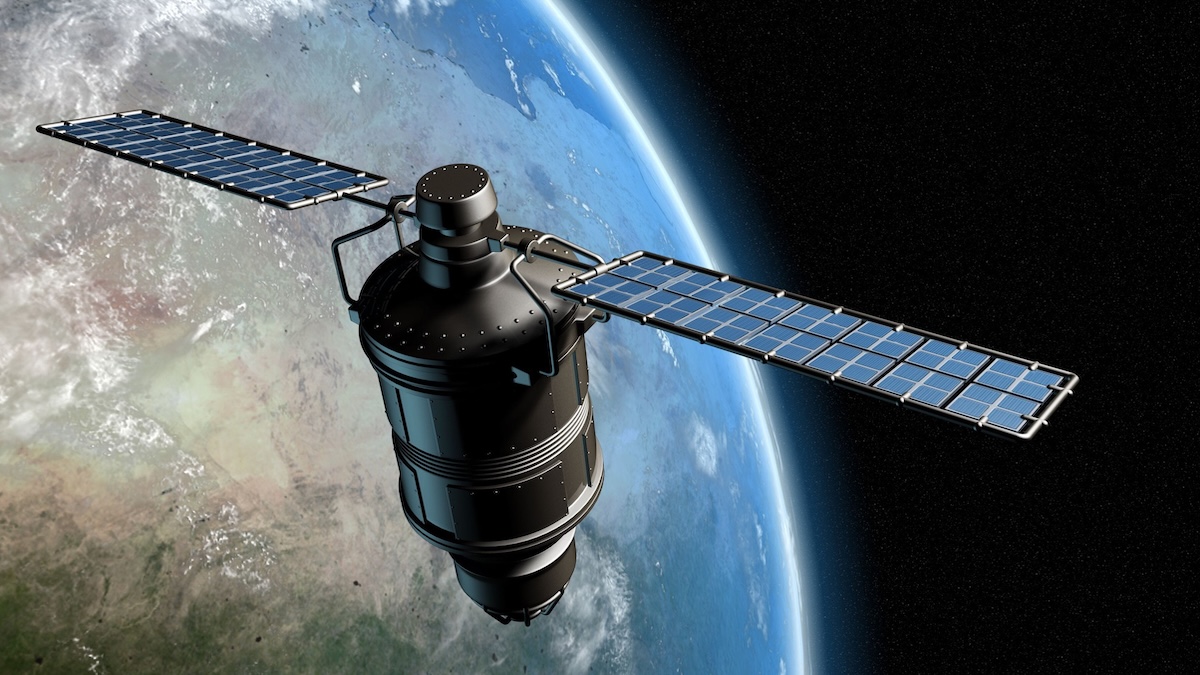
The distinction is grounded in coverage geometry. A terrestrial Part 15 transmitter generally affects a limited surrounding area. A satellite beam can illuminate a much larger geographic footprint, potentially exposing many Wi-Fi, internet-of-things and other unlicensed devices at once. That makes aggregate effects and geographic reach central engineering questions rather than secondary details.
Potential safeguards identified in the proceeding include power-flux-density limits, beam-size and geographic-coverage constraints, aggregate-interference controls and out-of-band-emission limits. The FCC also asks about contention mechanisms such as listen-before-talk. Each option carries a tradeoff: tighter beams and lower received power can improve coexistence, but they may reduce coverage, link margin or service continuity.
Research into distributed satellite arrays illustrates why beam control cannot be treated as a simple software setting. A recent resource-allocation study of distributed satellite systems found that wider spacing between antenna sub-platforms can narrow the principal beam while increasing grating lobes unwanted directional replicas that complicate frequency reuse. Adding more radiating elements can sharpen the beam without creating additional grating lobes, but increases system complexity and implementation effort. The study does not resolve the FCC proceeding, yet it demonstrates the physical tradeoffs behind proposed beam and aggregate-interference limits.
Authorization remains a systems question
The proceeding also leaves open how devices and spacecraft would receive permission to operate. Options for terrestrial equipment include authorization by rule, blanket licensing under Part 25, conventional licensing and hybrid Part 15/Part 25 arrangements. For spacecraft, the FCC is considering Part 25 licensing, authorization by rule for some operations and a permitted-space-station list. Under the approaches discussed, satellite systems would remain within the Commission’s satellite regulatory regime.
A separate proposal would clarify that Part 15 devices may operate aboard authorized spacecraft. The FCC tentatively concludes that distance from Earth and spacecraft shielding make harmful interference unlikely, while requesting comment on appropriate restrictions. Potential applications include extravehicular activity, links between spacecraft, and in-space servicing, assembly and manufacturing.
The proceeding therefore offers a possible route to simpler satellite uplinks, not a completed service framework. Its decisive work will be converting non-interference principles into measurable power, emission, beam and authorization limits that device manufacturers and satellite operators can test, certify and enforce especially before any satellite downlink is allowed into spectrum already shared by millions of terrestrial systems.
| More aerospace and engineering stories, right in your MSN feed. Follow AMI on MSN |
By Thomas Caldwell — AMI’s senior editor for mechanical and mobility engineering, covering vehicle electronics, systems integration, electrification, chassis systems, propulsion, and safety policy.