Seven Officials Referred Over Jeju Air Localizer Safety Claims After 179 Deaths
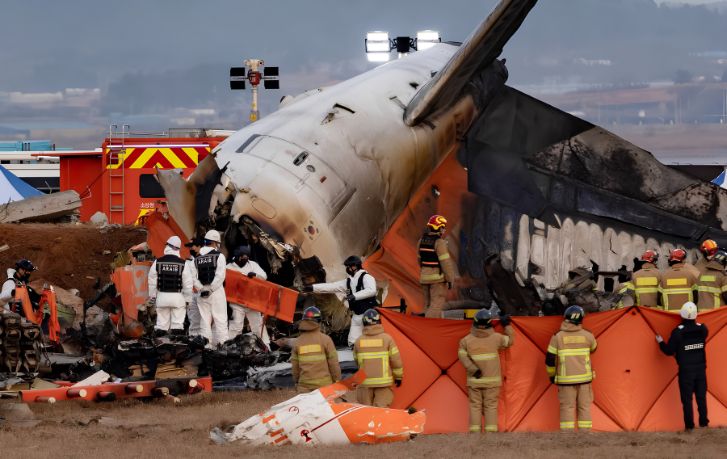
South Korean police referred seven transport ministry officials to prosecutors on Aug. 25 over allegations that they knowingly omitted collision-safety requirements when declaring a concrete-mounted airport navigation system compliant. The referral follows the Jeju Air crash at Muan International Airport that killed 179 passengers and crew members, but it is not a finding that the structure caused the crash or the loss of life.
The disputed statements concerned a localizer, a ground-based navigation system that helps guide aircraft during landing. Jeju Air’s passenger jet made an emergency belly landing on Dec. 29, 2024, and then struck the concrete mound housing Muan airport’s localizer. According to the special police investigation findings, ministry officials subsequently prepared two releases saying the installation complied with regulations, despite knowing about requirements they did not include.
The omission at the center of the case
The central question in the referral is narrower than accident causation: What did officials know about the applicable construction rules, and what did they communicate to the public after the crash?
Police allege that the officials selectively cited provisions favorable to the ministry while excluding rules requiring navigation structures in the relevant area to be made from materials and supports that break easily when struck by an aircraft. International Civil Aviation Organization provisions cited by investigators call for structures within 300 meters of a runway end that do not meet those breakaway requirements to be replaced or moved outside the zone.
That distinction matters because regulatory compliance cannot be evaluated by looking only at whether navigation equipment is permitted at a particular location. The support, foundation and surrounding installation also determine how the equipment interacts with an aircraft that leaves the intended operating surface. A localizer must be positioned to perform its navigation function, but installations exposed to a possible collision are expected to limit resistance rather than behave as rigid obstacles.
In airport engineering, this concept is generally described as frangibility. An easily breakable support is intended to separate or collapse under collision loads, reducing the additional forces imposed on an aircraft. It does not prevent a runway excursion, guarantee survivability or make the navigation equipment harmless. It is a consequence-mitigation measure: a way to avoid adding unnecessary structural resistance once an aircraft has already departed its normal path.
The concrete mound therefore presents two separate technical questions. One is whether its design and location complied with the rules that applied to Muan airport. The other is whether and to what degree the collision affected the outcome of Flight 2216. Police say officials concealed relevant requirements when addressing the first question. The available findings do not resolve the second.
Communications are part of the safety system
The referral also illustrates why post-accident technical communications require the same configuration discipline used in engineering work. A statement can be literally grounded in one provision yet still mislead if another applicable requirement is knowingly excluded. Compliance determinations must account for the complete rule set, the physical installation and the boundaries of any exception not merely the language that supports a preferred conclusion.
For passengers and airport users, that process affects more than institutional credibility. Accurate disclosures help investigators, airport operators and regulators identify whether similar structures require inspection, replacement or relocation. An incomplete compliance assurance can delay that broader assessment, particularly when the disputed feature involves a passive safety measure whose purpose becomes relevant only during an abnormal event.
Still, a prosecution referral is not a conviction. Prosecutors must review the allegations and determine how to proceed. The referral concerns the preparation and distribution of allegedly false official documents after the crash; it does not by itself establish who was responsible for the localizer’s original installation or whether the mound contributed to the death toll.
The accident board still has the causal question
A separate aviation accident investigation is continuing under South Korea’s prime minister’s office. That inquiry must distinguish the events that led to the emergency landing from the factors that influenced what happened afterward. It must also evaluate the localizer structure within the complete accident sequence rather than infer causation from its presence alone.
Police have said they will announce the final results of their broader probe after the aviation accident investigation board completes its work. Until then, the strongest confirmed conclusion is limited but consequential: investigators believe officials knew about breakaway-structure requirements and omitted them from public claims of compliance. Whether the concrete-mounted localizer changed the crash outcome remains an unresolved question for the accident board.
| More aerospace and engineering stories, right in your MSN feed. Follow AMI on MSN |
By Thomas Caldwell — AMI’s senior editor for mechanical and mobility engineering, covering vehicle electronics, systems integration, electrification, chassis systems, propulsion, and safety policy.