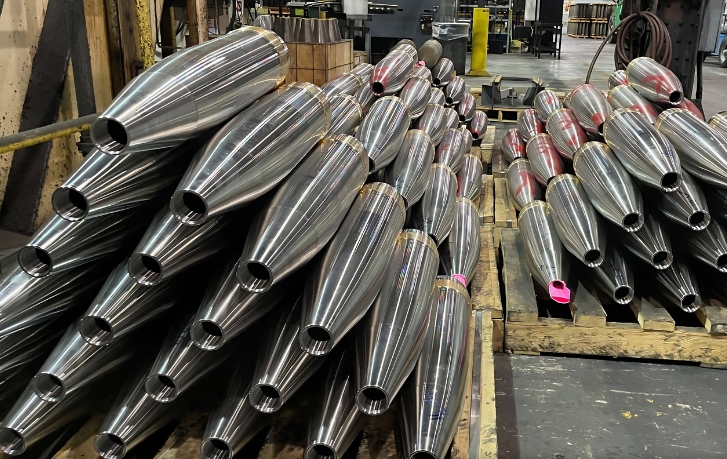
General Dynamics’ $533 Million Army Factory Reportedly Produced No Usable Shells
The U.S. Army paid General Dynamics $533 million for an automated artillery factory in Texas that reportedly failed to produce a single usable shell body. The central problem was not simply a late production ramp: the government committed to three manufacturing lines without first requiring an end-to-end demonstration that the equipment could turn the specified steel into parts meeting Army requirements.
The plant was intended to expand production of newer-model 155 mm projectile bodies. The Army halted work on two of its three lines in August 2025 and says it will spend no additional money on the facility. Yet the government made another $26.3 million in progress payments in December 2025 for two lines that had not produced a usable shell. The Army now says it is evaluating performance, seeking recoupment and redirecting resources.
Automation was purchased before the process was proven
General Dynamics proposed automated equipment supplied by Turkish manufacturer Repkon rather than replicating the company’s established Pennsylvania production method. Army and General Dynamics personnel visited Turkey, but they did not inspect a complete artillery production line in operation. Nor did the Army demand a full demonstration showing that the proposed line could make a compliant part before approving the project.
That distinction matters in heavy manufacturing. A collection of machines can perform correctly in isolation and still fail as a production system. Material behavior, forming loads, part handling, robot timing, tooling and inspection all have to work together across the complete process. The acceptance question is not whether an individual machine runs; it is whether the line repeatedly produces conforming parts at the required rate.
The Army said formal testing could not occur until the machinery was fully installed. That sequencing transferred a large share of the technical risk into the factory-construction phase, after substantial public money had already been committed. A staged validation program could not eliminate every commissioning problem, but an end-to-end trial using the required material and product specifications would have tested the central manufacturing premise earlier.
Former workers described robotic arms catching fire, moving unpredictably and striking equipment. They also said machines mangled shell noses and that a key forming process cracked the specified steel. Those accounts were part of reporting based on interviews with 36 people and a review of internal documents, photographs and factory material. They should be distinguished from formal findings about each malfunction, but they align with the confirmed bottom-line problem: the facility did not deliver parts meeting contract specifications.
Missed acceptance tests removed an important control point
General Dynamics also missed scheduled first article tests, the formal checkpoints intended to establish that an initial product conforms to requirements before broader production proceeds. Missing that milestone is more consequential than falling behind a routine output schedule. Without an accepted first article, higher production volume would only multiply uncertainty about whether the process can make a usable part.
The Defense Department did not competitively bid the project. Army officials accepted the risk of adapting available equipment because it was expected to be faster than obtaining a new production line designed around the required part. A later Defense Department watchdog assessment said the unproven approach hindered the Army’s wider production goal.
Speed was a real procurement constraint after Russia’s 2022 invasion of Ukraine increased pressure to replenish U.S. inventories and expand industrial capacity. But urgency changes the tradeoff; it does not repeal manufacturing validation. Buying available machinery can shorten procurement lead time, while adapting it to a different material or geometry can create development work that erases the apparent schedule advantage.
The cost also represents an opportunity consequence for taxpayers and the Army. Money tied up in an unsuccessful line was unavailable for other production equipment, facilities or defense priorities during the same period. The plant was expected to contribute 30,000 projectile bodies per month toward an Army goal of 100,000 rounds. As of March 2026, overall production had reached 36,000 per month, and inspectors said the missing Texas output limited the projected capacity.
Recovery remains unsettled
The Army characterizes its oversight as rigorous and says it expects to recover project funding through unspecified discounts on other General Dynamics production orders. That is not the same as a completed direct repayment, and the amount, timing and mechanics of any recovery remain unresolved. The service did not unilaterally terminate the awards when it stopped work on two lines.
General Dynamics maintains that it “met or exceeded requirements” and says the reporting “fundamentally mischaracterizes the circumstances,” although its spokesperson did not identify specific errors. The Army says it has no evidence of sabotage or spying by Repkon employees, removing an unsupported explanation from what is fundamentally a production and procurement problem.
The next meaningful measure is therefore not another installation milestone or payment adjustment. It is a successful acceptance test showing that a complete line can repeatedly turn the required steel into compliant projectile bodies. Until that happens, the $533 million plant remains a demonstration of why production capacity must be measured in accepted output not installed machinery.
| More aerospace and engineering stories, right in your MSN feed. Follow AMI on MSN |
By David Whitaker — Associate editor for AMI’s aerospace and drone systems desk, translating flight systems, aircraft programs, spaceflight, and UAV developments into accessible technical stories.