Golden Dome’s 7,800 Satellites Drive $1.2 Trillion 20-Year Cost Estimate
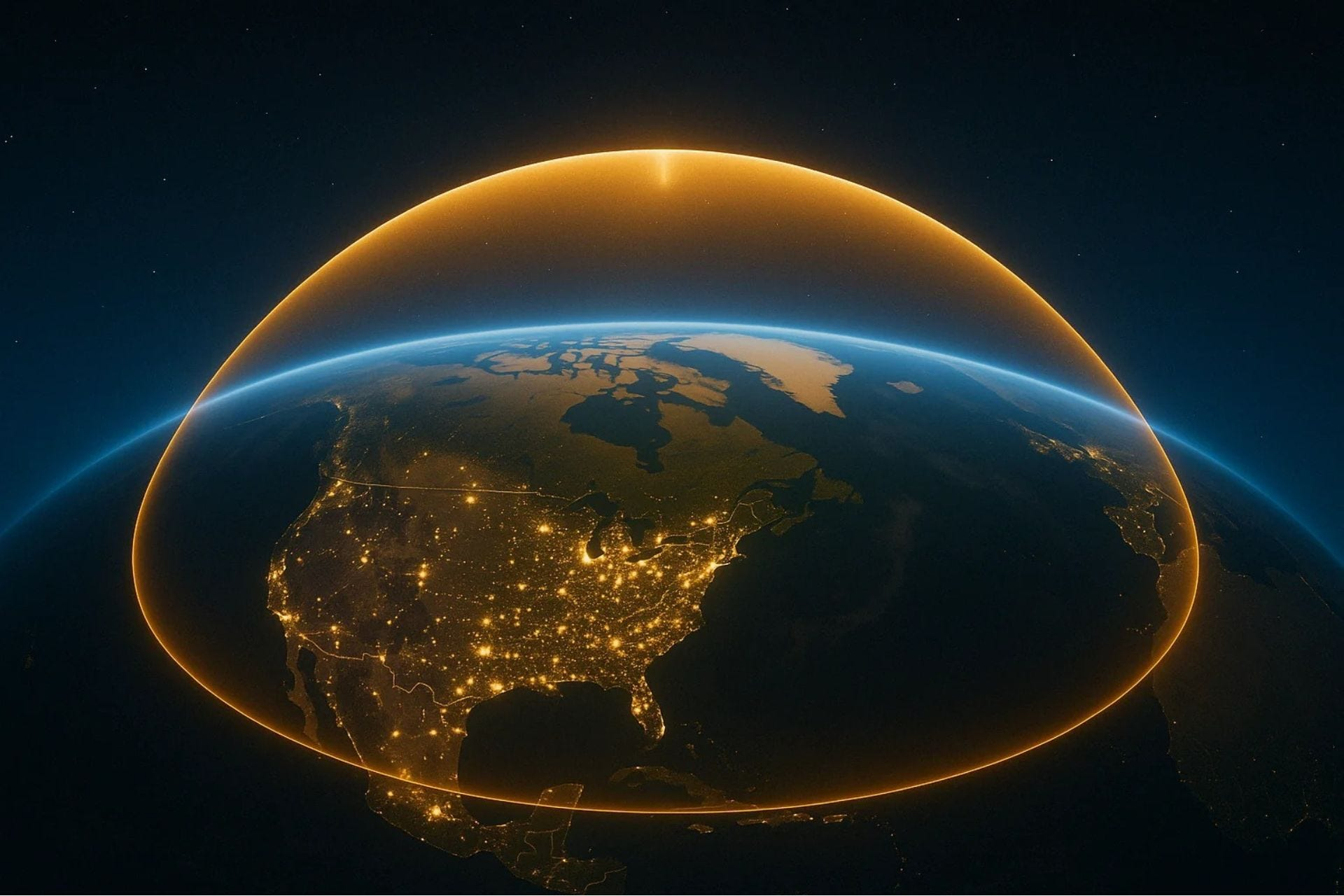
$1.2 trillion over 20 years. That is the Congressional Budget Office’s estimate for developing, deploying and operating a notional Golden Dome missile-defense architecture and the dominant cost is a proposed layer of 7,800 space-based interceptor satellites. The CBO put acquisition costs alone at just over $1 trillion, with the orbital interceptor layer accounting for roughly 70% of that amount.
The estimate is substantially higher than the $185 billion figure provided by Golden Dome director Gen. Michael Guetlein. A Congressional Research Service overview of Golden Dome lists both figures while describing a broader system of ground-based interceptors, sensors, command-and-control networks and space-based elements. The figures should not yet be treated as comparable bids for an identical system: they appear to cover different periods, and the publicly available information does not establish that they include the same architecture, activities or budget categories.
Constellation size changes the acquisition problem
The CBO number is easier to understand when the proposed satellite count is treated as the organizing variable rather than one feature among many. A 7,800-spacecraft interceptor layer would make Golden Dome a large-scale space production and integration program, not simply an expansion of existing missile defenses.
At that scale, acquisition extends beyond buying spacecraft. It encompasses the recurring production of satellite hardware, launch demand, deployment, integration with sensors and command systems, and the work required to make thousands of orbital elements function as part of a larger architecture. The available estimate does not separately quantify those implications, but the 70% share assigned to the interceptor layer shows where the CBO’s cost model concentrates the financial burden.
That distinction matters for federal budget planning. Ground-based interceptors, radars and command systems are also expensive, but the proposed orbital layer adds a manufacturing challenge measured in thousands of units. Any change in the required constellation size, spacecraft design or production assumptions could therefore have an outsized effect on total acquisition cost. Conversely, a Golden Dome architecture with a smaller or different orbital component would not necessarily resemble the system the CBO priced.
The $185 billion gap remains unresolved
The Pentagon’s position is that outside estimates do not represent the architecture it is building. Guetlein has argued that Golden Dome intends to use lower launch costs, commercial space manufacturing, improved computing and military systems that already exist. Those are potentially important cost controls, but they do not by themselves reconcile $185 billion with $1.2 trillion.
Scope is the first unresolved issue. The CBO examined the cost of a notional national missile-defense system consistent with the original executive direction, including 20 years of development, deployment and operations. The Pentagon director’s figure covers delivery through 2035, a shorter period. It may also reflect a more limited architecture, different accounting categories, contributions from existing service programs or some combination of those factors.
Until a common architecture and cost baseline are public, the gap is best understood as a warning about definition rather than proof that one side made a calculation error. Taxpayers and congressional budget planners cannot assess affordability cleanly if one estimate prices a 20-year system with 7,800 orbital interceptors while another counts a shorter program under different assumptions.
Integration is the second major constraint
Golden Dome is intended to connect capabilities that span land and space, including sensors, interceptors and command-and-control systems. That system-of-systems structure means affordability depends on more than lowering an individual satellite’s price. Existing military systems were not necessarily designed to operate as components of one nationwide network, so software, data sharing, testing and common command functions become program-level requirements.
Initial program testing has focused on command-and-control software and linking current systems with new technology. That emphasis is consistent with the architecture’s central challenge: thousands of spacecraft have limited value unless their information and functions can be integrated with the rest of the network. It also means a spacecraft production estimate cannot capture every source of schedule and budget pressure.
The public tradeoff is therefore larger than a dispute over two top-line numbers. Sustaining Golden Dome would compete with force readiness, modernization, personnel and other procurement priorities over many annual budgets. Congress has required annual reporting that includes architecture, cost and schedule information, but key quantities including the eventual numbers of ground systems, units and operational sites remain unsettled publicly.
The proposed space-based interceptor layer has not been approved for full production. Contractors are moving through staged development milestones, and Guetlein has said a production decision will depend on whether the capability proves effective, scalable and affordable. That decision is now the critical boundary around the CBO estimate: if Golden Dome proceeds toward anything close to 7,800 interceptor satellites, the constellation not the program’s nameplate is what drives the trillion-dollar acquisition challenge.
| More aerospace and engineering stories, right in your MSN feed. Follow AMI on MSN |
By David Whitaker — Associate editor for AMI’s aerospace and drone systems desk, translating flight systems, aircraft programs, spaceflight, and UAV developments into accessible technical stories.