Army’s $46 Million Chaparral Contract Shifts Focus to Field-Ready Autonomy
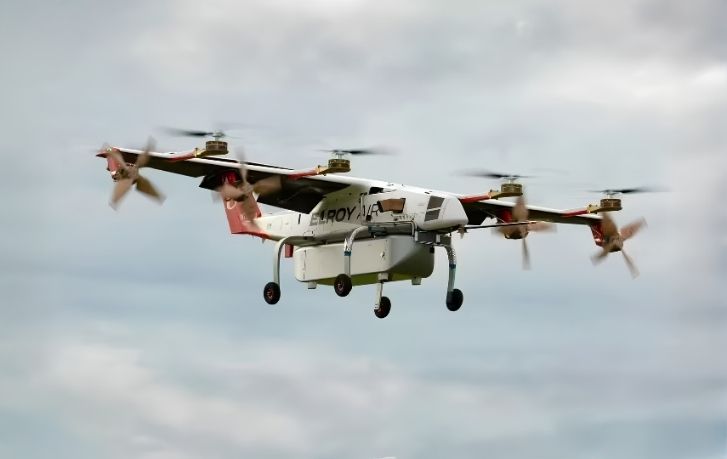
Elroy Air’s Chaparral cargo drone is moving beyond the basic question of whether an autonomous vertical-takeoff aircraft can transport a modular payload. A new $46.1 million U.S. Army contract shifts the development emphasis toward the supporting systems needed for field operation: protected communications, navigation without dependable GPS, mobile mission planning, expanded payload handling and greater autonomy.

The multiyear, firm-fixed-price award was issued through Army Contracting Command and is expected to run through February 18, 2029. Work is planned for South San Francisco, California, according to published contract details. The effort builds on Army-backed Chaparral development conducted during the previous two years.
That progression matters because an uncrewed cargo aircraft is not field-ready merely because its airframe, propulsion system and autopilot can complete a representative flight. The wider system must also manage payload exchanges, route and mission data, communications, navigation inputs and abnormal operating conditions with limited human intervention. Under the new program, those integration tasks are becoming central rather than secondary.
Payload handling expands into a systems problem
Chaparral is an autonomous hybrid-electric vertical-takeoff-and-landing aircraft built around modular cargo delivery. The Army-backed work calls for broader payload versatility and improved delivery mechanisms, which could require coordinated changes across mechanical interfaces, sensing, software and mission planning.
Earlier in 2026, Elroy Air reported demonstrations of three unattended delivery modes: releasing a payload from a hover, releasing one during forward flight and delivering cargo after landing. At a July demonstration in Byron, California, the company released payloads weighing 68 and 70 pounds during two airborne trials. It said those releases followed preprogrammed coordinates without operator input during execution.
Those demonstrations establish specific payload-handling activities that the company says it completed, but they do not verify the broader capabilities targeted by the new contract. No Army acceptance criteria, qualification results or required payload performance figures have been disclosed for the current program.
Navigation and communications become core development tracks
The planned expeditionary mission planner is intended to give operators a mobile tool for preparing and managing missions away from fixed infrastructure. Cyber-protected communications and navigation in GPS-denied or contested conditions are also listed as development priorities.
These elements are tightly connected to autonomy. A flight-control system needs trustworthy position and timing information, while the mission system must decide how to proceed when external data or communications are limited. Developing those functions is different from demonstrating that they satisfy military reliability, environmental or operational requirements. The contract announcement provides no test thresholds, redundancy architecture or reported results for these capabilities.
Communications reliability is also a broader integration issue for large uncrewed aircraft operating in U.S. airspace. The Federal Communications Commission has adopted dedicated spectrum rules for certain drone control links, including equipment certification and coordinated frequency assignments. Those civil rules do not establish Chaparral’s military communications design, but they illustrate why an aircraft’s command link must be treated as an aviation system with defined reliability and authorization requirements rather than as a generic wireless connection.
Domestic production is planned, but scale remains undefined
Elroy Air also participated earlier in 2026 in T-REX, a U.S. military test-and-evaluation event intended to accelerate the adoption of emerging technology across the Joint Force. Participation places Chaparral within a broader evaluation environment, but it does not by itself establish that the aircraft or its newly planned systems have completed qualification.
The company plans to begin U.S. manufacturing later in 2026 through an exclusive domestic partnership with Kratos Defense & Security Solutions. That creates a prospective path from development aircraft toward repeatable production, where configuration control, supplier qualification, inspection and software-hardware traceability become as consequential as flight performance.
Important production and program details remain undisclosed. The available information does not state the number of aircraft covered, manufacturing rate, first delivery milestone, current performance requirements or test criteria. The contract therefore marks a substantial systems-development phase, not confirmation of an operational fleet. Its decisive milestones will be evidence that the navigation, communications, payload and autonomy functions can be integrated reliably and then reproduced consistently on a U.S. production line.
| More aerospace and engineering stories, right in your MSN feed. Follow AMI on MSN |
By Stephen Wallace — Editor for AMI’s aerospace integration and unmanned mobility coverage, focused on drone manufacturing, VTOL systems, autonomous networks, and air-ground mobility links.