California High-Speed Rail Completes 89 Guideway Miles, but 2033 Target Faces Constraints
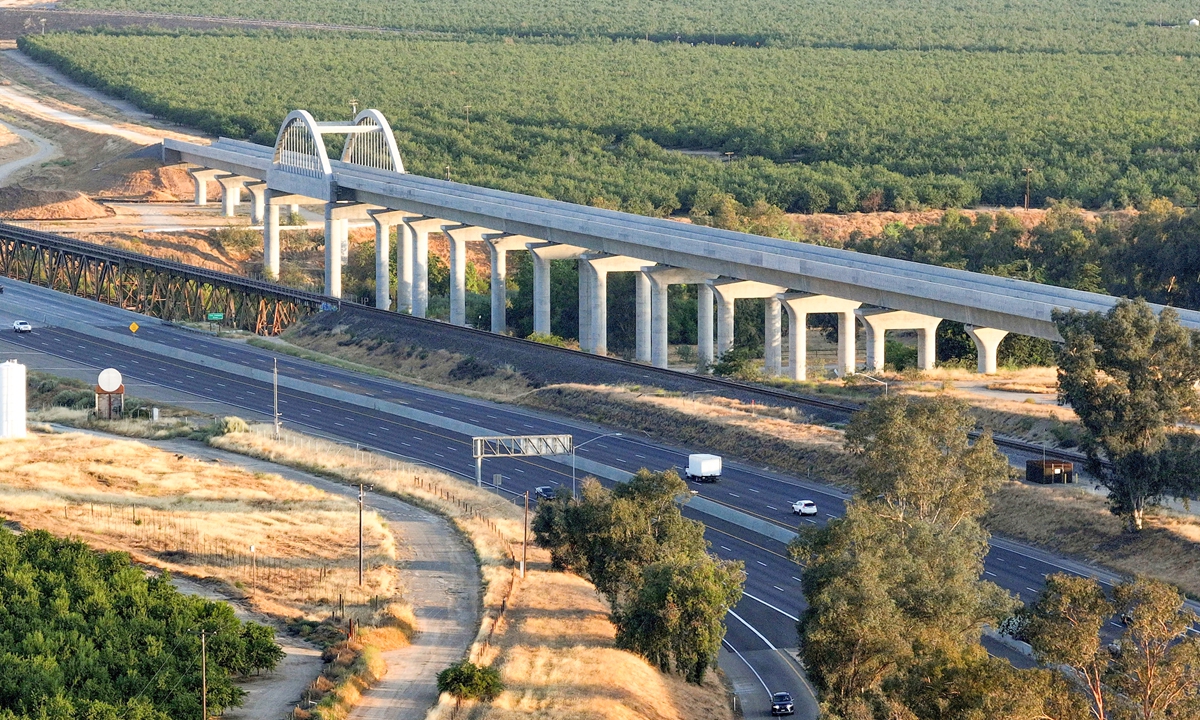
California’s high-speed rail program has completed 89 of the 119 guideway miles now under construction, but physical progress does not resolve the financing and utility-relocation constraints surrounding its targeted 2033 Merced-to-Bakersfield service. The California High-Speed Rail Authority’s August 2026 update also records 65 of 92 required structures as complete, showing that a substantial portion of the Central Valley civil corridor has taken shape.

The central tension is that finished concrete cannot operate as a railway by itself. Track, electric-power equipment, train control, testing and maintenance systems must still be installed and integrated. At the same time, an independent inspector general’s review warned that the authority could exhaust its current funding resources as soon as December 2027 if it does not secure financing. That finding makes the next construction transition as much a funding and policy test as an engineering milestone.
The project is approaching a systems-integration phase
The authority has signed a contract with Kiewit, Stacy Witbeck and Herzog covering high-speed track, overhead contact equipment, train control and associated railway infrastructure. The contractor is mobilizing, and track installation is planned to begin by the end of 2026.
This shift matters because guideway completion measures only part of railway readiness. The track geometry must support high-speed operation, the overhead contact system must deliver power reliably, and train-control equipment must coordinate movement and enforce operating limits. These systems also need compatible interfaces with structures, power supplies, communications, maintenance facilities and the trains ultimately selected for the route.
Integration therefore creates a different risk profile from repetitive civil construction. A completed viaduct or embankment is visible and readily counted. System readiness depends on connected equipment performing as a whole, followed by verification, testing and operational preparation. The authority expects train testing and readiness work between 2029 and 2033, leaving a multiyear sequence after initial track installation begins.
Recurring state support does not close the financing requirement
California established a Cap-and-Invest allocation of $1 billion annually through 2045 for high-speed rail in 2025. That commitment gives the program a recurring state funding base, but it is not equivalent to having all the cash required on the schedule needed to finish the first operating segment.
The inspector general estimated the revised Merced-to-Bakersfield segment at about $35.7 billion and said the authority may need to finance as much as $9.5 billion over five fiscal years. California has already spent approximately $18 billion on the broader program. Financing costs are important because borrowing can preserve construction continuity while adding interest expenses that do not produce additional guideway, stations or railway equipment.
The authority appointed Momentum Alliance Partners as a co-development partner to examine commercial, technical and financial options, including private investment and alternative delivery models. That appointment begins an evaluation; it does not constitute an approved public-private partnership or confirmed private funding.
The authority’s CEO report also says Senate Bill 198 would need to change to permit the type of partnership being considered. The operating target consequently depends partly on action outside the construction organization. Private participants would also require an acceptable allocation of revenue, schedule, construction and long-term operating risks. Public financing can distribute costs over time, but it does not eliminate them.
Utility relocation remains a physical and institutional constraint
Third-party utility relocation is contributing to costs and construction delays. This work can be less conspicuous than bridges or guideway, yet it directly affects access to construction areas and the sequence in which permanent infrastructure can be installed.
The affected assets are controlled or coordinated with outside parties, meaning the authority cannot manage every dependency through its primary construction contracts. For taxpayers, delays can extend project-management expenses and complicate the timing of contracts. For Central Valley communities and utility customers, relocation work must also preserve service and coordinate with roads, properties and other infrastructure.
The 2033 date should therefore be read as a target rather than a guaranteed opening. The inspector general argued that the schedule’s contingency could extend the window to September 2034 and questioned whether even that allowance was sufficient, while the authority maintains that it is working toward operations in 2033. The decisive milestone is no longer simply how many guideway miles are complete, but whether financing, utility access and railway-system integration can converge in time for testing to proceed between 2029 and 2033.
| More aerospace and engineering stories, right in your MSN feed. Follow AMI on MSN |
By Thomas Caldwell — AMI’s senior editor for mechanical and mobility engineering, covering vehicle electronics, systems integration, electrification, chassis systems, propulsion, and safety policy.