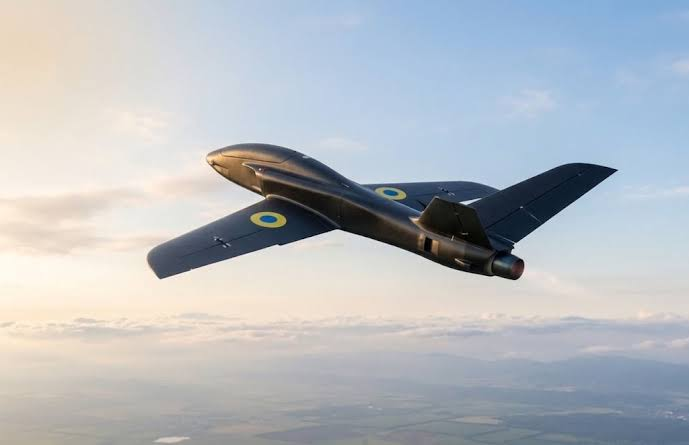
Ukraine Adds Alexa Spatium, but Geran-5 Interception Data Remains Undisclosed
Ukraine has added the Alexa Spatium jet-powered interceptor to its defense arsenal, but the public announcement leaves out the measurements needed to verify its most consequential claim: that it can counter the fast Geran-5 attack drone. Maximum speed, range and operational ceiling remain undisclosed.
The Ukrainian Ministry of Defense announced the addition on August 21, identifying Alexa Spatium as the country’s first jet-powered drone interceptor accepted into the Defence Forces’ arsenal. The ministry said testing confirmed the manufacturer’s stated tactical and technical specifications, and it named the Geran-3, Geran-4 and Geran-5 among the interceptor’s intended targets.
That is a meaningful procurement milestone, but it is not yet public proof of operational effectiveness against each listed target. Acceptance establishes that the system cleared a government process and met a defined set of requirements. Without the requirements, measured test results or target conditions, outside observers cannot determine how demanding that process was or whether it demonstrated reliable interception of a Geran-5 under representative conditions.
Three missing numbers define the open question
Speed is the most obvious gap. The Geran-5 is reported to reach approximately 600 kilometers per hour, while the Geran-4 is reported at roughly 450 to 500 kilometers per hour. Those remain attributed estimates rather than independently verified specifications, but they provide the relevant benchmark for assessing new Ukrainian interceptors.
An interceptor does not necessarily need to win a simple top-speed race in every engagement. Detection time, geometry, launch position, climb performance, acceleration, maneuverability and guidance all affect whether it can reach a target. Even so, a disclosed maximum speed would establish the platform’s basic performance boundary. Alexa Spatium’s description as “high speed” cannot substitute for that number.
Range and ceiling matter for the same reason. The ministry describes a substantial combat radius, a high operational ceiling and operation from low to medium altitudes, but it gives no numerical limits. An interceptor may have adequate speed yet provide only a narrow defensive window if its radius is short. It may also be fast in level flight while lacking the climb capability or endurance needed to reach a target at altitude. Public values would not prove reliable interception by themselves, but their absence prevents even a first-order comparison.
The contrast with the Crazy interceptor illustrates what measurable disclosure looks like. UV Military Cluster lists maximum speeds of 365 kilometers per hour for its wingless configuration and 310 kilometers per hour for the winged version. It also states a maximum range of 45 kilometers, 30 minutes of endurance and an operating-altitude range from 200 to 10,000 meters. Those figures do not establish mission success, but they allow the system’s boundaries to be evaluated against reported target performance.
Acceptance and scalable readiness are separate milestones
Production is the second unresolved issue. The ministry did not disclose how many Alexa Spatium systems have been delivered, the current manufacturing rate or a schedule for larger deployment. It said the interceptor is compact enough for transport in a pickup truck, uses a mobile catapult and can return for reuse if it does not complete its mission. Those characteristics could reduce deployment and replacement burdens, but only demonstrated reliability and repeatable production can turn them into a scalable defensive layer.
The distinction is especially important because Ukrainian officials have described a broader effort still in development. Defense Minister Yevhenii Khmara said four potential interceptors had undergone field testing and that the next task was to refine them and expand production to thousands of units. Meanwhile, technology specialist and presidential adviser Serhiy Beskrestnov said manufacturers had missed promised winter 2025–26 delivery targets and that trials exposed inadequate speed and other technical characteristics in proposed systems. Those assessments do not establish that Alexa Spatium failed; they show why acceptance alone cannot settle the wider readiness question.
Until a scalable interceptor layer is demonstrated, Ukraine remains dependent on fighter aircraft including F-16s using air-to-air missiles and portable ground-launched air-defense systems against faster drones. Those options provide established capabilities, but they do not offer an obvious inexpensive response at the scale envisioned for interceptor drones.
The next meaningful evidence would be a verified performance envelope, documented trial results against representative fast targets, and production figures showing repeatable output rather than prototype availability. Alexa Spatium has crossed the threshold into Ukraine’s arsenal. Whether it can cross the much harder threshold into reliable, large-scale Geran-5 defense remains publicly unverified.
| More aerospace and engineering stories, right in your MSN feed. Follow AMI on MSN |
By Stephen Wallace — Editor for AMI’s aerospace integration and unmanned mobility coverage, focused on drone manufacturing, VTOL systems, autonomous networks, and air-ground mobility links.