


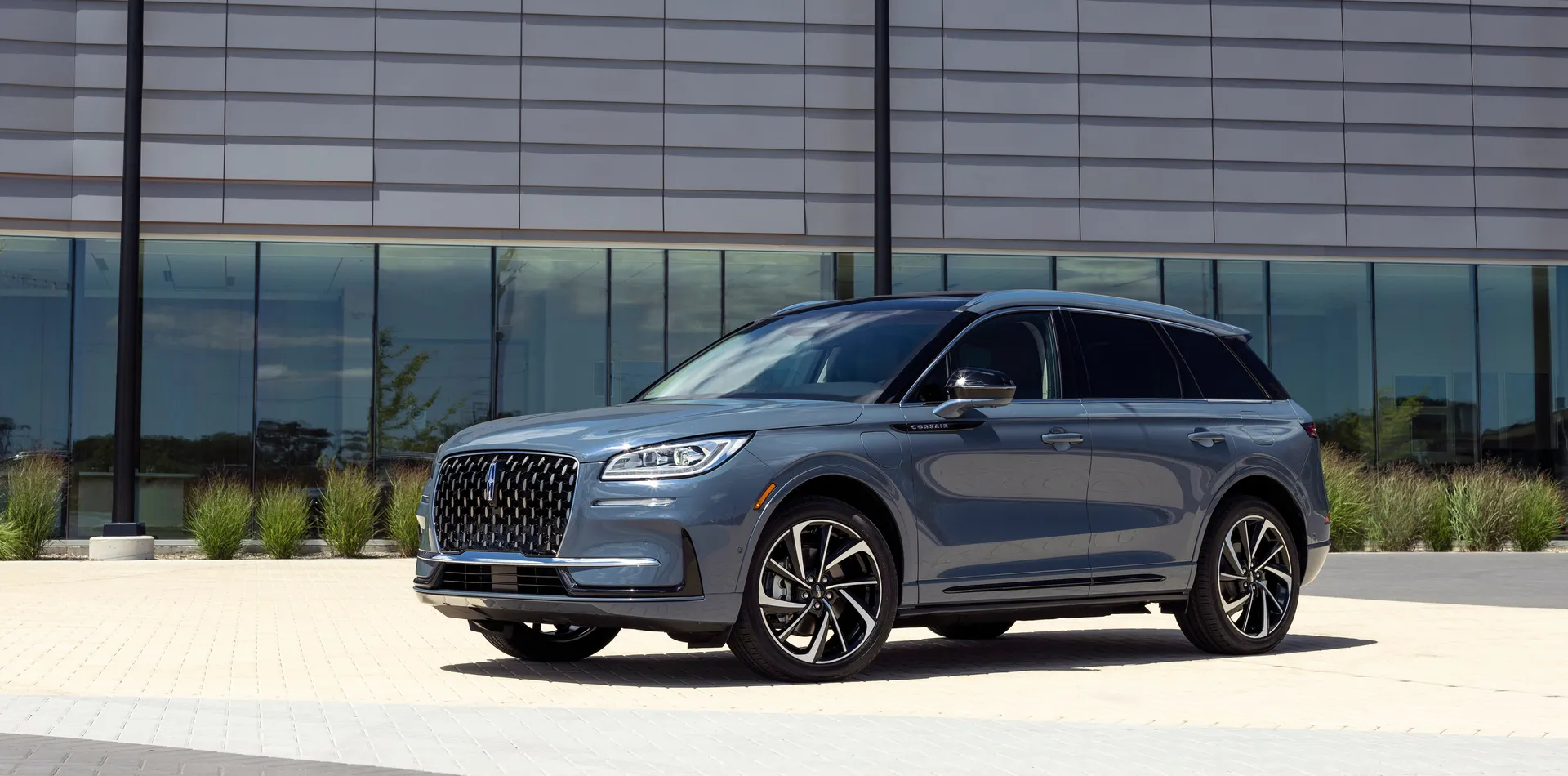
Ford Opens Orders for China-Built 305-Horsepower Lincoln Corsair Hybrid
The Lincoln Corsair is returning to the U.S. lineup through a manufacturing arrangement that runs counter to Ford’s longer-term direction. Ford opened orders on August 25 for the 2027 Lincoln Corsair Hybrid, a 305-horsepower luxury crossover that will be imported from China after production of the model in Louisville, Kentucky, ends.
The apparent contradiction is largely about timing and factory capacity. Importing the Corsair lets Lincoln retain its smallest crossover while Ford converts the former production site for a different vehicle and manufacturing system. Ford says it intends to increase Lincoln production in the United States beginning in 2030 and phase out Chinese imports for the U.S. market as part of that plan. That future shift has been announced, not completed, and Ford has not established where the Corsair will be built after the import phase ends.
A hybrid replaces the Kentucky-built Corsair
Every 2027 Corsair will use a turbocharged 2.0-liter hybrid powertrain producing a combined 305 horsepower. All-wheel drive is standard. That makes the revived model more than a sourcing substitution: Lincoln is also consolidating the Corsair around one electrified propulsion configuration rather than simply importing an unchanged version of the outgoing vehicle.
The standard equipment also includes BlueCruise 1.5, which adds hands-free operation on designated controlled-access highways and an automatic lane-change function. The human-factors boundary matters: Lincoln identifies BlueCruise as driver assistance, not self-driving technology. Drivers must continue watching the road and remain ready to take control. Lincoln says four years of BlueCruise are included with the Corsair.
Four years of Lincoln’s Security Package and Connectivity Package are also included, with connected navigation and an unlimited Wi-Fi hotspot among the connectivity functions. These bundled services underscore how vehicle capability now depends partly on software, maps and an active connected-services framework, rather than only on hardware installed at the factory.
The redesign includes a reshaped hood and grille, revised headlamps, updated rear lighting and new wheel designs. Inside, the higher Reserve trim can be equipped with 24-way front seats providing heating, ventilation and massage for both front occupants. Those changes distinguish the 2027 model, but its consequential engineering story remains the combination of hybrid-only propulsion, standard all-wheel drive and standard hands-free highway assistance.
Louisville is being rebuilt around an electric pickup
The Corsair’s move to China frees Louisville Assembly Plant for the Ford Fathom midsize electric pickup. Ford says the three-million-square-foot plant underwent a $2 billion overhaul after falling silent in late 2025, with its former equipment removed to install the company’s Universal EV Production System.
That system changes both vehicle architecture and factory workflow. Ford plans to assemble the Fathom in three main sections a front structure, rear structure and battery before joining them after much of the component installation is complete. Large aluminum castings replace numerous stamped and welded pieces, while the battery also serves as the vehicle floor.
For production workers, the divided assembly approach is intended to reduce work inside a largely completed body shell. Ford reports an 84% reduction in reaching over the fender, along with less twisting, turning and bending. The company also says the Fathom’s wiring harness is more than 4,000 feet shorter and 22 pounds lighter than the harness in its first-generation electric SUV. Those are manufacturing and ergonomic claims for a new system still moving toward production, rather than established field results.
Ford expects prototype Fathom builds using production-qualified parts in the first quarter of 2027, followed by customer vehicles later that year. This makes the imported Corsair a bridge across a real capacity transition: Louisville cannot simultaneously remain the Corsair’s home and undergo a ground-up conversion for Ford’s new electric-truck architecture.
The 2030 plan leaves a location unresolved
Lincoln already imports the Nautilus from China, a practice that began in 2024. The Corsair will therefore expand that sourcing strategy in the near term even as Ford publicly commits to reversing it later. The company’s 2030 manufacturing plan says Chinese-built Lincoln imports will be phased out as U.S. production grows.
What Ford has not yet clarified is whether the Corsair and Nautilus will move to existing U.S. plants, be redesigned for other production lines or leave the lineup when Chinese imports end. That unanswered plant assignment is the critical systems-integration issue: moving a vehicle requires capacity, tooling, supplier logistics, workforce preparation and product timing to align. For now, the China-built Corsair restores a model whose absence reportedly contributed to Lincoln’s nearly 13% U.S. sales decline through July, while Louisville’s next test arrives with Fathom prototype builds in early 2027.
| More aerospace and engineering stories, right in your MSN feed. Follow AMI on MSN |
By Thomas Caldwell — AMI’s senior editor for mechanical and mobility engineering, covering vehicle electronics, systems integration, electrification, chassis systems, propulsion, and safety policy.


