Ford’s Four-Door Mustang Reportedly Targeted Below $40,000 to Start
Ford reportedly plans to offer its proposed four-door Mustang at a starting price below $40,000. The figure comes from a dealer briefed on Ford’s product plans at a Las Vegas meeting earlier this month, according to the Detroit Free Press. Ford has not confirmed either the vehicle or its pricing, and the company says it does not comment on speculation about future products.
If achieved, that target would position the sedan near the lower end of today’s Mustang range rather than as a costly premium derivative. The current four-cylinder Mustang coupe starts at roughly $33,000, so a four-door version beginning below $40,000 could reach young families that want Mustang styling and performance but need easier rear-seat access and more usable passenger space.
The price is the most consequential new detail because it begins to define what Ford may be trying to build. A high-priced four-door Mustang could function as a specialized halo car. A sub-$40,000 model instead suggests a higher-volume product intended to expand the Mustang audience and restore a Ford offering to a sedan market that Detroit automakers have largely left to foreign competitors.
A target, not a showroom price
Several important qualifications remain. The dealer’s account does not establish final production approval, and Ford has disclosed no engineering specifications, manufacturing location or firm launch date. Product plans and prices can change as development proceeds, particularly when a vehicle remains several years from its possible introduction.
The reported number also appears to be a starting-price target. It does not indicate which engine, trim level or standard equipment would be included, nor whether destination charges would fall inside or outside that figure. Those details would determine whether the sedan truly sits close to the entry-level coupe or merely uses a low-volume base configuration to cross the advertised threshold.
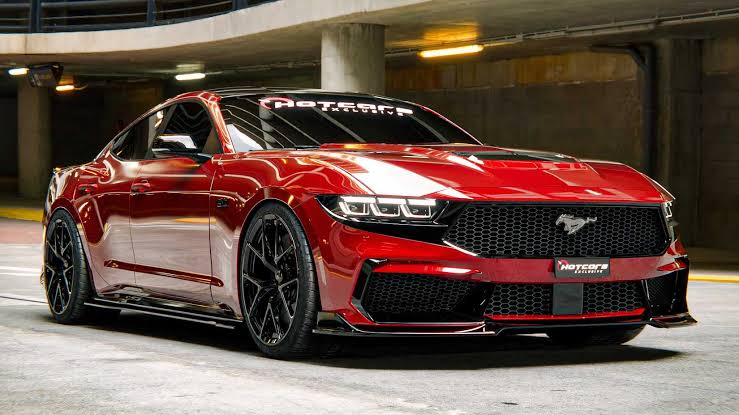
Ford reportedly showed dealers an image of a car resembling the current two-door Mustang but with four doors and a more sedan-like profile. The company is said to be considering a market introduction near the end of the decade, although it remains unclear whether that would correspond to a 2028 or 2029 model.
Four doors change more than the silhouette
Turning the Mustang into a credible family sedan requires more than cutting two additional door openings. Rear occupants need adequate entry space, legroom and headroom, while the structure must retain the stiffness expected of a performance car. Wheelbase, roofline, seating position and cargo access all influence whether the extra doors deliver practical value without making the car feel disconnected from the existing Mustang.
Those packaging decisions can also add mass. Longer body structures, rear doors, hinges, latches and additional reinforcement introduce weight that affects acceleration, braking, efficiency and chassis tuning. Ford has released no dimensions or weight figures, so it is too early to determine how the proposed sedan would balance passenger utility against the response expected from the nameplate.
Powertrain planning is similarly unsettled. Two people familiar with the proposed vehicle described hybrid power, with one identifying a hybrid V-8, but the dealer briefed in Las Vegas said Ford did not specify an engine. A hybrid system could support fuel economy or performance or a combination of both but it would also add motors, power electronics, battery hardware, cooling requirements and control complexity. Without specifications, claims about output, efficiency or electric-only operation would be premature.
The Mustang name has historically been attached to two-door coupes and convertibles, apart from design studies that never reached production. Ford counts the Mustang Mach-E electric crossover separately, making a production four-door sedan a distinct challenge to the car’s established identity rather than another Mach-E body style.
There is a commercial reason to explore that change. U.S. Mustang sales declined from more than 122,000 in 2015 to about 45,000 last year. Four doors and a relatively accessible price could enlarge the potential customer base without moving the model into a luxury bracket, but only if Ford preserves enough performance character to justify the badge.
The next meaningful evidence will be a public Ford confirmation or a production commitment accompanied by specifications. Until then, the sub-$40,000 figure is best understood as an ambitious positioning target: enough money to place the proposed sedan above the basic coupe, but not enough to hide major packaging, hybrid-system and structural costs inside a premium price.
| More aerospace and engineering stories, right in your MSN feed. Follow AMI on MSN |
By Thomas Caldwell — AMI’s senior editor for mechanical and mobility engineering, covering vehicle electronics, systems integration, electrification, chassis systems, propulsion, and safety policy.