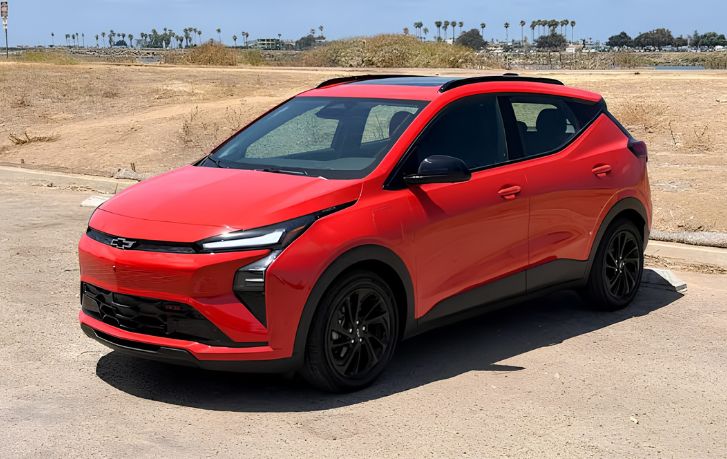
Sub-$30,000 Chevrolet Bolt Travels 243 Miles at 70 MPH, Beating Highway Estimate
Two highway tests of similar 2027 Chevrolet Bolts produced sharply different results: 243 miles at a steady 70 mph and 197 miles at 75 mph. The first run put the least-expensive new electric vehicle in the United States 11 miles beyond its 232-mile EPA highway estimate. The second illustrates why drivers should not treat one favorable result as a universal range promise.
Tom Moloughney conducted the 243-mile test in a base Chevrolet Bolt LT on the New Jersey Turnpike. The car had 17-inch wheels and the 65-kilowatt-hour lithium iron phosphate battery offered throughout the Bolt lineup. It averaged 3.6 miles per kilowatt-hour before the test ended with 1% battery charge and 2 miles of estimated range showing on the instrument cluster.
The conditions favored efficiency. Temperatures ranged from 71 to 80 degrees Fahrenheit, tire pressures matched Chevrolet’s recommendation, and the climate controls were set to their efficiency mode. Those details matter because highway range is a system-level result shaped by the vehicle, environment and driver rather than battery capacity alone.
The redesigned Bolt carries a 262-mile EPA combined estimate, but that figure should not be used as the direct benchmark for a highway-only run. The relevant comparison here is its 232-mile EPA highway estimate, which the 70-mph test exceeded by 11 miles. The result demonstrates that this configuration can travel more than 240 highway miles under favorable warm-weather conditions; it does not establish that every Bolt will do so on every trip.
A second test establishes an important boundary
EV Motoring recorded 197 miles and 2.8 miles per kilowatt-hour in a separate test of a similar Bolt at 75 mph. That represents 46 fewer miles than the 70-mph result and a substantial reduction in measured efficiency.
It would be incorrect, however, to assign the entire difference to the additional 5 mph. These were independent tests rather than consecutive runs conducted with one vehicle under identical conditions. Differences in weather, acceleration, climate-control demand and other operating conditions could all have contributed. The comparison shows sensitivity, not a controlled cause-and-effect measurement of speed alone.
The efficiency figures also help explain why apparently small changes can accumulate over a long drive. At the reported 3.6 miles per kilowatt-hour, the 70-mph Bolt converted its available energy into considerably more distance than the other car did at 2.8 miles per kilowatt-hour. The tests do not isolate which variables produced that gap, but they show that battery capacity by itself cannot predict the mileage a driver will see.
The pack’s lithium iron phosphate chemistry is another configuration detail, not an explanation for the difference between the tests. Both results must be understood in the context of a 65-kilowatt-hour pack, vehicle setup and operating environment. No battery chemistry removes the effects of speed, acceleration, cabin heating or cooling, and weather on usable trip range.
Price makes the result more consequential
The base Bolt starts below $30,000; MotorTrend lists the basic model at $28,995. That makes the 243-mile run notable beyond the test itself: more than 240 miles of observed highway travel is no longer confined to higher-priced electric vehicles. The redesigned model also adds range, faster charging and more cabin technology compared with its predecessor.
Range remains only one part of long-distance operation. A road trip also depends on charging opportunities, charging time and the reserve a driver chooses to maintain. This test finished at 1%, a level many drivers would not plan to reach during ordinary travel. Its 243 miles therefore represent a near-full-pack test outcome, not necessarily a practical target between charging stops.
Other independent testing organizations have also found that some electric vehicles beat their estimates while others fall short. Consumer Reports notes that results vary across models in its 70-mph evaluations, reinforcing the value of examining the test speed and conditions rather than relying on one rating alone.
For the 2027 Bolt, the strongest supported conclusion is bounded but meaningful: a base car priced below $30,000 delivered 243 miles at 70 mph in warm, efficiency-oriented conditions. The separate 197-mile result is the equally important constraint, showing how far real-world outcomes can diverge even when the vehicles and nominal highway speeds appear similar.
| More aerospace and engineering stories, right in your MSN feed. Follow AMI on MSN |
By Thomas Caldwell — AMI’s senior editor for mechanical and mobility engineering, covering vehicle electronics, systems integration, electrification, chassis systems, propulsion, and safety policy.