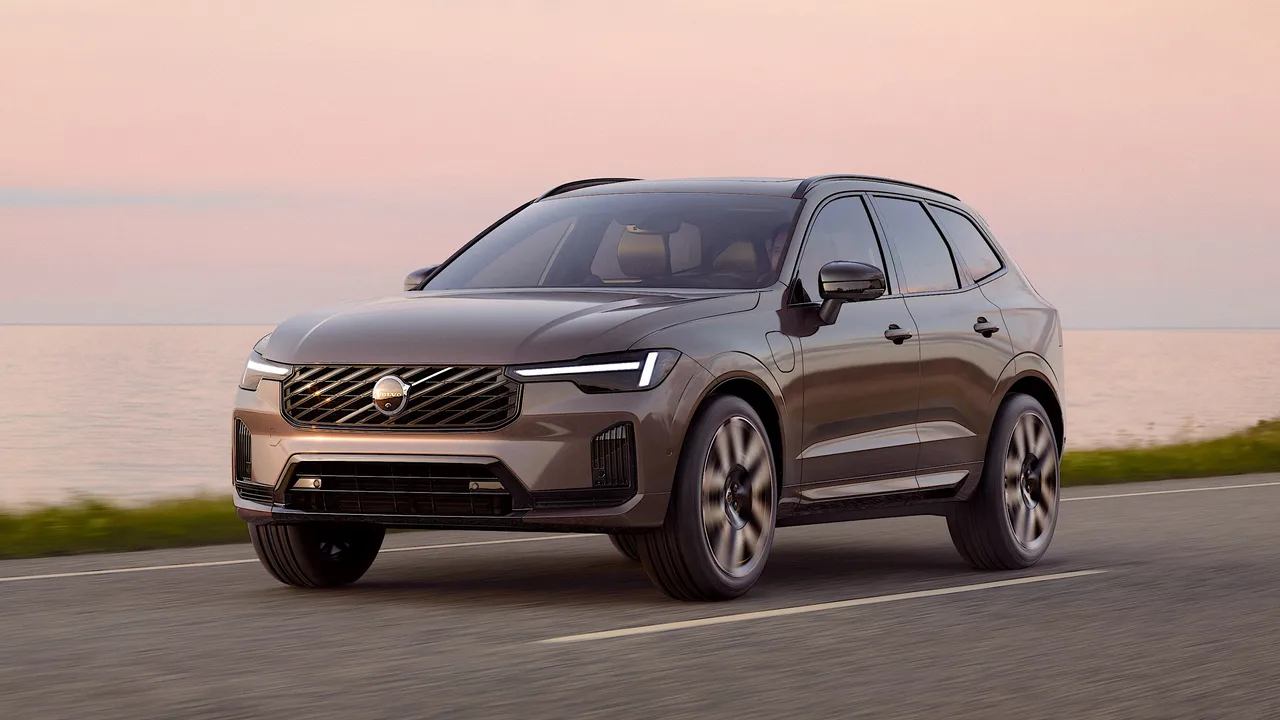
Volvo Says 2028 XC60 Will Travel 78 Miles on Electricity
Seventy-eight miles is Volvo’s claimed electric range for the 2028 XC60 plug-in hybrid, more than twice the current model’s 35 miles. The larger XC90 is slated to rise from 32 to 73 electric miles. If confirmed under the applicable U.S. testing process, Volvo says those figures would make the SUVs the country’s two longest-range plug-in hybrids.
The central change in Volvo’s newly announced XC60 and XC90 is a much larger, floor-mounted battery. Usable capacity increases from 18.8 to 37.9 kilowatt-hours in both vehicles, giving regularly charging owners enough claimed range to conduct substantially more daily travel without starting the gasoline engine.
More battery changes how the hybrid can be used
Conventional plug-in hybrids often provide enough electric range for a short commute but rely on their engines for a greater share of routine driving. A claimed 78 miles moves the XC60 closer to the range associated with early full-electric cars: it exceeds the first-generation Nissan Leaf’s cited 73-mile EPA rating.
That comparison does not make the XC60 an electric vehicle. It still carries a turbocharged four-cylinder engine, fuel system and mechanical components required for hybrid operation. What changes is the operating boundary. An owner who charges consistently could use battery power for a much larger portion of ordinary driving while retaining gasoline backup for trips beyond the available charging network.
Volvo says its median U.S. customer makes a 22-mile round trip and that the vast majority of its American drivers travel less than 30 miles per day. Against those figures, the XC60’s claimed range could cover multiple typical days between charges. Actual results will vary with speed, weather, climate-control use, terrain, payload and driving style, and the certification basis for the 78- and 73-mile figures has not yet been confirmed.
Charging remains the condition behind the benefit
Doubling capacity does not automatically double gasoline-free driving in practice. Owners must have reliable access to a plug and use it regularly. Otherwise, the vehicle carries the mass of a substantially larger battery without realizing its primary operating advantage.
Volvo says a Level 2 charger can replenish the battery in under six hours, approximately 14% longer than before despite the large capacity increase. A cited 16-amp home-charging configuration is said to complete charging in four hours. More detailed electrical specifications will be needed to explain the difference between those figures and show how charging time varies by supply and equipment.
Volvo did not state whether the updated SUVs support direct-current fast charging. That omission matters more with a 37.9-kilowatt-hour usable pack than it would with a small commuter-oriented hybrid battery. Level 2 charging is well suited to overnight or workplace use, but it is less convenient for restoring a large amount of range during a brief highway stop.
The gasoline system limits that inconvenience on long journeys. With full batteries and fuel tanks, Volvo claims total ranges of 590 miles for the XC60 and 560 miles for the XC90. Those totals illustrate the design’s core compromise: the vehicles retain long-distance flexibility without depending on charging stops, but they must carry both electric and combustion powertrain systems.
Output and all-wheel drive remain
Both SUVs retain standard all-wheel drive and turbocharged four-cylinder engines, with claimed peak combined output remaining at 455 horsepower. Volvo therefore is not presenting the larger battery as a trade of powertrain output for range. The principal physical cost is greater battery capacity and mass, although Volvo has not provided complete efficiency, packaging or certified-range data for the production vehicles.
The redesign also reflects Volvo’s broader change in product planning. The company stepped back in 2024 from its earlier commitment to end combustion-engine sales by 2030. Long-range plug-in hybrids now provide an intermediate path alongside its fully electric models, particularly for customers concerned about charging availability on longer trips.
Production of the long-range XC60 and XC90 plug-in hybrids is scheduled to begin in fall 2026, with U.S. sales planned for early 2027 as 2028 models. Their practical significance will ultimately depend on two still-developing points: how the range claims perform under U.S. certification and real-world conditions, and whether owners can charge often enough to use nearly 38 kilowatt-hours of battery as intended.
| More aerospace and engineering stories, right in your MSN feed. Follow AMI on MSN |
By Thomas Caldwell — AMI’s senior editor for mechanical and mobility engineering, covering vehicle electronics, systems integration, electrification, chassis systems, propulsion, and safety policy.