Switzerland Paid $2 Billion Toward F-35s Without Guaranteed Fixed Price
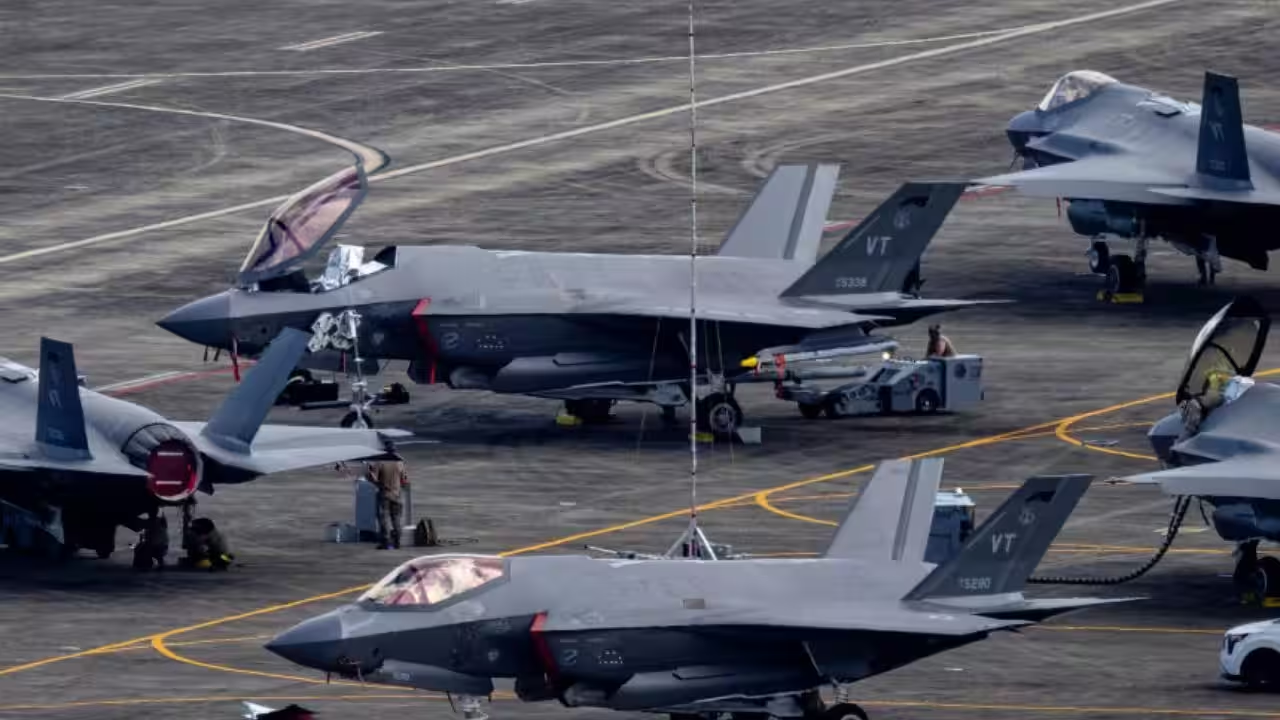
Switzerland had paid approximately $2 billion toward its F-35 fighter aircraft by the end of June, even though parliamentary overseers concluded that the guaranteed fixed price previously described by the government never existed. The finding leaves taxpayers and defense planners without certainty over the acquisition’s final cost.

Defense Minister Martin Pfister faced National Council questions on September 21 after its Control Committee criticized how the Federal Council and Defense Department handled the purchase. The committee’s 95-page oversight report said authorities had presented the aircraft as carrying a flat, fixed price despite the absence of such a guarantee. Pfister repeatedly deferred a fuller response to the Federal Council’s forthcoming statement.
The central accountability problem is not simply that fighter aircraft can become more expensive. It is that “fixed price” has a specific public meaning: lawmakers and taxpayers reasonably read it as a firm boundary around the government’s exposure. If the underlying arrangement did not provide that guarantee, then the earlier description overstated the certainty available to officials, regardless of whether the procurement remains affordable within a revised plan.
Payment progress makes that distinction consequential. The approximately $2 billion already transferred does not establish the final procurement cost, and it should not be treated as evidence that the entire acquisition has been settled. It does show that Switzerland is well into the payment schedule while the pricing basis remains contested. The next aircraft installment is due in early 2027, giving the forthcoming government response practical importance beyond a dispute over past wording.
The purchase price is also only one layer of fighter-fleet cost. Pfister said he saw no reason to revise the operating-cost estimates presented in the 2022 Army Message. He argued that higher U.S. costs, driven primarily by inflation, had been offset by the dollar’s decline. That explanation can support a Swiss-franc operating estimate at a particular exchange rate, but it does not resolve the separate question of whether the aircraft acquisition itself carried a guaranteed fixed price.
This separation matters for budget oversight. Inflation, currency movements, aircraft payments and long-term operating expenses can move differently. A favorable exchange rate may offset higher dollar-denominated expenses during one period, while later installments remain exposed to different conditions. Without claiming that costs will necessarily rise, lawmakers need to know which figures are contractual commitments, which are estimates and which depend on economic assumptions.
A second unresolved issue concerns nearly CHF 2.5 million spent on outside legal work. Law firm Homburger produced several opinions and position papers between April 2021 and November 2024. Pfister said the Defense Department’s General Secretariat sought that advice on behalf of federal procurement agency Armasuisse, describing the arrangement as a new approach. He also said the specific procurement-related reason the contract was not competitively tendered can no longer be determined.
External counsel is not inherently unusual in a complex international aircraft acquisition. The accountability concern is whether responsibilities, procurement justification and review authority remained traceable when the work crossed organizational lines. Here, the inability to reconstruct why a contract worth nearly CHF 2.5 million avoided competition creates a documentation gap precisely where legal advice was helping shape a high-value public purchase.
That gap is not evidence of criminality or financial loss. Pfister said the oversight commission found neither unlawful conduct nor financial damage. Those findings should remain separate from the committee’s criticism of administrative shortcomings and the government’s fixed-price characterization. Weak documentation and inaccurate public certainty can warrant oversight without proving misconduct.
A related disclosure dispute concerns the evaluation criteria used to select the F-35. Pfister rejected the allegation that those criteria had been tailored to favor the aircraft, saying Air Force requirements were established before bids arrived and that there was no evidence of manipulation. The criteria remain unavailable publicly while litigation over document access continues; Armasuisse has appealed a Federal Administrative Court ruling to the Federal Supreme Court. Pfister said the evaluation matrix could be provided to parliamentary security-policy committees.
That arrangement reflects a real procurement tradeoff. Detailed evaluation material may face legitimate disclosure constraints, yet parliamentary reviewers still require enough access to test whether the selection process matched requirements set before bidding. The immediate milestone is therefore not another aircraft payment but the Federal Council’s formal response to the oversight findings. It must explain what “fixed price” meant in practice, how future installments are bounded and why key legal-procurement decisions cannot now be reconstructed.
| More aerospace and engineering stories, right in your MSN feed. Follow AMI on MSN |
By David Whitaker — Associate editor for AMI’s aerospace and drone systems desk, translating flight systems, aircraft programs, spaceflight, and UAV developments into accessible technical stories.