

Greenland Deal Permits Two U.S. Bases and Golden Dome, Awaits Approval
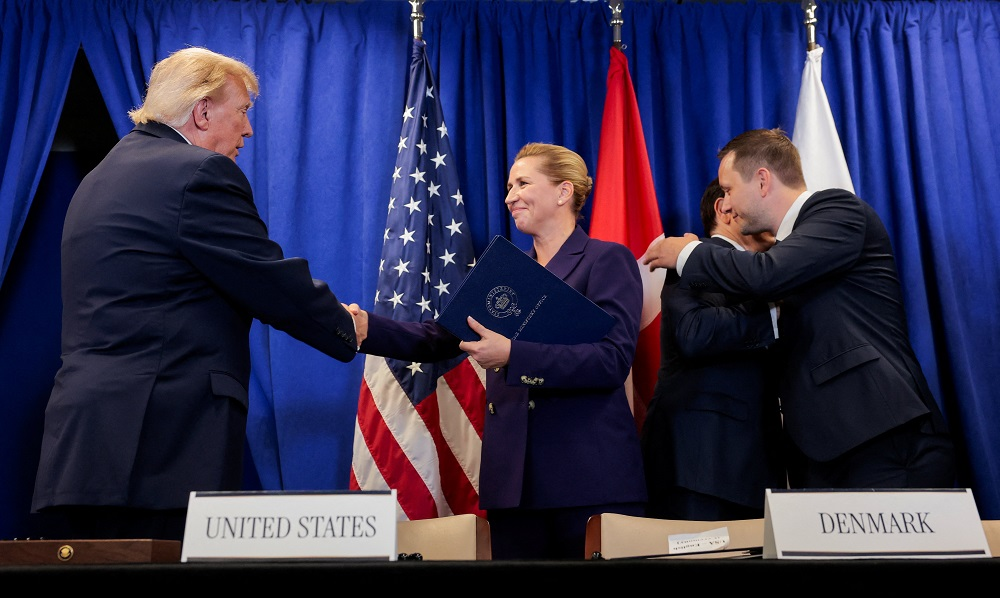
Greenland’s new defense agreement creates room for a potentially permanent expansion of U.S. military infrastructure, but it does not build a base, deploy personnel or fund a missile-defense system. The United States, Greenland and Denmark signed the framework on September 22, opening two additional military sites and permitting a Golden Dome presence. As outlined in the released terms of the agreement, implementation still requires approval from the Danish and Greenlandic parliaments.

That distinction is central to what has actually changed. The agreement establishes legal and geographic access at Narsarsuaq in southern Greenland and Mestersvig in the east. It also allows the United States to modernize and expand activities at Pituffik Space Base in northwestern Greenland, its existing installation on the island. Future defense areas could be added by mutual agreement, and the framework has no stated end date.
Access comes before construction
For military infrastructure, permission is only the first layer. Narsarsuaq is a former Cold War airbase, while Mestersvig is an outpost currently used by Denmark’s Sirius Dog Sled Patrol. Their designation as defense areas does not establish what facilities will be constructed, which missions will operate there or how many people will be assigned. The technical details and operating arrangements must still be agreed among the parties.
No construction schedule, projected cost, force level or site-by-site development plan has been disclosed. The agreement therefore expands the map of places available to U.S. forces without defining the scale of the resulting footprint. Statements about building two major bases describe an intended direction, not completed infrastructure or an approved procurement program.
The same boundary applies to Golden Dome, the proposed U.S. missile-defense program. The text allows a Golden Dome system to be established in Greenland against ballistic missile threats, giving the program a potential Arctic location. It does not specify the Greenland-based system’s configuration, sensors, interceptors, supporting communications, construction requirements or deployment schedule. Authorization matters because major defense architecture cannot be positioned without host-government access, but it is not equivalent to engineering design, acquisition or operational readiness.
The agreement reaches beyond the two sites
The framework grants U.S. aircraft and vessels broad access across Greenland and its territorial waters. That could support a wider range of Arctic operations than a narrow base agreement because access, transit and support rights affect how personnel and equipment can move between established locations. The practical capacity gained, however, will depend on later decisions about facilities, logistics, staffing and funding.
The pact also sets limits. Non-NATO countries would be barred from establishing manned or unmanned military installations or maintaining a persistent military presence in Greenland. Foreign-investment controls would restrict significant influence in sensitive sectors including critical infrastructure and resource extraction by investors outside NATO, NATO partner countries and the European Union. Those provisions connect defense access with control over infrastructure and resources that could carry long-term security significance.
For Greenland’s residents and government, that creates a durable tradeoff. Expanded access could strengthen NATO’s Arctic infrastructure, but it also increases the prospective foreign military footprint and places restrictions on who may invest in sensitive parts of Greenland’s economy. Denmark and Greenland retain sovereignty and approval authority, while the United States gains a framework for broader access. The requirement for mutual agreement on later technical details prevents the signed pact from functioning as an unrestricted construction permit.
A large expansion from today’s footprint
The historical comparison shows the possible range without predicting its outcome. During the Cold War, the United States maintained 17 installations and more than 10,000 personnel in Greenland. Today, Pituffik is the remaining U.S. base. Adding Narsarsuaq and Mestersvig would be the first major geographic expansion of that footprint since the Cold War, but nothing in the agreement indicates a return to Cold War staffing levels or installation numbers.
The immediate consequence is therefore capacity on paper: two named defense areas, broader aircraft and vessel access, room for additional mutually agreed sites and legal permission for Golden Dome infrastructure. Whether that becomes a limited upgrade or a much larger Arctic buildout depends on parliamentary votes and the still-undisclosed decisions on design, cost, personnel and schedule.
| More aerospace and engineering stories, right in your MSN feed. Follow AMI on MSN |
By David Whitaker — Associate editor for AMI’s aerospace and drone systems desk, translating flight systems, aircraft programs, spaceflight, and UAV developments into accessible technical stories.