Federal Investigators Examine Fourth Hawker Hunter Power-Loss Ocean Crash
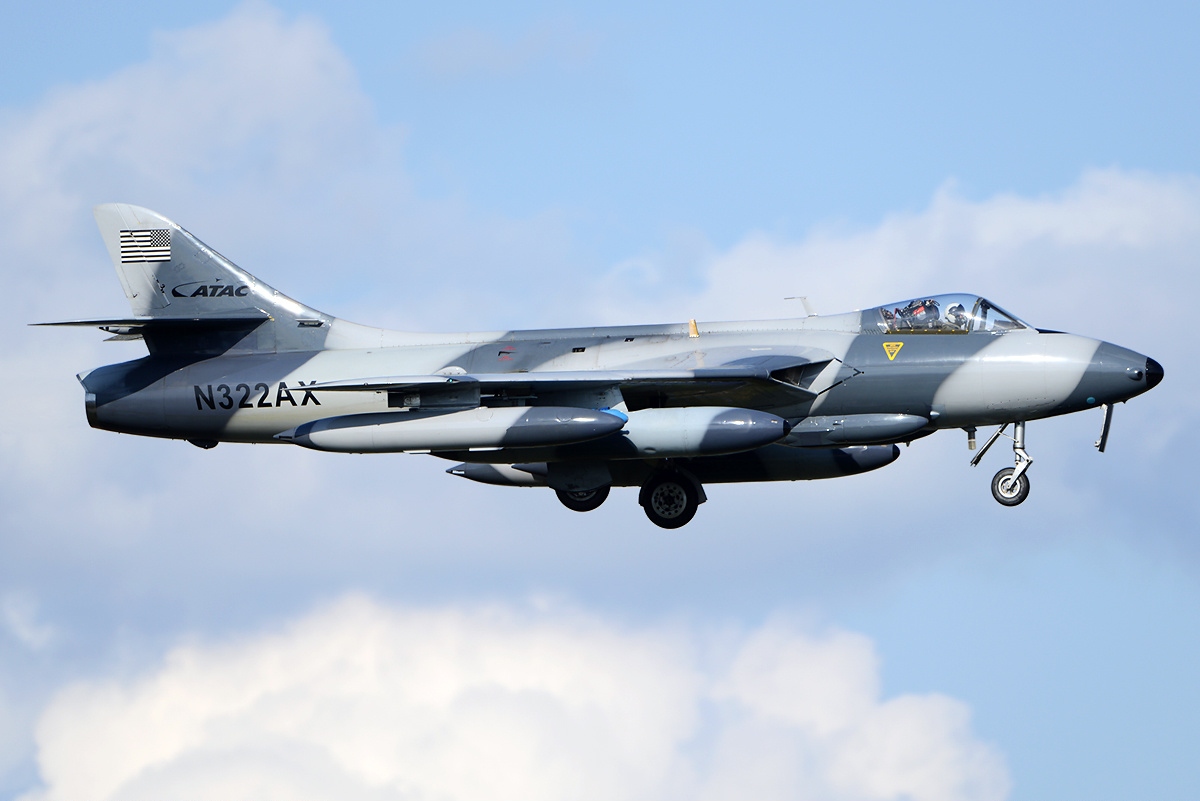
Federal investigators have opened an inquiry into the fourth ocean crash since 2018 involving an Airborne Tactical Advantage Company Hawker Hunter after a partial or total loss of engine power. The latest aircraft lost thrust during a U.S. Navy training mission on September 22, 2026, before crashing into the Pacific northwest of Morro Bay, California.

The pilot ejected and was rescued by a Navy crew, and was reported in good condition the next day. None of the four crashes was fatal. That fortunate record does not resolve the central safety question: four closely related ATAC-operated Hawker Hunter Mk 58 or Mk 58A jets have gone into the ocean following engine-power losses, yet completed investigations have established a specific initiating failure in only one case.
Similar outcomes do not prove a common defect
The earlier accidents occurred in Hawaii in 2018, off North Carolina in 2022 and off California’s Big Sur coast in 2025. Grouping them by the reported symptom is useful for directing scrutiny, but it is not the same as identifying a shared cause. Engine power can be lost or limited through different mechanical, fuel-system, control or environmental pathways, and the available findings do not establish that one mechanism connects all four events.
The National Transportation Safety Board has explicitly cautioned that it is premature to characterize the earlier accidents as a pattern or speculate about a broader safety review. No cause has been determined for the Morro Bay crash, and the investigation remains in its evidence-gathering stage.
The one firm mechanical finding came from the 2022 accident. Investigators found that a bearing failed in the governor of the engine’s high-pressure fuel pump. The resulting fault limited pump output to no more than 850 pounds per square inch, well below the stated operating range of 1,900 to 2,200 pounds per square inch. That finding explains the power loss in that aircraft; it does not, by itself, diagnose the other three.
Ocean recovery creates a major evidence gap
The lack of a definitive cause in the 2018 and 2025 cases reflects an important investigative constraint rather than proof that no mechanical fault existed. Much of the wreckage was not recovered, preventing investigators from conducting the component-level examination needed to establish why the engines lost power.
Aircraft accident investigations often depend on physical evidence that can distinguish an initiating failure from damage caused during impact. With incomplete wreckage, investigators may be unable to inspect fuel-system hardware, engine components and control linkages closely enough to determine whether a part failed before the crash. Similar pilot reports can therefore remain linked only at the symptom level.
The latest investigation will examine the pilot, aircraft, operating environment, maintenance records, flight-track data, communications and air traffic control material. Those sources can narrow the sequence and operating conditions even if recovery is limited, but a conclusive mechanical finding may still depend on which components are retrieved and in what condition.
A vintage design in a demanding training role
The aircraft that crashed near Morro Bay was built in 1956. ATAC operates more than 20 Hawker Hunters worldwide and uses them to support training for the Navy, Air Force and Marine Corps. The Mk 58 and Mk 58A are closely related single-seat variants of a transonic British fighter design developed during the Cold War.
ATAC’s Hawker Hunter description identifies the type as being powered by a Rolls-Royce Avon Mk 207 turbojet. Continued operation of such an old airframe and engine family depends on inspection, refurbishment, parts control and maintenance discipline, but age alone is not an accident finding. ATAC spokesperson John Rupp said the aircraft undergo a strict inspection regimen, receive Navy flight clearance for contract work and are considered by the company to be safe and capable.
Former ATAC mechanic and aviation consultant Steve Picatti similarly said the Hunter can be safe when properly maintained and suggested that high annual utilization contributes to the fleet’s accident exposure. Those are attributed professional and company assessments, not NTSB conclusions about the latest crash or the fleet as a whole.
The broader accident count provides context but not causation. The Aviation Safety Network has recorded 10 Hawker Hunter accidents since 2018, eight involving ATAC aircraft. The operational consequence now turns on whether investigators can move beyond the recurring power-loss description and recover evidence of another specific mechanism. Until then, four similar ocean crashes justify close examination, but only the failed fuel-pump governor in the 2022 aircraft has been established as a cause.
| More aerospace and engineering stories, right in your MSN feed. Follow AMI on MSN |
By David Whitaker — Associate editor for AMI’s aerospace and drone systems desk, translating flight systems, aircraft programs, spaceflight, and UAV developments into accessible technical stories.